

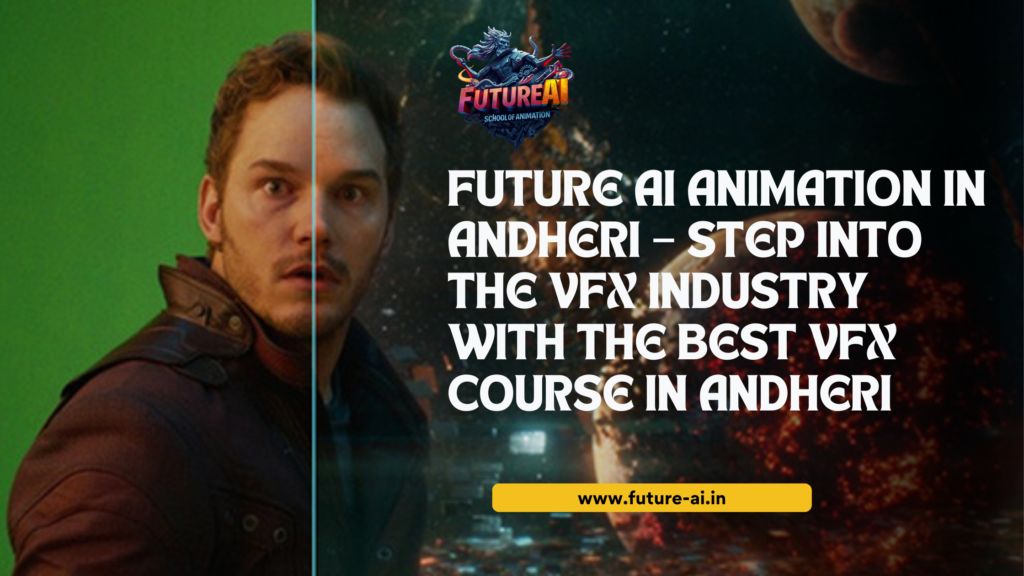
Visual storytelling today depends heavily on Visual Effects. Whether it is a high-budget film, a fast-paced commercial, a gaming cinematic, or even a short-form OTT clip, VFX shapes the way visuals are produced and consumed. As the demand for digital content continues to increase, so does the requirement for skilled VFX professionals who can blend creativity with technical precision.
For students aiming to build a future in this dynamic field, enrolling in a VFX Course in Andheri at Future AI Animation in Andheri places them in the center of Mumbai’s creative district. Andheri is home to multiple production studios, editing suites, post-production companies and digital agencies—making it a natural learning environment for future VFX artists.
This regenerated blog provides a complete explanation of the VFX industry, the detailed curriculum at Future AI Animation, career paths, growth opportunities and salary expectations.
What is VFX? A Clear Understanding of Visual Effects
VFX, or Visual Effects, is the art of combining computer-generated visuals with live-action footage to create scenes that cannot be accomplished through traditional filming. These digital enhancements help filmmakers, advertisers and game developers bring ideas to life with greater imagination and accuracy.
Common VFX applications include:
- Designing explosions, debris, water simulations and atmospheric effects
- Creating fantasy creatures, robots or digital characters
- Developing futuristic environments, cities and landscapes
- Removing or replacing backgrounds using chroma key (green-screen)
- Tracking camera movement to match live footage with CGI
- Extending sets or adding elements that appear realistic
- Producing composite shots by layering multiple digital assets
Nearly every modern production—regardless of genre—incorporates VFX to elevate visual quality.
Why Study VFX in Andheri? A Strategic Location for Creative Careers
Andheri has evolved into one of Mumbai’s strongest media clusters. A large number of studios, production houses and VFX companies operate within this region, offering students immediate exposure to authentic industry environments.
Benefits of choosing Andheri for VFX education:
- Easy access to film studios and OTT production houses
- Several VFX and animation companies within close distance
- Frequent masterclasses and training sessions by industry experts
- Networking opportunities with working artists and supervisors
- Clear understanding of real workflows used in studios
- Stronger internship and placement possibilities
This combination of learning and industry exposure gives students a competitive advantage when entering the job market.
Future AI Animation – Complete Term-Wise VFX Course Curriculum
The curriculum at Future AI Animation is divided into four detailed terms, each focusing on foundational skills, advanced tools, cinematic understanding and future technologies such as AI-driven VFX workflows.
TERM 1 – Core Art Skills, Fundamentals and Creative Development
The first term focuses on building strong artistic principles, which are essential for any future VFX specialist.
1. Foundations of Graphic Design
Students explore composition, color interaction, visual hierarchy, and fundamental design theory.
2. Typography for Visual Media
Understanding how type selections influence design flow, readability and branding.
3. Digital Illustration
Learning to sketch, develop concepts and create digital artworks using industry tools.
4. Storytelling and Script Formation
Studying scene structure, visual narrative and script breakdown.
5. Anatomy and Figure Drawing
Improving accuracy in drawing human and animal forms to support later animation work.
6. Character Design Concepts
Creating stylized or realistic characters suitable for animation and VFX sequences.
7. Digital Painting Fundamentals
Working with lighting, shadows, atmosphere and surface textures.
8. Animation Principles
Mastering timing, motion curves, staging and other foundational animation rules.
9. Initial Portfolio Development
Students begin organizing their early sketches and artworks.
10. Primary Cinematography Concepts
Understanding lenses, angles, lighting setups and visual storytelling.
TERM 2 – 3D Tools, Motion Graphics and Post-Production Essentials
This term introduces learners to professional 3D creation tools and editing software.
1. Broadcast Media Design
Creating on-screen visuals for news, advertisements and digital campaigns.
2. Understanding Digital Content Formats
Studying how visuals adapt across screens and platforms.
3. Basics of 3D Modeling and Animation
Learning to build 3D objects, apply textures and create simple motions.
4. Motion Graphics Using 3Ds Max
Designing animated transitions, promotional elements and title graphics.
5. V-Ray Rendering Techniques
Creating photorealistic outputs using light simulation and advanced shading.
6. Cinema 4D for Advanced Graphics
Exploring professional techniques widely used in media industries.
7. Compositing Foundations
Practicing chroma keying, rotoscoping, tracking and combining layers.
8. Video Editing and Post-Production
Understanding timelines, color correction, audio balancing and visual refinement.
9. Broadcast Workflow Study
Exploring how media houses structure content from concept to output.
10. Motion Graphics Portfolio Creation
Preparing showreels for broadcast and social media design roles.
11. Non-Linear Editing Tools
Training with Premiere Pro, Final Cut Pro and DaVinci Resolve.
12. Storyboards and Animatics
Creating visual blueprints for animation and VFX sequences.
TERM 3 – Advanced VFX, Cinematic Production and Real-World Techniques
Students move into hands-on VFX creation, scene building and advanced editing processes.
1. Visual Tone and Cinematic Mood Development
Exploring lighting and color theories that define a scene’s emotional impact.
2. Multi-Camera Editing
Combining footage from multiple perspectives for dynamic storytelling.
3. Advanced Sound Enhancement Techniques
Working with sound layers to create cohesive audio experiences.
4. CGI Integration with Live Footage
Ensuring digital elements blend naturally into real environments.
5. Advanced VFX Simulation
Creating water, fire, smoke, dust, magical effects and interactive particle systems.
6. Matchmoving and Camera Tracking
Ensuring CGI aligns with real-world camera movement.
7. Procedural Animation Introduction
Using automated systems to create repetitive or complex motion variations.
8. Environment and Scene Construction
Building detailed 3D worlds for gaming, films and advertising.
9. Realistic Animation Techniques
Understanding physics, weight, timing and natural movement.
10. Rigging for Characters and Assets
Learning technical setup for animation-ready characters.
11. AR and VR-Ready Asset Creation
Designing visuals suitable for immersive experiences.
12. Lip Sync Animation
Achieving accurate dialogue matching for characters.
13. Cinematic Storytelling Techniques
Understanding transitions, rhythm and narrative flow.
TERM 4 – AI-Driven Visual Effects and Next-Generation Tools
The final term prepares students for the future of the VFX industry.
1. Introduction to AI-Based Design Systems
Learning how prompt engineering influences AI-generated results.
2. AI Concept Art and Matte Paintings
Using AI for visual ideation, backgrounds and environmental designs.
3. AI-Assisted Product Visualization
Creating digital product ads with AI-enhanced CGI techniques.
4. Ethics and Responsibility in AI-Generated Art
Understanding originality, permissions and responsible usage.
5. AI Tools for VFX Production
Using AI for rotoscoping, cleanup, motion refinement and editing acceleration.
Career Opportunities After Completing a VFX Course
Graduates can pursue opportunities in:
- Film production studios
- OTT platforms
- Advertising agencies
- Animation and VFX studios
- Gaming companies
- Digital media organizations
- Architectural visualization firms
- AR/VR development companies
- Marketing and branding agencies
Popular Job Roles in the VFX Industry
- Roto Artist
- Cleanup Artist
- Compositor
- FX Simulation Artist
- Lighting Artist
- Matchmove Artist
- 3D Generalist
- Matte Painter
- Environment Artist
- VFX Production Manager
- VFX Supervisor
Salary Scope in VFX Careers
Entry-Level Salaries
₹18,000 – ₹30,000 per month
Mid-Level Salaries
₹35,000 – ₹80,000 per month
Senior-Level Salaries
₹1,20,000 – ₹2,50,000 per month
International Jobs
$40,000 – $120,000 annually
Freelance Opportunities
₹1,000 – ₹10,000 per shot or ₹50,000 – ₹2 lakh per project
With strong portfolios and experience, salaries increase significantly.
Who Should Join the VFX Course at Future AI Animation?
This course is suitable for:
- Students after 12th
- College learners exploring creative fields
- Individuals looking to switch careers
- Filmmaking and animation enthusiasts
- Gaming and CGI lovers
- Digital content creators
No previous software knowledge is needed.
Why VFX Will Continue Growing Rapidly
- Increasing OTT content production
- Growing demand for CGI-driven advertising
- Global outsourcing to Indian VFX studios
- Expansion of gaming and virtual worlds
- Rise of virtual production stages
- Adoption of AI and real-time tools
At Future AI Animation in Andheri, students get access to a complete range of industry-focused creative programs designed for modern digital careers. Our flagship Animation Course in Andheri builds strong foundations in drawing, storytelling, character design, 3D animation and cinematic production—perfect for anyone aiming to become a professional animator. Along with animation, students can also explore our Broadcast Prime course for television graphics and motion branding, the VFX Film Making program for advanced compositing and CGI, our specialized Advanced Gaming Course with Augmented Reality for future-ready game designers, Web Design & UX/UI for aspiring digital creators, and our dedicated Dynamics modules for those interested in simulations, particles, fluids and real-world effects. Each course is taught with updated tools, studio practices and hands-on training, ensuring every learner gains practical skills and a competitive edge in the creative industry.
Conclusion
A VFX Course in Andheri at Future AI Animation in Andheri provides all the essential skills needed for a successful career in modern visual content creation. With a curriculum that combines artistic training, technical mastery and AI-enhanced workflows, students develop the competence required for professional studio environments. Future AI Animation, supported by placement opportunities through Raj VFX Studio, ensures learners begin their careers with confidence, strong portfolios and industry exposure.
Contact Information
Future Ai Animation Andheri — Animation and VFX Courses in Andheri, Mumbai
Phone: +91 88799 98001
Email: info@future-ai.in
Address: Unit No. 1606, Chandak Unicorn, Dattaji Salvi Marg, Off Veera Desai Road, Andheri, Mumbai, Maharashtra 400053
Website: www.future-ai.in
Google Map: https://maps.app.goo.gl/7MLbP43WkC1XNjxKA

