

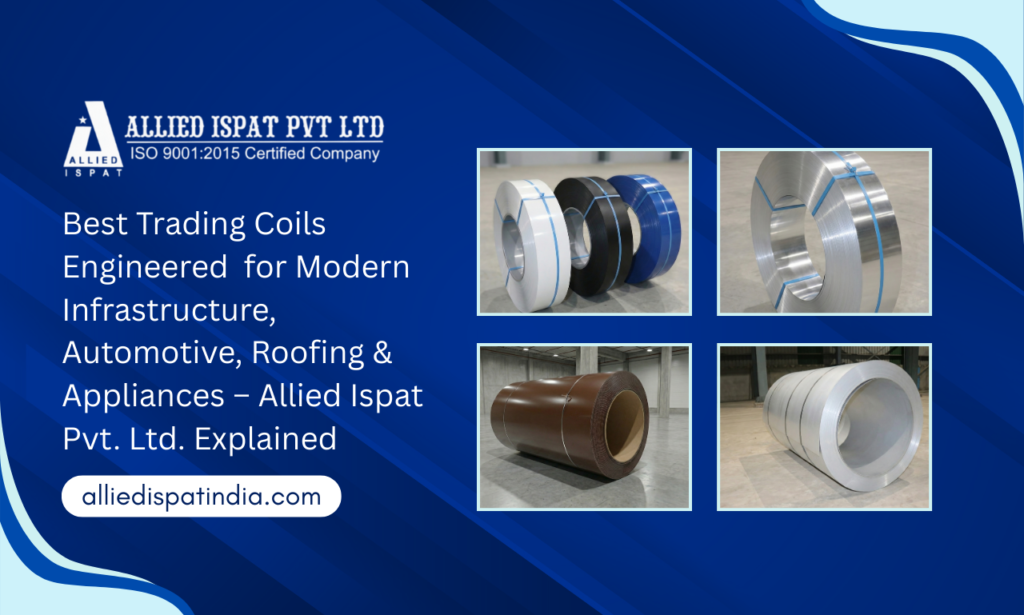
Introduction:
Allied Ispat Pvt. Ltd. has emerged as a dependable force in India’s steel supply ecosystem by delivering engineered trading coils that meet the exacting requirements of modern infrastructure and high-performance manufacturing. As industries evolve toward automation, tighter tolerances, and long-life products, the role of steel coils has expanded from being a basic raw material to a decisive factor in production efficiency, product quality, and long-term cost control.
Today, sectors such as automotive, roofing, infrastructure, and appliance manufacturing demand more than standard steel inputs. They require coils that are precision-cut, corrosion-resistant, aesthetically consistent, and compliant with international quality standards. This in-depth article explores how engineered trading coils support modern manufacturing needs and why choosing the right trading coil partner is critical for sustainable industrial growth.
The Strategic Role of Trading Coils in Modern Manufacturing
Steel trading coils sit at the very beginning of the manufacturing value chain. From these coils emerge components used in buildings, vehicles, appliances, industrial machinery, and infrastructure projects that define modern life.
In earlier manufacturing models, steel coils were often sourced as generic inputs, with quality adjustments made during processing. However, this approach no longer works in today’s environment, where:
- Production lines operate at high speed with minimal tolerance for variation
- Automation demands uniform material behavior
- Scrap and rework directly impact profitability
- End users expect long-lasting, visually refined products
Engineered trading coils solve these challenges by delivering predictable performance right from the start. When the input material is consistent, downstream processes become more stable, efficient, and cost-effective.
What Makes a Trading Coil “Engineered”?
An engineered trading coil is defined not just by its base metal, but by how precisely it is processed, coated, and supplied.
Core characteristics of engineered trading coils
- Accurate thickness tolerance to ensure consistent forming
- Controlled width for seamless machine compatibility
- Uniform surface finish to support painting, profiling, and fabrication
- Advanced coating systems for corrosion and weather resistance
- Customization options including slit coils, narrow widths, and wide formats
- ISO-aligned quality control for consistency and traceability
This engineering-focused approach transforms steel coils into a reliable production asset rather than a variable risk.
Trading Coils in Automotive Manufacturing: Precision at Scale
Automotive manufacturing is one of the most demanding applications for steel coils. Every component must meet strict safety, durability, and performance standards while being produced in very high volumes.
Key requirements in automotive coil selection
- Formability without failure: Steel must bend, stamp, and draw without cracking
- Consistent mechanical properties across batches
- Clean and smooth surfaces to reduce finishing defects
- Corrosion resistance to support long vehicle lifecycles
Even minor variations in coil quality can cause line stoppages, tooling damage, or rejected components—making coil selection a critical decision.
Preferred coil types for automotive applications
- GI (Galvanized Iron) coils for corrosion protection
- CR (Cold Rolled) coils for dimensional precision and surface quality
- PPGI coils where appearance and durability are equally important
Importance of customized coils in automotive plants
Automotive manufacturers often run specialized tooling and automated lines that cannot accommodate generic coil sizes. Custom-slit coils, produced to exact width and thickness specifications, help:
- Reduce trimming losses
- Minimize machine changeovers
- Improve throughput consistency
- Maintain uniform component quality
Engineered trading coils therefore play a direct role in improving production efficiency and cost control in the automotive sector.
Roofing & Infrastructure: Coils Built for Harsh Conditions
Roofing and infrastructure projects place steel under constant environmental stress. Exposure to sun, rain, humidity, pollution, and temperature fluctuations demands materials that can perform reliably over decades.
Challenges faced by roofing materials
- Corrosion due to moisture and coastal conditions
- UV degradation of surface coatings
- Structural stress from wind and load
- Long service-life expectations with minimal maintenance
Ideal trading coil solutions for roofing
- GI coils for basic corrosion resistance
- GL (Galvalume) coils for enhanced protection using aluminum-zinc coating
- PPGI / PPGL coils for combined durability and visual appeal
Color-coated coils are increasingly preferred in modern infrastructure because they offer:
- Stable color and gloss retention
- Improved weather resistance
- Clean, uniform aesthetics for architectural applications
For commercial, industrial, and residential roofing, the right coil selection directly impacts durability, appearance, and lifecycle cost.
Appliance Manufacturing: Where Precision Meets Aesthetics
Appliance manufacturing demands steel coils that perform both structurally and visually. Products such as refrigerators, washing machines, ovens, and air conditioners rely heavily on steel panels that are visible to the end user.
Requirements unique to appliance manufacturing
- High surface quality to avoid visible defects
- Consistent thickness for automated forming and assembly
- Durable coatings to resist daily wear and cleaning
- Uniform color and gloss for brand consistency
Coil types commonly used
- PPGI coils for superior finish and design flexibility
- GI and GL coils for corrosion resistance and longevity
Engineered trading coils enable appliance manufacturers to maintain tight quality standards while scaling production efficiently.
Custom Coil Widths, Thickness & Slitting: Eliminating Inefficiency
One of the most common challenges in manufacturing is the mismatch between standard coil dimensions and machine requirements. This mismatch leads to:
- Excessive trimming and scrap
- Frequent machine adjustments
- Slower production cycles
- Increased material cost per unit
Advantages of customized coil solutions
- Exact width matching for machinery
- Controlled thickness for precise forming
- Slit coil formats for multiple profiles
- Reduced waste and improved yield
- Faster setup and stable production runs
Customization turns steel coils into a productivity advantage, especially for manufacturers using roll forming machines and automated fabrication systems.
Coating Technology: Beyond Surface Appearance
Coating quality is often underestimated, yet it plays a crucial role in both functional performance and long-term durability.
What defines superior coating performance
- Premium PPGI / PPGL materials
- Uniform coating thickness across the coil
- Strong adhesion between coating layers
- Resistance to corrosion, UV exposure, and abrasion
High-quality coatings protect steel from environmental damage while preserving appearance—reducing maintenance and replacement costs over the product lifecycle.
ISO-Certified Supply Chain & Quality Discipline
In B2B manufacturing, reliability is built on process discipline. ISO-aligned supply chains ensure that quality is not dependent on chance, but on standardized systems.
Benefits of ISO-compliant coil supply
- Consistent specifications across batches
- Documented quality checks and traceability
- Reduced variability and manufacturing risk
- Greater confidence for domestic and global buyers
Stringent inspection at every stage from incoming material to final dispatch ensures that each trading coil meets defined standards before reaching the customer.
Why Manufacturers Choose Allied Ispat as Their Trading Coil Partner
Manufacturers today look for partners who understand production realities, not just material specifications. Allied Ispat’s approach focuses on aligning steel supply with operational needs.
Key reasons manufacturers trust Allied Ispat
- Expertise in customized coil dimensions and slitting
- Industry-grade materials suitable for demanding applications
- Consistent stock availability to avoid production delays
- Organized logistics and timely dispatch
- Long-term supply reliability built on quality systems
This combination positions Allied Ispat as a Trading Coil Manufacturer and Supplier in India that supports growth, scalability, and operational confidence.
Applications Across Industries
Engineered trading coils supplied by Allied Ispat are used across a wide range of industrial applications, including:
- Automotive components and assemblies
- Roofing sheets and infrastructure panels
- Home appliances and white goods
- Roll forming and profiling operations
- General industrial fabrication
Each application benefits from predictable input quality, enabling smoother operations and superior finished products.
Frequently Asked Questions
Which trading coil is best for roofing applications?
PPGI and GL coils are widely preferred due to their corrosion resistance, weather durability, and long-lasting surface finish.
Are color-coated coils suitable for appliance manufacturing?
Yes. PPGI coils offer excellent surface quality, color consistency, and durability required for visible appliance components.
Why are customized slit coils better than standard coils?
Customized slit coils match machine specifications precisely, reducing scrap, downtime, and production inefficiencies.
How does ISO certification benefit manufacturers sourcing trading coils?
ISO certification ensures standardized processes, consistent quality, traceability, and reduced supply risk.
What makes Allied Ispat a reliable trading coil supplier?
Customization capability, stringent quality control, ISO-compliant systems, and dependable logistics.
Conclusion: Building the Future with Engineered Trading Coils
Modern infrastructure and manufacturing depend on materials that deliver precision, durability, and consistency. Trading coils are no longer basic commodities they are critical inputs that influence production efficiency, product performance, and long-term cost structures.
By supplying engineered, customizable, and quality-controlled trading coils for automotive, roofing, and appliance manufacturing, Allied Ispat Pvt. Ltd. empowers manufacturers to meet evolving industry demands with confidence. With advanced coating technology, exact tolerances, and ISO-certified processes, Allied Ispat delivers steel solutions that are truly engineered for modern manufacturing and infrastructure.

