

CFO Works understands that financial management is one of the most important pillars of business stability and growth. In the beginning, many businesses rely on spreadsheets, basic accounting tools, and manual tracking systems to manage their finances. That approach may work for a while, but as operations expand, it becomes increasingly difficult to maintain accuracy, speed, and control through scattered or outdated methods.
As a business grows, financial activities become more demanding. Invoicing, vendor payments, payroll, expense approvals, taxation, compliance, receivables, and reporting all begin to require more structure. When these processes are handled through disconnected tools or manual follow-ups, the finance function becomes slower and less reliable. Reports take time, reconciliations become messy, and decision-makers struggle to get a clear picture of the company’s actual financial position.
This is where modern financial systems become essential. Businesses no longer need only bookkeeping support. They need connected systems that can improve visibility, reduce manual work, support compliance, and make financial information easier to use. That is why many businesses in Mumbai are moving toward cloud-based solutions like Zoho.
However, software alone does not solve financial problems. The real impact depends on how the platform is implemented. A poorly configured system can create confusion, while a well-implemented one can bring clarity and efficiency across the entire finance process. This is why Zoho Implementation Services in Mumbai play such an important role in improving financial management.
The Need for a More Structured Finance System
Financial management today is expected to do much more than record numbers. It must help business owners understand cash flow, track outstanding payments, monitor spending, support tax readiness, and generate useful reports for decision-making. If finance data is spread across Excel sheets, emails, separate applications, and manual records, it becomes difficult to manage that responsibility effectively.
A business may look busy and profitable on the surface, yet still lack real financial clarity. Delayed invoicing can affect collections. Untracked expenses can weaken margins. Poor reporting can make it difficult to plan. Management may make decisions based on incomplete or outdated figures, which increases operational risk.
As transaction volumes increase, these issues become harder to ignore. The finance team spends more time correcting entries and compiling data than analyzing it. Business owners lose visibility into what is happening in real time. This is why businesses are increasingly looking for systems that organize financial activity in one place and reduce dependence on manual effort.
What Zoho Brings to Financial Management ?
Zoho offers a cloud-based finance ecosystem designed to simplify and connect core financial processes. Instead of using separate tools for invoicing, accounting, expense management, and inventory-related functions, businesses can operate through an integrated structure where financial information is centralized and accessible.
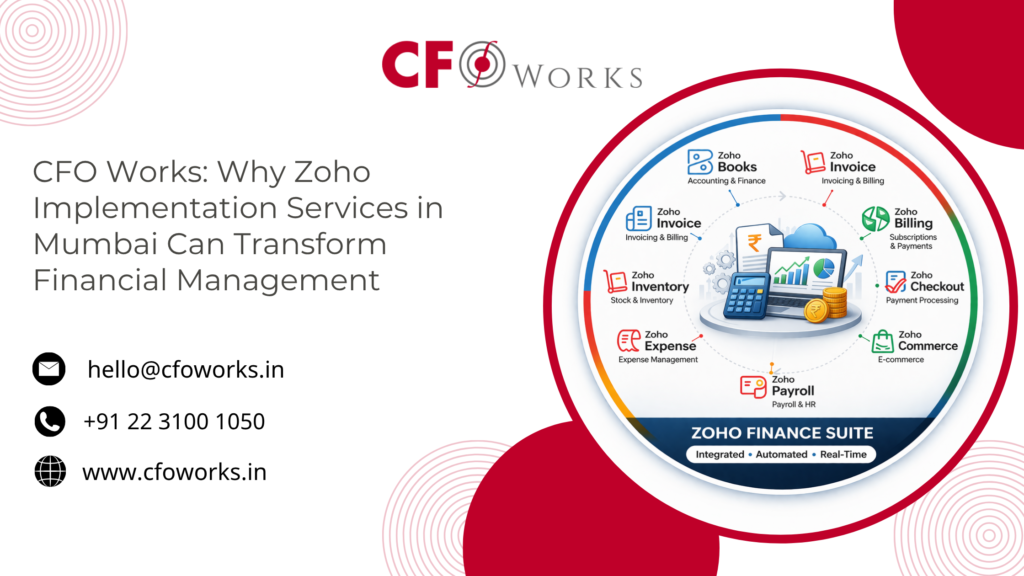
The Zoho Finance Suite includes tools such as Zoho Books, Zoho Invoice, Zoho Expense, and Zoho Inventory. These applications support different aspects of business finance, but their strength lies in how they work together. A transaction recorded in one part of the system can contribute to more accurate reporting and smoother workflow across the rest of the platform.
This connected setup reduces duplication and gives businesses better control over their data. Because Zoho is cloud-based, it also offers the flexibility to access financial information from anywhere. For business owners, managers, and finance teams, this means faster access to reports, easier collaboration, and less reliance on physical records or office-based systems.
For businesses in a city like Mumbai, where speed and efficiency are crucial, this kind of financial accessibility is highly valuable.
Why Zoho Is Becoming More Popular in Mumbai ?
Businesses in Mumbai often operate in a fast-moving and competitive environment. Finance processes need to be efficient, accurate, and adaptable. Manual accounting methods may work in the early stage, but they often become a bottleneck as the company grows.
Zoho is becoming more popular because it helps businesses reduce that bottleneck. It allows finance operations to become more streamlined and organized. Invoices can be created faster, expenses can be tracked more clearly, reconciliations can be handled with greater structure, and reports can be reviewed without long delays.
Another reason businesses prefer Zoho is its balance between usability and capability. Many growing businesses want a finance platform that is not overly complicated but still strong enough to support scaling operations. Zoho fits that requirement well, especially for startups and SMEs that want better control without moving into an overly heavy system too early.
Key Financial Benefits of Zoho
A properly implemented Zoho environment can improve several important areas of financial management.
Better Invoicing Discipline
Invoicing has a direct impact on cash flow. If billing is delayed or inconsistent, collections suffer. Zoho helps businesses create structured invoices, automate recurring billing, and set reminders for payment follow-ups. This improves billing consistency and helps businesses manage receivables more effectively.
Improved Expense Management
Manual expense tracking often leads to weak visibility and delayed approvals. Zoho allows businesses to record, categorize, and review expenses digitally. This gives management a clearer view of spending and helps reduce unnecessary financial leakage.
Easier Reconciliation
Bank reconciliation is often one of the most time-consuming accounting activities. Zoho helps organize and match transactions more efficiently, which reduces manual workload and improves the accuracy of records.
Real-Time Reporting
A major strength of cloud-based finance platforms is access to live financial data. Businesses no longer need to wait until the end of the month to understand where they stand. Revenue, expenses, receivables, and profit trends can be viewed more quickly, which helps management respond faster.
Support for Compliance
Tax and compliance processes become easier when financial records are structured properly. Zoho supports organized financial tracking, which helps businesses prepare more accurately for compliance requirements and internal reviews.
Why Implementation Matters More Than Most Businesses Expect ?
A common mistake businesses make is assuming that once software is purchased, the improvement will happen automatically. In reality, software is only the starting point. Its usefulness depends on how well it is set up and aligned with the company’s actual finance processes.
If the chart of accounts is not designed properly, reporting becomes unreliable. If tax settings are incomplete, compliance can be affected. If user roles are unclear, workflow discipline suffers. If historical data is migrated poorly, the business may lose trust in the system from day one.
This is why implementation is not just a technical step. It is a business-critical process that determines whether the software becomes an asset or a problem.
How Zoho Implementation Services in Mumbai Help Businesses ?
Zoho Implementation Services in Mumbai help businesses make the shift from basic software adoption to meaningful financial system improvement. Their role is to ensure that Zoho is configured according to real business needs rather than used as a generic setup.
The process usually begins with understanding how the business currently manages finance. Every business has its own structure. A service company, consultant, trader, startup, or product-based business will all have different requirements for invoicing, approvals, expense tracking, and reporting.
Once those needs are understood, the system is configured accordingly. This includes setting up ledgers, tax rules, user roles, invoice formats, approval flows, reporting categories, and other financial structures. When this is done correctly, the system becomes easier to use and more relevant for daily business operations.
Another important part of implementation is data migration. Customer records, vendor data, opening balances, item details, and previous transactions must be moved accurately into the new system. If this step is weak, the business may experience reporting errors and inconsistencies. Proper implementation reduces this risk.
Automation is also a major benefit. Recurring invoices, payment reminders, report schedules, and approval workflows can all be set up to reduce repetitive manual work. This improves efficiency and allows finance teams to spend more time on analysis instead of routine tasks.
Why Startups and SMEs Gain the Most Value ?
Startups and SMEs often need structured finance systems the most, even if they do not always realize it early enough. These businesses usually operate with lean teams and limited bandwidth. They need a system that brings discipline without creating complexity.
For startups, Zoho can help build financial structure from the beginning. It allows them to track collections, monitor expenses, and maintain better visibility over their numbers as they grow.
For SMEs, Zoho helps replace fragmented processes with a more connected and scalable finance environment. Instead of depending on multiple spreadsheets and manual processes, they can move toward clearer reporting and stronger operational control.
In both cases, the result is better management visibility and more confidence in financial decision-making.
Common Problems When Implementation Is Weak
When implementation is not handled properly, businesses often experience unnecessary challenges. Reports may not match the real position of the business. Tax settings may be inaccurate. Data may be incomplete or duplicated. Teams may not understand how to use the system effectively.
In some cases, the software is activated, but the business continues using old manual processes alongside it. That creates confusion rather than efficiency. The software then feels underwhelming, even though the actual problem is not the platform itself but the lack of proper implementation.
Conclusion
CFO Works believes that better financial management begins with the right systems and the right implementation strategy. As businesses grow, manual methods often become slower, less accurate, and more difficult to manage. Zoho offers a practical and scalable solution for businesses that want more control, better reporting, and a stronger finance structure.
But the software delivers real value only when it is implemented properly. That is why Zoho Implementation Services in Mumbai matter. They help businesses configure the system around their operations, migrate data accurately, automate repetitive finance tasks, and create reports that support real decision-making.
For startups, SMEs, and growing companies, a well-implemented Zoho system can improve invoicing discipline, expense visibility, compliance readiness, reporting quality, and overall financial clarity. In a competitive business environment like Mumbai, that level of control can make a meaningful difference.
CFO Works LLP
Virtual CFO Services in Mumbai
712, Kalpataru Avenue, Akurli Road, Kandivali East, Mumbai – 400101
Phone: +91 22 3100 1050
Email: hello@cfoworks.in
Website: www.cfoworks.in