

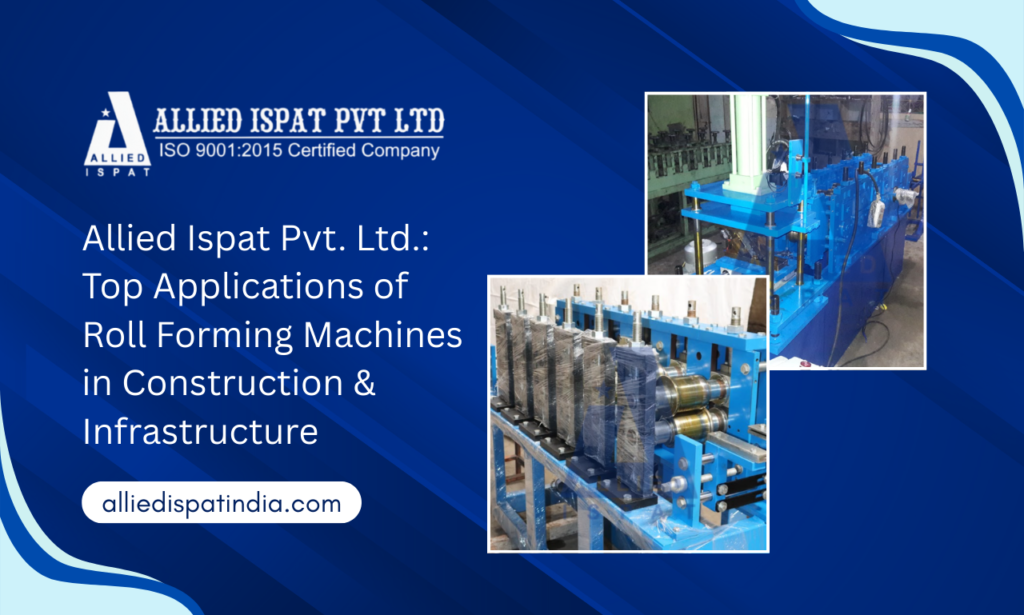
Introduction: How Roll Forming Machines Drive Modern Construction Efficiency
The construction and infrastructure industry has undergone a dramatic transformation in recent years. Projects today are larger, faster, and more technically demanding than ever before. From industrial parks and logistics warehouses to metro rail networks, airports, and high-rise commercial developments, the demand for precision-engineered steel components at scale has become non-negotiable.
Traditional metal fabrication techniques such as manual bending, cutting, and welding were effective when project volumes were smaller and tolerances were flexible. However, these methods struggle to meet modern requirements for uniformity, speed, structural accuracy, and cost efficiency, especially when thousands of identical profiles are required.
This shift has positioned roll forming machines as a critical manufacturing technology for the construction and infrastructure sector. By enabling the continuous shaping of steel coils into highly accurate profiles, roll forming allows manufacturers to deliver consistent quality, high output, and repeatable precision across large production runs.
Within India’s rapidly growing construction manufacturing ecosystem, Allied Ispat Pvt. Ltd. has emerged as a reliable partner for manufacturers supplying ceiling systems, roofing solutions, rolling shutters, and structural components. With a strong focus on engineering robustness, application-specific machine design, and long-term performance, the company supports infrastructure-focused manufacturers across the country.
This comprehensive guide explores what roll forming machines are, why they are essential, and how they are applied across construction and infrastructure projects, highlighting their role in building faster, stronger, and more scalable structures.
Understanding Roll Forming Machines
What is roll forming?
Roll forming is a continuous cold metal forming process in which flat steel coils are gradually shaped into a specific cross-sectional profile using a series of roller stations. Each station makes a small, controlled bend, ensuring the material flows smoothly into its final shape without cracking, warping, or internal stress.
Unlike batch-based fabrication methods, roll forming operates continuously, making it ideal for producing long, uniform steel sections required in construction and infrastructure applications.
Key components of a roll forming machine
A standard industrial roll forming machine includes:
- Decoiler unit for smooth coil feeding
- Entry guide and straightener to maintain alignment
- Multiple roll forming stations with precision-machined rollers
- Punching or notching systems (optional)
- Cut-to-length mechanism (hydraulic or servo-controlled)
- Electrical and control systems (manual, PLC, or CNC)
Each component contributes to dimensional accuracy, surface quality, and production efficiency.
How Roll Forming Differs from Conventional Fabrication
Limitations of traditional fabrication methods
Press braking, welding, and manual bending are still used in niche or low-volume applications, but they present challenges for large-scale construction manufacturing:
- Inconsistent dimensions across batches
- Higher dependency on skilled labor
- Slower production cycles
- Increased scrap and material wastage
- Difficulty maintaining uniform quality
These limitations become costly when projects demand thousands of meters of identical profiles.
Advantages of roll forming technology
Roll forming machines overcome these challenges by offering:
- Continuous, high-speed production
- Cold forming without heat distortion
- Exceptional dimensional consistency
- Superior surface finish
- Predictable output over long runs
These benefits explain why roll forming machines have become a foundation technology for construction-focused manufacturers.
Why Roll Forming Machines Are Essential for Construction & Infrastructure
Why modern construction demands automated forming
Infrastructure projects operate under strict constraints related to time, cost, and safety. Delays or inconsistencies in component manufacturing can disrupt entire project schedules.
Roll forming machines address these challenges by delivering:
Precision and repeatability
Each profile produced is identical, ensuring perfect alignment during on-site installation.
High production efficiency
Continuous forming allows manufacturers to meet tight deadlines without compromising quality.
Cost optimization
Lower labor costs, minimal scrap, and reduced rework improve overall project economics.
Structural reliability
Uniform cross-sections enhance load distribution and long-term performance.
As a result, industrial roll forming machines are now indispensable for manufacturers serving large construction and infrastructure projects.
Major Applications of Roll Forming Machines in Construction & Infrastructure
1. False Ceiling and POP Framework Systems
False ceiling systems are widely used in commercial buildings, hospitals, hotels, malls, and residential complexes. Components such as:
- GI ceiling channels
- POP frames
- C and U sections
- Furring channels
require precise dimensions to ensure smooth installation and long-term stability.
Roll forming machines manufacture these profiles with:
- Consistent thickness
- Accurate edge geometry
- Smooth, scratch-free surfaces
- Uniform mechanical strength
This precision reduces on-site adjustments, speeds up installation, and improves finished aesthetics.
2. Industrial Roofing Sheets and Structural Supports
Industrial roofing systems must withstand heavy loads, weather exposure, and thermal variation. Roll forming machines are extensively used to produce:
- Roofing sheets
- Trapezoidal and corrugated profiles
- Purlins and support sections
Through controlled cold roll forming:
- Load-bearing capacity remains consistent
- Surface finish stays uniform
- Large volumes are produced efficiently
- Material wastage is minimized
This makes roll forming technology ideal for manufacturers supplying warehouses, factories, and logistics hubs.
3. Rolling Shutter Guide Channels and Profiles
Rolling shutters are essential for security and access control in industrial and commercial spaces. The performance of these systems depends heavily on the accuracy of:
- Guide channels
- Bottom rails
- Supporting profiles
Roll forming machines ensure:
- Perfect alignment
- Uniform cross-sections
- Smooth edges for reduced friction
- Durability under repeated operation
Manufacturers positioning themselves as a Roll Forming Machine Supplier in India must deliver machines capable of producing shutter components with this level of consistency.
4. Structural Steel Sections for Infrastructure Projects
Large infrastructure developments such as metro stations, airports, bridges, and commercial complexes rely on cold-formed steel sections for framing and support.
Roll forming machines are used to manufacture:
- C-sections
- U-sections
- Omega profiles
- Custom structural shapes
These profiles offer:
- High dimensional accuracy
- Consistent mechanical properties
- Compatibility with automated assembly
- Compliance with engineering standards
Roll forming enables manufacturers to meet both safety requirements and volume demands of infrastructure-scale projects.
5. Interior Partition and Modular Construction Systems
Modern interior construction increasingly relies on lightweight steel frameworks for:
- Office partitions
- Concealed supports
- Modular wall systems
Roll forming machines produce profiles that balance strength, precision, and ease of installation.
Key benefits include:
- Clean architectural finish
- Lightweight yet rigid sections
- Faster installation timelines
- Long-term dimensional stability
These applications highlight how roll forming supports both large infrastructure and detailed interior construction.
Benefits of Roll Forming Machines for Construction Manufacturers
Why manufacturers invest in roll forming technology
Roll forming machines deliver value across multiple operational dimensions:
Reduced material wastage
Optimized forming minimizes scrap and offcuts.
Faster manufacturing cycles
Continuous production supports just-in-time supply.
Uniform product quality
Consistency simplifies installation and reduces errors.
Enhanced durability
Cold-formed profiles retain strength over time.
Lower maintenance costs
Robust machine design ensures long operational life.
These advantages make roll forming machines a strategic investment for construction-focused manufacturers.
Why Infrastructure Projects Prefer Roll-Formed Steel Components
Performance advantages of roll-formed steel
Infrastructure projects demand materials that perform reliably under heavy loads and long service life. Roll-formed steel components offer:
- High strength-to-weight ratio
- Predictable structural performance
- Ease of transport and handling
- Faster on-site assembly
Typical infrastructure applications
- Warehouses and logistics parks
- Metro rail systems
- Airports and terminals
- Industrial plants
- Large commercial developments
As a Roll Forming Machine Manufacturer in India, Allied Ispat Pvt. Ltd. designs machines that support these demanding applications.
Choosing the Right Roll Forming Machine Manufacturer
What manufacturers should evaluate
Selecting the right roll forming machine partner is critical. Key factors include:
- Engineering strength and machine durability
- Customization capability
- Surface finish quality
- Automation options
- After-sales support
Allied Ispat Pvt. Ltd. combines these elements to deliver machines optimized for construction and infrastructure manufacturing.
Engineering Features That Define High-Performance Roll Forming Machines
Advanced roll forming machines designed for construction applications typically include:
- Heavy-duty frames for continuous industrial operation
- Precision-machined rollers for surface consistency
- Stable drive systems for controlled speed
- Options for manual, semi-automatic, and fully automatic operation
These features ensure consistent output even under demanding production schedules.
Role of Roll Forming in India’s Infrastructure Expansion
Supporting domestic manufacturing growth
India’s infrastructure development is closely linked to its manufacturing capabilities. Roll forming technology supports:
- “Make in India” initiatives
- Strong domestic supply chains
- Reduced dependency on imports
By enabling scalable, cost-effective production, roll forming machines play a direct role in sustainable infrastructure growth.
Allied Ispat Pvt. Ltd. contributes by supplying locally engineered, globally competitive roll forming solutions.
Importance of Customization in Roll Forming for Construction
Every construction project has unique requirements. Customization in roll forming machines allows manufacturers to:
- Develop project-specific profiles
- Match precise thickness and width specifications
- Optimize production for specialized applications
Working with a Roll Forming Machine Manufacturer in India that offers customization transforms machinery into a long-term strategic asset.
Frequently Asked Questions (FAQs)
What are roll forming machines used for in construction?
They are used to manufacture ceiling channels, roofing sheets, shutter guides, structural sections, and partition profiles.
Why is roll forming preferred over traditional fabrication?
It offers continuous production, higher accuracy, reduced wastage, and lower labor costs.
Which steel coils are suitable for roll forming?
GI, PPGI, CR, HR, and color-coated coils are commonly used.
Are roll forming machines suitable for large infrastructure projects?
Yes. Their speed, consistency, and scalability make them ideal for infrastructure-scale manufacturing.
Can roll forming machines produce custom profiles?
Yes. Machines can be engineered for project-specific designs.
Conclusion: Enabling the Future of Construction with Roll Forming Technology
Roll forming machines have become a foundational technology in modern construction and infrastructure manufacturing. Their ability to deliver precision, speed, consistency, and scalability makes them indispensable for today’s high-demand projects.
Through application-focused engineering and durable machine design, Allied Ispat Pvt. Ltd. empowers manufacturers to meet India’s growing infrastructure needs with confidence and efficiency.
Looking to invest in reliable roll forming machines for construction or infrastructure applications?
Partner with Allied Ispat Pvt. Ltd. for high-performance roll forming solutions built for long-term success.
Contact Allied Ispat India
Head Office: Allied Ispat Pvt. Ltd.
69, Chotta Sonapur, Maulana Shaukat Ali Road, Mumbai — 400008
Phone: +91 98211 77009
Manufacturing Works:
Plot No. C-17/9, MIDC Taloja, Behind Bank of Baroda, Dist. Raigad — 410208
Phone: +91 87790 51606
Get Directions: https://maps.app.goo.gl/gyEqxBGcw9jLsYm26
Email: info@alliedispatindia.com | sales@alliedispatindia.com
Website: https://alliedispatindia.com

