

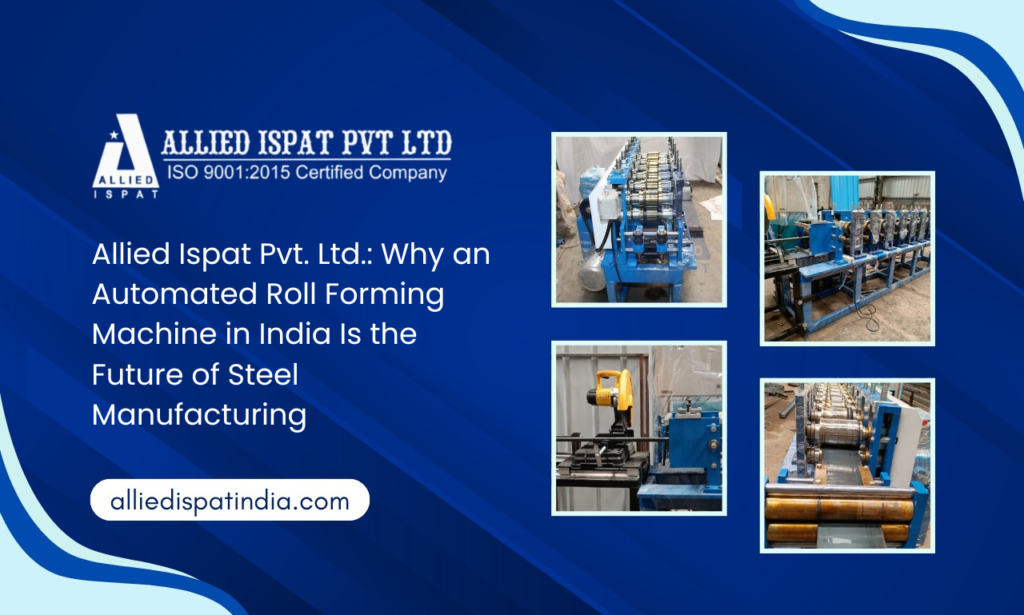
The steel manufacturing industry in India is evolving at an unprecedented pace. Rapid urbanization, infrastructure development, industrial expansion, renewable energy projects, and smart construction techniques have significantly increased the demand for precision-engineered steel products. Manufacturers are now expected to produce high-quality profiles at faster speeds while maintaining strict dimensional accuracy and cost efficiency.
Meeting these expectations with conventional fabrication methods has become increasingly difficult. Processes that involve manual measuring, cutting, bending, and welding consume more time, require higher labour input, and often lead to inconsistent product quality. As production volumes grow, these limitations directly affect profitability and customer satisfaction.
This is where an Automated Roll Forming Machine in India has emerged as a game-changing solution.
Designed to deliver continuous, high-speed production, automated roll forming machines convert flat metal coils into finished steel profiles through a carefully engineered sequence of roll forming stations. Every operation—from material feeding and profile shaping to hydraulic cutting—is synchronized using intelligent automation, ensuring maximum productivity with minimal human intervention.
Whether manufacturing roofing sheets, rolling shutter slats, purlins, cable trays, solar mounting structures, warehouse racks, or customized structural sections, automated roll forming provides manufacturers with the speed, precision, and consistency required to compete in today’s industrial landscape.
As an experienced Roll Forming Machine Manufacturer in India, Allied Ispat Pvt. Ltd. delivers advanced roll forming solutions designed to meet the unique production requirements of businesses across multiple industries. By combining robust engineering, customized machine design, and modern automation technology, the company enables manufacturers to improve efficiency, reduce operational costs, and scale their production with confidence.
This guide explains how automated roll forming machines work, their essential components, industrial applications, and the reasons why they have become an indispensable investment for modern steel manufacturers.
What Is an Automated Roll Forming Machine?
An automated roll forming machine is a continuous manufacturing system used to produce uniform metal profiles from steel coils. Instead of shaping the material in one operation, the machine gradually forms it by passing the strip through multiple precision rollers arranged in a specific sequence.
Each roll forming station applies a controlled amount of pressure, allowing the metal to take shape without causing excessive stress or deformation. This progressive forming method produces highly accurate profiles with excellent structural strength and surface quality.
Automation further improves the process by integrating:
- Automatic material feeding
- PLC-controlled production
- Digital length measurement
- Hydraulic cutting
- Continuous product discharge
As a result, manufacturers can produce thousands of identical components efficiently while maintaining exceptional consistency throughout the production cycle.
Essential Components of an Automated Roll Forming Machine
Every roll forming machine is made up of several precisely engineered systems that work together to deliver uninterrupted and accurate production.
1. Coil Decoiler
The production cycle begins with the decoiler, which securely holds the steel coil and releases the material at a controlled speed.
A well-designed decoiler ensures:
- Smooth coil unwinding
- Stable material tension
- Continuous feeding
- Reduced production interruptions
Consistent coil feeding is the foundation of accurate roll forming.
2. Material Feeding System
After leaving the decoiler, the steel strip enters the feeding section.
This mechanism guides the material accurately into the roll forming line while maintaining proper alignment.
Its primary functions include:
- Accurate strip positioning
- Uniform feeding speed
- Prevention of material deviation
- Improved profile consistency
An efficient feeding system minimizes production defects and improves machine performance.
3. Roll Forming Section
The roll forming section is the most important part of the machine.
It consists of multiple sets of hardened rollers that gradually transform the flat steel strip into the required profile.
Instead of applying excessive force at one point, each station performs a small forming operation, resulting in:
- Higher dimensional accuracy
- Better profile symmetry
- Reduced internal stress
- Superior product quality
The number of forming stations depends on the complexity of the profile being manufactured.
4. PLC-Based Control System
Modern roll forming machines use a Programmable Logic Controller (PLC) to automate production.
Operators can easily set parameters such as:
- Product length
- Production quantity
- Line speed
- Cutting position
- Batch settings
The PLC coordinates every stage of production, reducing manual intervention while ensuring consistent results.
5. Hydraulic Cutting Unit
Once the profile reaches the programmed length, the hydraulic cutting system performs a clean and accurate cut.
Because the cutter operates in synchronization with the production line, the machine maintains continuous production without unnecessary stoppages.
Key benefits include:
- Accurate profile lengths
- Smooth cutting edges
- Faster production
- Reduced finishing work
6. Product Exit Table
The finished profiles are transferred to the receiving table, where they are collected, inspected, and prepared for packaging or further processing.
This organized workflow helps improve handling efficiency while minimizing product damage.
How Does an Automated Roll Forming Machine Operate?
Although the machine performs sophisticated operations, the production process follows a simple and highly efficient sequence.
Step 1: Loading the Steel Coil
The required steel coil is mounted onto the decoiler.
Depending on production needs, manufacturers commonly process:
- Mild Steel (MS)
- Galvanized Steel (GI)
- Cold Rolled Steel (CR)
- Stainless Steel
- Colour-Coated Steel
- Pre-Painted Steel
- Aluminium
Selecting the appropriate material depends on the product application and customer requirements.
Step 2: Precision Material Feeding
The feeding mechanism transfers the steel strip into the roll forming section while maintaining proper alignment.
Accurate feeding ensures consistent profile dimensions throughout production.
Step 3: Progressive Roll Forming
As the material passes through multiple roller stations, it is gradually shaped into the final profile.
This progressive approach offers several advantages:
- Excellent dimensional precision
- Uniform bends
- Improved structural strength
- Better surface finish
- Lower material stress
Step 4: Automated Process Monitoring
The PLC continuously monitors and synchronizes:
- Feeding speed
- Forming operations
- Product length
- Cutting sequence
Automation minimizes production errors while maintaining smooth machine operation.
Step 5: Hydraulic Cutting
Once the programmed length is achieved, the hydraulic cutting unit separates the finished profile without interrupting production.
This synchronized operation helps maximize output while maintaining cutting accuracy.
Step 6: Product Collection
Completed steel profiles move to the exit table, where they undergo quality inspection before packaging or dispatch.
The continuous production cycle significantly improves manufacturing efficiency.
Products Manufactured Using Roll Forming Machines
One of the biggest strengths of roll forming technology is its versatility.
By replacing roller tooling, manufacturers can produce a wide variety of steel profiles, including:
- Roofing Sheets
- Wall Cladding Panels
- Rolling Shutter Slats
- C-Channels
- Z-Purlins
- Solar Mounting Rails
- Cable Trays
- Ceiling Channels
- Drywall Studs
- Door Frames
- Window Reinforcement Sections
- Storage Rack Profiles
- Industrial Framing Members
- Customized Structural Profiles
This flexibility allows manufacturers to diversify their product offerings while using the same production platform.
Types of Roll Forming Machines
The ideal machine depends on production requirements, business size, and investment plans.
Manual Roll Forming Machines
Manual machines are suitable for small-scale production where operators perform several production tasks manually.
Best suited for:
- Low-volume manufacturing
- Prototype development
- Small workshops
Semi-Automatic Roll Forming Machines
These machines combine manual supervision with automated production functions.
Advantages include:
- Higher productivity
- Better consistency
- Reduced labour effort
- Moderate investment
They are widely used by growing manufacturing businesses.
Fully Automatic Roll Forming Machines
Fully automatic machines integrate every production stage into one intelligent manufacturing system.
Major features include:
- Automatic feeding
- PLC-controlled operation
- Continuous production
- Hydraulic cutting
- Digital production monitoring
These machines are ideal for manufacturers seeking high-volume production with maximum efficiency.
Why Automation Is Becoming Essential
Manufacturers across India are embracing automation to remain competitive in an increasingly demanding marketplace.
Automated roll forming provides measurable business benefits, including:
- Higher production capacity
- Faster manufacturing cycles
- Excellent dimensional accuracy
- Lower material wastage
- Improved product consistency
- Reduced labour dependency
- Better production planning
- Enhanced operational safety
- Stronger long-term profitability
By investing in automation, businesses can improve operational efficiency while preparing for future expansion.
Why Allied Ispat Pvt. Ltd. Is the Right Choice
Selecting the right machine manufacturer is just as important as selecting the right technology.
Allied Ispat Pvt. Ltd. has established itself as a trusted Roll Forming Machine Manufacturer in India by delivering customized, high-performance roll forming solutions built for reliability and long-term productivity.
The company offers:
- Fully Automatic Roll Forming Machines
- Semi-Automatic Roll Forming Machines
- Customized Roll Forming Production Lines
- Precision Roller Tooling
- Heavy-Duty Machine Construction
- PLC-Controlled Automation
- Hydraulic Cutting Technology
- Installation & Commissioning Support
- Operator Training
- Dedicated After-Sales Service
Every solution is designed around the customer’s production goals, ensuring optimal performance, lower operating costs, and sustainable business growth.
Key Benefits of an Automated Roll Forming Machine in India
In today’s highly competitive manufacturing landscape, success depends on producing high-quality steel profiles quickly, accurately, and cost-effectively. Customers expect products that meet precise engineering standards, while manufacturers aim to reduce production costs, improve efficiency, and maximize profitability.
Traditional fabrication methods often involve multiple production stages, repeated material handling, and greater dependence on manual labour. These factors increase production time, create inconsistencies, and limit manufacturing capacity.
An Automated Roll Forming Machine in India addresses these challenges by combining every major production process into one continuous manufacturing line. From feeding the steel coil to forming the profile and cutting it to the required length, every stage is synchronized through intelligent automation.
The result is faster production, superior accuracy, reduced waste, and higher operational efficiency.
Let’s understand why manufacturers across India are investing in automated roll forming technology.
1. Significantly Higher Production Capacity
One of the biggest advantages of automated roll forming is its ability to produce large quantities of steel profiles without frequent interruptions.
Once the machine is configured and the steel coil is loaded, production continues automatically with very little operator intervention. This continuous workflow eliminates unnecessary delays that are common in conventional fabrication.
Manufacturers benefit from:
- Higher daily production output
- Faster order processing
- Better machine utilization
- Reduced idle time
- Increased manufacturing capacity
For businesses handling large infrastructure or industrial projects, this increased productivity helps meet tight deadlines while improving profitability.
2. Outstanding Dimensional Accuracy
Precision is essential when manufacturing steel profiles that must fit perfectly during installation.
Automated roll forming machines achieve exceptional dimensional accuracy by gradually shaping the material through multiple roll forming stations. Each roller performs a specific forming operation, allowing the profile to develop smoothly without distortion.
This process ensures:
- Uniform profile dimensions
- Accurate bend angles
- Consistent cross-sections
- Excellent profile symmetry
- Reliable structural performance
Accurate profiles reduce installation errors and improve the overall quality of finished projects.
3. Consistent Product Quality
Maintaining consistent quality across thousands of manufactured components can be difficult when production relies heavily on manual operations.
Automated roll forming removes this inconsistency by maintaining identical production parameters throughout the manufacturing cycle.
The benefits include:
- Repeatable production quality
- Uniform profile appearance
- Consistent mechanical strength
- Fewer rejected products
- Greater customer confidence
Whether producing roofing sheets or warehouse rack sections, manufacturers can deliver the same high-quality product from the first profile to the last.
4. Reduced Manufacturing Time
Time is one of the most valuable resources in any production facility.
Unlike conventional fabrication, where multiple machines perform separate operations, automated roll forming combines feeding, forming, measuring, and cutting into one integrated process.
This streamlined production flow helps manufacturers:
- Complete orders faster
- Reduce production bottlenecks
- Improve delivery schedules
- Increase machine efficiency
- Respond quickly to urgent customer requirements
Shorter production cycles improve customer satisfaction while increasing overall plant productivity.
5. Better Material Utilization
Steel is a major manufacturing expense, making efficient material utilization essential for controlling production costs.
Automated roll forming machines use precision feeding systems and synchronized hydraulic cutting to minimize unnecessary material loss.
Manufacturers experience:
- Lower scrap generation
- Reduced trimming losses
- Accurate finished lengths
- Better raw material utilization
- Improved production yield
Over time, these improvements contribute significantly to cost savings and operational efficiency.
6. Lower Labour Dependency
Automation simplifies many repetitive manufacturing activities that traditionally required manual effort.
Instead of manually measuring, feeding, or cutting steel sections, operators supervise the automated production process and focus on machine performance and quality control.
This improves workforce productivity by allowing employees to concentrate on higher-value tasks such as:
- Production monitoring
- Quality inspection
- Preventive maintenance
- Production scheduling
- Machine optimization
Lower labour dependency also helps manufacturers address workforce shortages while maintaining efficient operations.
7. Increased Production Reliability
Unexpected production interruptions can affect customer commitments and overall business performance.
Automated roll forming machines operate with programmed production parameters, reducing process variations and improving manufacturing reliability.
Reliable production allows manufacturers to:
- Meet delivery commitments
- Maintain consistent production schedules
- Improve customer satisfaction
- Increase production planning accuracy
- Reduce operational uncertainty
Consistent machine performance becomes especially valuable when handling large-scale industrial projects.
PLC Automation – The Intelligence Behind Modern Roll Forming
The Programmable Logic Controller (PLC) serves as the central control system of an automated roll forming machine.
Instead of manually controlling every production stage, operators simply enter production settings through an easy-to-use interface.
The PLC automatically manages:
- Product length
- Production quantity
- Feeding synchronization
- Machine speed
- Hydraulic cutting
- Production monitoring
- Error detection
Because every stage of production is electronically synchronized, manufacturers achieve greater precision while minimizing human error.
The PLC also makes machine operation easier by allowing quick production adjustments whenever profile specifications change.
Precision Hydraulic Cutting
Accurate cutting is essential for producing steel profiles that meet customer specifications.
Modern hydraulic cutting systems operate in perfect synchronization with the production line, ensuring every profile is cut accurately without stopping the machine.
Advantages include:
- Precise cutting lengths
- Clean profile edges
- Consistent finished products
- Reduced finishing work
- Higher production efficiency
This synchronized cutting process improves product quality while maintaining continuous production.
Superior Surface Finish
Many roll-formed products are manufactured using galvanized, pre-painted, or colour-coated steel. Protecting these surfaces during production is essential to maintaining corrosion resistance and visual appearance.
Automated roll forming machines preserve surface quality through:
- Precision-machined rollers
- Stable feeding mechanisms
- Accurate roller alignment
- Controlled production speeds
These features reduce scratches, dents, and coating damage, ensuring the finished product is ready for installation with minimal additional processing.
Safer Manufacturing Environment
Automation also contributes to improved workplace safety by reducing direct operator interaction with moving materials and cutting equipment.
Modern roll forming machines are equipped with multiple safety features, including:
- Emergency stop systems
- Protective safety guards
- Controlled feeding mechanisms
- Stable machine operation
- Electrical protection systems
While automation enhances safety, manufacturers should also ensure proper operator training, routine maintenance, and adherence to industrial safety standards.
Customized Roll Forming Solutions for Different Manufacturing Needs
No two manufacturing facilities have exactly the same production requirements. Product dimensions, material thickness, production capacity, and factory layouts vary from one business to another.
For this reason, leading machine manufacturers design customized roll forming solutions based on:
- Product profile drawings
- Material specifications
- Coil dimensions
- Production targets
- Required automation level
- Factory layout
- Future expansion plans
Customized machines improve production efficiency, reduce operational challenges, and provide better long-term value than standard equipment.
As a trusted Roll Forming Machine Manufacturer in India, Allied Ispat Pvt. Ltd. develops tailor-made roll forming systems that combine precision engineering, robust construction, advanced PLC automation, and high-performance hydraulic cutting technology. Every solution is engineered to help manufacturers improve productivity, maintain consistent product quality, and achieve sustainable business growth.
How Different Industries Benefit from Automated Roll Forming Machines
The versatility of an Automated Roll Forming Machine in India makes it one of the most valuable investments for manufacturers across multiple industries. As businesses seek faster production, higher precision, and lower manufacturing costs, automated roll forming has become the preferred method for producing steel profiles in large volumes.
Unlike conventional fabrication, which involves multiple operations and significant manual handling, roll forming offers a continuous manufacturing process that delivers consistent quality from the first profile to the last. Whether the requirement is for lightweight framing sections or heavy-duty structural components, automated roll forming provides the flexibility and efficiency that modern industries demand.
Let’s explore the sectors where this technology is making the biggest impact.
Construction and Infrastructure Industry
India’s booming construction and infrastructure sector is one of the largest consumers of roll-formed steel products. Residential projects, commercial buildings, industrial facilities, airports, metro rail systems, and smart city developments all require precision-manufactured steel components.
Automated roll forming machines are widely used to manufacture:
- Roofing Profiles
- Wall Cladding Panels
- Ceiling Channels
- Drywall Studs
- Partition Tracks
- Door Frame Sections
- Window Reinforcement Profiles
- Structural Framing Components
Since every profile is manufactured with identical dimensions, contractors experience faster installation, lower material wastage, and improved structural performance.
For large infrastructure projects where thousands of identical sections are required, automation ensures reliable quality and timely delivery.
Roofing Sheet Manufacturing
Roofing systems are expected to withstand harsh weather conditions while offering durability and aesthetic appeal. Producing roofing sheets with accurate dimensions is therefore essential.
Automated roll forming technology enables manufacturers to produce various roofing profiles, including:
- Corrugated Roofing Sheets
- Trapezoidal Roofing Profiles
- Standing Seam Panels
- Decking Sheets
- Ridge Profiles
- Wall Cladding Systems
Continuous production ensures each sheet maintains consistent width, height, and profile geometry, reducing installation issues at construction sites.
Rolling Shutter Manufacturing
The rolling shutter industry depends heavily on precision manufacturing because every component must work together perfectly for smooth operation.
Roll forming machines manufacture:
- Rolling Shutter Slats
- Bottom Rails
- Guide Channels
- Side Frames
- Reinforcement Profiles
Automation helps shutter manufacturers achieve:
- Higher production speed
- Excellent dimensional accuracy
- Uniform product quality
- Better surface finish
- Lower rejection rates
These advantages allow businesses to handle both bulk commercial orders and customized production requirements efficiently.
Solar Mounting Structure Industry
India’s renewable energy sector is expanding rapidly, creating enormous demand for precision-engineered solar mounting structures.
Solar projects require durable steel profiles capable of supporting panels for decades while maintaining structural stability under varying weather conditions.
Automated roll forming machines manufacture:
- Solar Mounting Rails
- C-Channels
- Support Members
- Mounting Brackets
- Customized Solar Profiles
The high accuracy achieved through roll forming simplifies installation while improving the overall reliability of solar power systems.
Cable Tray and Electrical Infrastructure
Electrical installations in factories, commercial buildings, hospitals, airports, and data centres require reliable cable management systems.
Roll forming machines are used to manufacture:
- Cable Trays
- Ladder Trays
- Raceway Sections
- Support Channels
- Mounting Brackets
Consistent profile dimensions ensure easier installation and better load-bearing performance.
Warehousing and Storage Systems
With the growth of logistics and e-commerce, demand for warehouse storage systems has increased significantly.
Manufacturers use automated roll forming machines to produce:
- Rack Uprights
- Beam Sections
- Storage Shelves
- Pallet Rack Components
- Industrial Storage Frames
Accurate manufacturing improves structural stability while allowing quick assembly during warehouse installation.
Automotive Manufacturing
Automotive companies require precision-engineered steel components that meet strict dimensional and quality standards.
Roll forming technology is commonly used for producing:
- Chassis Reinforcements
- Structural Channels
- Side Members
- Support Brackets
- Safety Reinforcement Profiles
The repeatability of automated production ensures every component meets the exact specifications required by the automotive industry.
Furniture and Modular Interior Systems
Steel profiles are increasingly used in modern furniture because they offer durability, strength, and design flexibility.
Automated roll forming machines manufacture components for:
- Office Furniture
- Storage Cabinets
- Display Racks
- Modular Workstations
- Shelving Systems
The superior surface finish produced by automated machines reduces post-production processing while enhancing product appearance.
Why Automated Roll Forming Is Better Than Conventional Fabrication
Although conventional fabrication methods remain useful for low-volume custom work, they often require multiple production stages involving cutting, bending, punching, drilling, and welding.
Automated roll forming combines these operations into one continuous production process, delivering significant operational advantages.
| Feature | Conventional Fabrication | Automated Roll Forming |
|---|---|---|
| Production Process | Multiple Independent Operations | Continuous Production Line |
| Production Speed | Moderate | High-Speed Manufacturing |
| Labour Requirement | High | Significantly Lower |
| Product Consistency | Operator Dependent | Highly Consistent |
| Material Waste | Higher | Optimized Material Usage |
| Profile Accuracy | Moderate | Excellent Precision |
| Production Capacity | Limited | Ideal for High-Volume Production |
| Operating Cost | Higher | Lower Cost Per Component |
For businesses manufacturing standardized steel profiles, automated roll forming provides a faster, more economical, and more reliable production method.
How Automation Supports Business Expansion
Investing in automation is about more than improving today’s production—it prepares manufacturers for future growth.
Higher Manufacturing Capacity
Continuous production allows businesses to manufacture significantly more products within the same operating hours.
This enables companies to:
- Accept larger customer orders
- Expand into new markets
- Improve delivery performance
- Increase annual production capacity
Higher output directly contributes to business growth.
Better Cost Control
Automation helps manufacturers optimize resources across the production process.
Businesses benefit from:
- Lower labour costs
- Reduced raw material wastage
- Better machine utilization
- Lower rejection rates
- Reduced production downtime
Improved efficiency results in higher profitability over the long term.
Enhanced Customer Satisfaction
Consistent product quality and reliable delivery schedules strengthen customer relationships.
Automated roll forming ensures every profile is manufactured according to the same specifications, helping businesses build trust and secure repeat orders.
Greater Product Diversification
Modern roll forming machines can manufacture multiple steel profiles simply by replacing the roller tooling.
This allows manufacturers to diversify into industries such as:
- Construction
- Renewable Energy
- Industrial Fabrication
- Warehousing
- Infrastructure
- Electrical Systems
Diversification creates additional revenue opportunities while reducing dependence on a single market.
How to Select the Right Roll Forming Machine
Choosing the right machine requires careful evaluation of both current production requirements and future expansion plans.
Define Your Production Needs
Before investing, consider:
- Product Profile
- Material Thickness
- Coil Width
- Production Volume
- Line Speed
- Future Growth Plans
Selecting the correct machine configuration ensures long-term productivity.
Evaluate Machine Quality
A high-performance roll forming machine should include:
- Heavy-Duty Fabricated Structure
- Precision-Machined Rollers
- Hardened Shafts
- Reliable Gearbox System
- Premium Hydraulic Components
- Industrial Electrical Controls
Quality construction improves durability while reducing maintenance requirements.
Review Automation Features
Look for machines equipped with:
- PLC Control System
- Touchscreen HMI
- Automatic Length Programming
- Digital Production Monitoring
- Hydraulic Cutting
- Fault Detection Functions
These technologies simplify operation while improving production efficiency.
Consider After-Sales Support
Reliable after-sales service is essential for maintaining uninterrupted production.
Choose a manufacturer that provides:
- Installation Assistance
- Commissioning Support
- Operator Training
- Spare Parts Availability
- Preventive Maintenance
- Technical Support
Strong after-sales support helps maximize machine performance throughout its service life.
Why Allied Ispat Pvt. Ltd. Is the Preferred Choice
Choosing the right machine supplier is just as important as selecting the right equipment.
Allied Ispat Pvt. Ltd. has built a reputation as a leading Roll Forming Machine Manufacturer in India by delivering advanced, customized, and reliable roll forming solutions for manufacturers across multiple industries.
The company offers:
- Fully Automatic Roll Forming Machines
- Semi-Automatic Roll Forming Machines
- Customized Roll Forming Production Lines
- Precision Roller Tooling
- PLC-Controlled Automation
- Hydraulic Cutting Systems
- Installation & Commissioning
- Operator Training
- Comprehensive After-Sales Support
By combining engineering excellence with customer-focused solutions, Allied Ispat helps businesses improve production efficiency, maintain superior quality standards, and achieve long-term manufacturing success.
The Future of Automated Roll Forming Machines in India
The manufacturing industry is rapidly transitioning toward automation, digitalization, and intelligent production systems. Customers today expect shorter delivery timelines, superior product quality, and cost-effective solutions, making advanced manufacturing technologies more important than ever.
An Automated Roll Forming Machine in India is no longer just a production asset—it has become a strategic investment that enables businesses to increase efficiency, improve product consistency, and remain competitive in a fast-changing industrial landscape.
As India continues investing in infrastructure, renewable energy, smart cities, industrial parks, logistics hubs, and modern manufacturing, the demand for automated roll forming solutions will continue to rise. Companies that embrace automation today will be better positioned to meet future market demands while maximizing operational efficiency.
Industry 4.0 Is Transforming Roll Forming
Modern factories are increasingly adopting Industry 4.0, where machines, software, and production data work together to create smarter manufacturing environments.
Unlike traditional production lines that rely heavily on manual supervision, today’s automated roll forming machines use intelligent control systems to monitor performance, optimize production, and improve decision-making in real time.
Industry 4.0 technologies enable manufacturers to:
- Monitor machine performance continuously
- Collect production data automatically
- Improve production planning
- Detect operational issues quickly
- Optimize machine efficiency
- Reduce production downtime
These capabilities help manufacturers improve productivity while maintaining consistent product quality across every production batch.
Digital Automation Enhances Manufacturing Efficiency
Automation goes beyond replacing manual labour. It creates a connected production system where every stage of manufacturing operates in perfect synchronization.
Modern roll forming machines equipped with PLC-based automation can automatically manage:
- Material feeding
- Forming sequence
- Line speed
- Product length
- Hydraulic cutting
- Production counting
- Fault notifications
This level of automation reduces operator intervention while ensuring precise and repeatable manufacturing results.
Manufacturers benefit from faster production, fewer operational errors, and improved resource utilization.
Predictive Maintenance for Maximum Machine Uptime
Every manufacturing facility depends on reliable equipment. Unexpected machine failures can delay customer orders, increase repair costs, and reduce overall productivity.
Predictive maintenance helps businesses avoid these challenges by identifying wear and performance issues before they lead to breakdowns.
Regular monitoring should include:
- Roller assemblies
- Bearings
- Hydraulic systems
- Gearboxes
- Electric motors
- Drive chains
- Electrical panels
- PLC components
Implementing preventive and predictive maintenance provides several long-term benefits:
- Reduced unplanned downtime
- Longer machine lifespan
- Lower maintenance expenses
- Improved production reliability
- Better spare parts management
Routine servicing ensures the machine continues operating at peak efficiency for years.
Data-Driven Manufacturing
One of the biggest advantages of automated machinery is the ability to collect valuable production data.
Manufacturers can analyse operational information such as:
- Daily production volume
- Machine operating hours
- Production speed
- Material consumption
- Product rejection rate
- Machine utilization
- Shift performance
This data helps management identify improvement opportunities, optimize production schedules, and make informed business decisions.
Data-driven manufacturing not only improves operational efficiency but also supports continuous process improvement.
Supporting Sustainable Manufacturing
Sustainability has become an important priority across the manufacturing sector. Businesses are expected to minimize waste, improve energy efficiency, and use raw materials responsibly without compromising productivity.
Automated roll forming contributes to sustainable manufacturing by:
- Reducing material wastage
- Improving steel utilization
- Lowering product rejection
- Minimizing unnecessary rework
- Optimizing production efficiency
Efficient manufacturing processes reduce environmental impact while helping companies lower operating costs and improve profitability.
Flexibility to Manufacture Multiple Steel Profiles
One of the greatest strengths of roll forming technology is its ability to produce different steel profiles using the same production line.
By replacing roller tooling and adjusting machine settings, manufacturers can produce products for various industries without investing in separate manufacturing systems.
Common applications include:
- Roofing Profiles
- Wall Cladding Sections
- Rolling Shutter Components
- Solar Mounting Rails
- C-Channels
- Z-Purlins
- Cable Trays
- Ceiling Channels
- Warehouse Rack Profiles
- Door Frame Sections
- Custom Structural Profiles
This flexibility enables businesses to diversify their product portfolio and respond quickly to changing market demands.
Factors to Consider Before Investing in an Automated Roll Forming Machine
Choosing the right roll forming machine is a long-term business decision. Manufacturers should evaluate several important factors before making an investment.
Production Capacity
Ensure the machine matches your:
- Daily production targets
- Material specifications
- Profile complexity
- Future expansion plans
Selecting the appropriate production capacity prevents unnecessary operational limitations later.
Engineering Quality
Reliable machines are built using high-quality engineering components such as:
- Heavy-duty machine frames
- Precision-machined rollers
- Hardened shafts
- Industrial-grade bearings
- Robust gearboxes
- Premium hydraulic systems
Superior engineering improves machine durability while reducing maintenance requirements.
Automation Features
Modern manufacturing demands intelligent automation.
Look for features such as:
- PLC Control System
- Touchscreen HMI Interface
- Automatic Length Control
- Digital Production Counter
- Hydraulic Flying Cut-Off System
- Error Detection and Alarm Functions
These technologies simplify machine operation while improving production efficiency.
Service and Technical Support
Excellent after-sales service plays a major role in maximizing machine performance.
A dependable manufacturer should provide:
- Machine Installation
- Commissioning Support
- Operator Training
- Spare Parts Availability
- Preventive Maintenance Assistance
- Technical Troubleshooting
Reliable support helps manufacturers maintain uninterrupted production and extend equipment life.
Why Allied Ispat Pvt. Ltd. Leads the Industry
When investing in advanced manufacturing equipment, choosing the right machine supplier is just as important as choosing the technology itself.
Allied Ispat Pvt. Ltd. has earned the trust of manufacturers across India by delivering customized roll forming solutions that combine innovation, durability, and precision engineering.
The company’s expertise includes:
- Fully Automatic Roll Forming Machines
- Semi-Automatic Roll Forming Machines
- Customized Roll Forming Production Lines
- Precision Roller Tooling
- PLC-Based Automation
- Hydraulic Cutting Systems
- Machine Installation & Commissioning
- Operator Training
- Reliable After-Sales Service
Every machine is designed to deliver consistent performance, high productivity, and long-term operational value, making Allied Ispat a preferred Roll Forming Machine Manufacturer in India.
Frequently Asked Questions (FAQs)
1. What is an Automated Roll Forming Machine?
It is a continuous manufacturing system that transforms metal coils into accurately shaped steel profiles using multiple roll forming stations, PLC-controlled automation, and synchronized hydraulic cutting.
2. Which industries commonly use roll forming machines?
Roll forming machines are widely used in construction, roofing, rolling shutters, solar energy, cable tray manufacturing, warehousing, automotive, electrical infrastructure, and industrial fabrication.
3. What materials can be processed using a roll forming machine?
Most automated machines can process:
- Mild Steel (MS)
- Galvanized Steel (GI)
- Cold Rolled Steel (CR)
- Stainless Steel
- Aluminium
- Colour-Coated Steel
- Pre-Painted Steel
4. What are the biggest advantages of automated roll forming?
Major benefits include:
- Faster production
- High dimensional accuracy
- Consistent product quality
- Lower labour costs
- Reduced material wastage
- Better production efficiency
- Improved profitability
5. Can the same machine manufacture different profiles?
Yes. By changing the roller tooling and adjusting production settings, manufacturers can produce a wide range of customized steel profiles on the same machine.
6. Why is PLC automation important?
PLC automation controls every stage of production, including feeding, forming, cutting, speed regulation, and production monitoring. It minimizes manual errors while improving accuracy and efficiency.
7. Does automated roll forming reduce manufacturing costs?
Yes. Automation reduces scrap, improves material utilization, lowers labour requirements, minimizes production downtime, and increases machine productivity, resulting in lower production costs over time.
8. How important is machine maintenance?
Routine preventive maintenance helps extend machine life, reduce unexpected breakdowns, improve reliability, and maintain consistent production quality.
9. Why choose Allied Ispat Pvt. Ltd.?
Allied Ispat Pvt. Ltd. offers customized engineering solutions, advanced PLC-controlled roll forming machines, heavy-duty construction, precision roller tooling, installation support, operator training, and dependable after-sales service, making it one of the trusted names in the Indian roll forming industry.
10. Is investing in an Automated Roll Forming Machine worth it?
Absolutely. Businesses that invest in automation benefit from higher production capacity, consistent product quality, improved operational efficiency, lower manufacturing costs, and greater long-term competitiveness.
Conclusion
The future of steel manufacturing lies in automation, precision engineering, and intelligent production systems. An Automated Roll Forming Machine in India empowers manufacturers to produce high-quality steel profiles faster, more efficiently, and with greater consistency than traditional fabrication methods.
From construction and infrastructure to solar energy, warehousing, and industrial fabrication, automated roll forming has become the preferred manufacturing solution for businesses aiming to increase productivity while reducing operational costs.
Partnering with an experienced manufacturer is equally important to maximize the benefits of automation. Allied Ispat Pvt. Ltd. combines engineering expertise, customized machine design, advanced PLC automation, and dependable after-sales support to help businesses build efficient and future-ready production facilities.
Whether you are modernizing an existing manufacturing line or establishing a new facility, investing in a high-performance roll forming solution from Allied Ispat Pvt. Ltd. is a smart step toward sustainable growth, operational excellence, and long-term profitability.
Get in Touch with Allied Ispat Pvt. Ltd.
Looking for a reliable Roll Forming Machine Manufacturer in India that understands your production goals?
Allied Ispat Pvt. Ltd. offers customized automated roll forming machines designed to deliver exceptional accuracy, high productivity, and long-lasting performance.
Contact our team today to discuss your requirements, request a consultation, and discover how our advanced roll forming solutions can help transform your manufacturing operations.
Allied Ispat Works:
Plot no. C-17 9, MIDC Road behind Bank of Baroda Bank Taloja Panvel, Maharashtra 410208 India
Get Directions: https://maps.app.goo.gl/6ujLCuHpǪLu1Uy3r8
Phone: 087790 51606
Email: info@alliedispatindia.com | sales@alliedispatindia.com
Website: www.alliedispatindia.com