

Introduction: Why Manufacturing Quality Begins with the Right Roll Forming Machine
In the steel processing and metal fabrication industry, production efficiency is not measured by speed alone. The ability to manufacture accurate, consistent, and reliable metal profiles plays an equally important role in maintaining product quality and controlling operating costs. For businesses producing rolling shutter components, false ceiling sections, partition profiles, and industrial steel products, investing in a suitable roll forming machine is a decision that can influence manufacturing performance for years. Allied Ispat Pvt. Ltd., a Roll Forming Machine Manufacturer in India and part of the Malik Group of Companies, focuses on industrial roll forming machinery designed to support precision manufacturing, dependable operation, and consistent profile production.
Modern manufacturers often compare machinery based on production capacity, automation features, and initial investment. Although these factors are relevant, they do not fully explain how a machine will perform under practical manufacturing conditions. Structural rigidity, roller alignment, tooling geometry, material compatibility, cutting accuracy, and maintenance accessibility all influence the quality of finished products. A machine with inadequate engineering may produce inconsistent profiles, require frequent adjustments, or generate avoidable material wastage, even when its advertised operating speed appears impressive.
As a Roll Forming Machine Manufacturer in Mumbai, Allied Ispat Pvt. Ltd. understands that manufacturers require equipment suited to their particular material specifications, profile designs, and production objectives. Whether upgrading an existing production line or evaluating an Automatic Roll Forming Machine Manufacturer for a new facility, industrial buyers should examine engineering quality alongside automation and output capacity. This guide explains the technical features that distinguish high-quality roll forming machinery and the considerations that support informed equipment purchasing decisions.
What Makes a Roll Forming Machine High Quality in Modern Manufacturing?
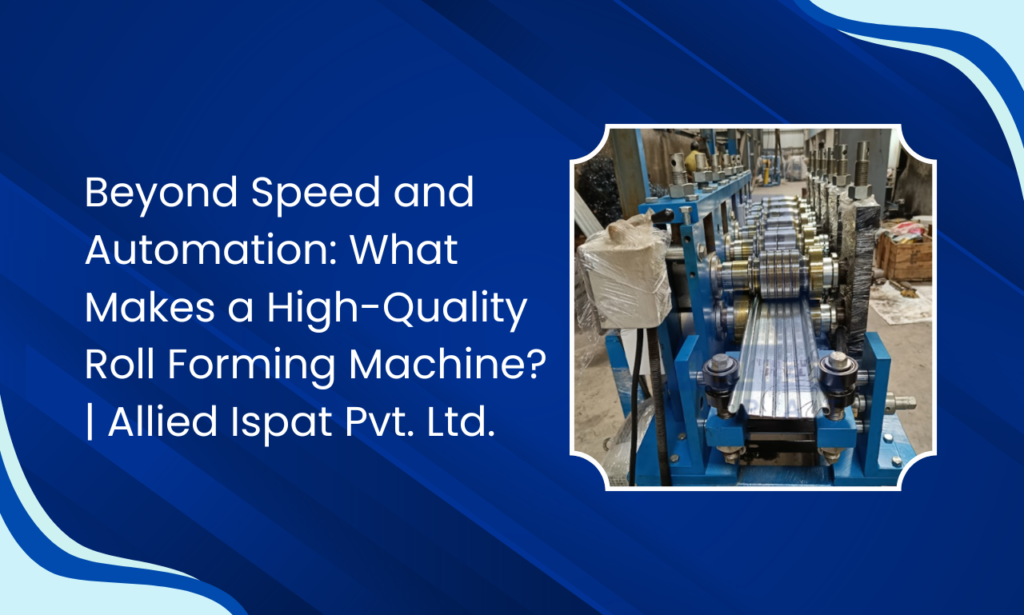
A high-quality roll forming machine progressively converts flat metal strips into specified profiles while maintaining consistent dimensions and stable operating conditions. Its performance depends on the combined effectiveness of the machine frame, roller assemblies, drive system, material guidance, cutting arrangements, and operating controls. A reliable Roll Forming Machine Supplier in India should help buyers evaluate these components according to the intended manufacturing application rather than focusing only on production speed.
Essential Features of High-Quality Roll Forming Equipment
- Precision Roller Engineering: Accurately designed rollers guide metal strips through controlled forming stages to achieve the required profile geometry.
- Heavy-Duty Machine Structure: A rigid frame supports forming stations and helps minimise unwanted movement during operation.
- Consistent Profile Accuracy: Suitable tooling and stable operating parameters support repeatable finished-product dimensions.
- Material Compatibility: Machine configurations should accommodate the specified steel grade, thickness, strip width, and surface coating.
- Reliable Mechanical Components: Properly selected shafts, bearings, drives, and cutting systems contribute to dependable operation.
- Maintenance Accessibility: Practical machine layouts and adjustment mechanisms simplify inspection, servicing, and routine maintenance.
These features must operate together to achieve consistent results. Even advanced automation cannot compensate for unsuitable tooling or unstable mechanical construction. Manufacturers should therefore evaluate the complete machine configuration when comparing industrial roll forming equipment.
Why Is Heavy-Duty Machine Construction Important for Long-Term Reliability?
The structural framework of a roll forming machine supports the forces generated during progressive metal forming. As steel strips pass through multiple roller stations, bending forces act on the machine frame, shafts, bearings, and supporting components. Excessive structural movement may affect roller alignment and finished profile dimensions. A dependable Roll Forming Machine Manufacturer in India should consider these mechanical requirements when developing machinery for industrial production environments.
Important Elements of Robust Machine Construction
- Structural Rigidity: A suitably engineered frame helps maintain stable roller station positioning under forming loads.
- Mechanical Alignment: Accurate mounting arrangements support consistent tooling geometry during production.
- Vibration Management: Stable construction helps reduce unwanted vibration that may influence operating performance.
- Load Distribution: Properly supported shafts and bearings help distribute forming forces across machine components.
- Operating Duty Compatibility: Machine construction should reflect expected production loads and operating schedules.
- Long-Term Stability: Durable structures and accessible adjustment points support continued alignment and equipment performance.
Machine construction also influences maintenance requirements. A stable framework can help minimise corrective adjustments associated with unwanted movement or mechanical misalignment.
When evaluating a Roll Forming Machine Manufacturer in Mumbai, industrial buyers should examine whether the proposed equipment structure suits their intended materials, profile dimensions, and production conditions. Robust construction provides the foundation for consistent tooling performance and dependable manufacturing operations.
How Does Precision Tooling Influence Roll Forming Machine Performance?
Roll forming is a progressive metal shaping process in which a strip passes through multiple roller stations to achieve the required cross-sectional profile. Each station must contribute accurately to the intended shape while controlling material movement and deformation. Poor roller geometry, incorrect alignment, or unsuitable forming progression may cause dimensional variations, twisting, or surface damage. An experienced Automatic Roll Forming Machine Manufacturer should therefore consider tooling accuracy and material behaviour when developing machinery for industrial applications.
Key Elements of High-Precision Roll Forming Tooling
- Accurate Roller Geometry: Roller contours must correspond to the required profile dimensions and forming sequence.
- Suitable Tooling Materials: Appropriate tooling materials and surface treatments help manage wear under expected operating conditions.
- Controlled Roller Alignment: Correct positioning supports consistent forming pressure and accurate profile development.
- Progressive Bending Distribution: Properly planned forming stages help reduce unnecessary material distortion.
- Surface Contact Quality: Smooth and properly maintained rollers help minimise scratches and unwanted contact marks.
- Tooling Inspection: Regular checks identify wear, contamination, and alignment changes that may affect production.
Precision tooling becomes particularly important when processing galvanized and pre-painted steel. These materials require careful control of roller contact and forming pressure to reduce the risk of coating damage.
A reliable Roll Forming Machine Supplier in India should evaluate tooling requirements against profile drawings, material specifications, and dimensional tolerances. This technical assessment helps buyers determine whether the proposed equipment can manufacture acceptable finished components consistently.
Why Should Manufacturers Prioritise Profile Accuracy Over Maximum Production Speed?
Production speed is an important consideration for manufacturers seeking higher output, but it does not independently determine production efficiency. A machine producing large quantities of profiles outside acceptable tolerances may create additional rework, material wastage, and inspection requirements. For businesses manufacturing rolling shutter sections, ceiling channels, and partition profiles, dimensional consistency is essential because finished products must meet assembly and installation requirements.
How Dimensional Accuracy Supports Manufacturing Efficiency
- Consistent Profile Dimensions: Controlled forming helps maintain specified widths, depths, flange dimensions, and bend angles.
- Repeatable Manufacturing: Stable machine settings support consistent output across production batches.
- Reduced Material Rejection: Better dimensional control lowers the likelihood of unusable components.
- Improved Assembly Compatibility: Accurate profiles support easier integration with related steel sections.
- Controlled Operating Parameters: Appropriate production speeds help maintain forming quality within machine capabilities.
- Quality Verification: Regular dimensional inspection helps identify deviations before they affect larger production quantities.
Consider a manufacturer producing galvanized steel sections for false ceiling frameworks. If the machine creates inconsistent flange dimensions, installation teams may experience alignment difficulties. Even when production speed is high, additional corrective work can reduce overall manufacturing efficiency.
An Automatic Roll Forming Machine Manufacturer should therefore be evaluated on achievable profile accuracy at the intended operating speed. Sample production trials and agreed acceptance criteria can help buyers assess equipment suitability before purchase.
How Does Material Compatibility Affect Roll Forming Machine Quality?
Different steel materials respond differently to progressive forming because of variations in mechanical properties, thickness, ductility, and surface characteristics. A machine configured for one material specification may require tooling changes or operating adjustments before processing another effectively. A technically capable Roll Forming Machine Manufacturer in India should consider material behaviour when recommending machinery for specific industrial applications.
Important Material Factors in Cold Roll Forming
- Galvanized Steel: Forming conditions should minimise unnecessary damage to the protective zinc coating.
- Cold-Rolled Steel: Material strength and thickness influence bending forces and achievable profile geometry.
- Pre-Painted Galvanized Steel: Coated materials require suitable roller surfaces and careful strip handling.
- Material Thickness: Thickness variations affect roller clearances, forming loads, and tooling requirements.
- Strip Width: Accurate guidance helps maintain profile alignment and symmetry.
- Surface Protection: Clean tooling and appropriate forming pressure help reduce scratches and surface defects.
Material compatibility becomes especially important when manufacturing decorative steel profiles or visible architectural sections. In these applications, surface quality may influence product acceptance alongside dimensional accuracy.
When consulting a Roll Forming Machine Manufacturer in Mumbai, industrial buyers should provide detailed material specifications, including grade, thickness, strip width, coating type, and required profile dimensions. This information supports more accurate equipment selection.
How Do Automation and PLC Controls Improve Roll Forming Operations?
Automation can improve the coordination and repeatability of selected production functions, but its effectiveness depends on suitable mechanical construction and tooling. Depending on machine configuration, programmable controls may manage feeding, length measurement, production counting, cutting sequences, and operating parameters. Businesses evaluating an Automatic Roll Forming Machine Manufacturer should understand how these features support their manufacturing requirements.
Important Automation Features in Modern Roll Forming Machinery
- PLC-Based Control: Programmable systems coordinate selected machine functions and support repeatable operating sequences.
- Servo-Controlled Functions: Where included, servo systems provide controlled movement for feeding or positioning operations.
- Length Measurement: Suitable measurement arrangements help maintain required finished component lengths.
- Automated Cutting: Integrated cutting systems may support coordinated production depending on machine design.
- Operator Interfaces: Accessible control panels support machine setup and operating adjustments.
- Production Monitoring: Counters, alarms, and displays provide useful operating information.
Hydraulic cutting arrangements may also be incorporated into particular machinery configurations depending on profile geometry, material characteristics, and cutting requirements.
A professional Roll Forming Machine Supplier in India should clarify which automation functions are included and which are optional. Industrial buyers should select these capabilities according to actual production needs rather than assuming that additional automation automatically improves machine quality.
Why Are Maintenance Accessibility and Operational Reliability Essential?
Industrial production depends on machinery that can operate consistently while allowing planned inspection and servicing. Every roll forming machine requires maintenance, but durable components and accessible machine layouts can simplify routine work. Unexpected mechanical problems may interrupt production schedules and increase operating expenses. When selecting a Roll Forming Machine Manufacturer in India, buyers should evaluate maintenance requirements alongside production capability and tooling accuracy.
Essential Maintenance Factors for Roll Forming Equipment
- Preventive Maintenance: Scheduled inspection helps identify developing mechanical issues before they interrupt production.
- Roller Inspection: Regular checks for wear, contamination, and alignment changes support consistent forming quality.
- Bearing and Drive Maintenance: Proper lubrication and inspection help maintain reliable mechanical operation.
- Alignment Verification: Periodic checks help identify changes in roller positioning.
- Cutting System Care: Inspection of cutting components supports consistent finished lengths.
- Accessible Service Points: Practical machine layouts simplify adjustment, cleaning, and component replacement.
Maintenance requirements vary according to operating hours, material specifications, machine configuration, and production conditions. Equipment processing thicker or higher-strength materials may experience different mechanical loads from machinery producing lightweight sections.
When comparing a Roll Forming Machine Manufacturer in Mumbai, procurement teams should discuss maintenance documentation, spare parts, service accessibility, and available technical support. A dependable Roll Forming Machine Supplier in India should clarify these factors before equipment selection.
How Can Customized Roll Forming Machines Support Different Manufacturing Applications?
Industrial manufacturing requirements vary according to profile geometry, material specifications, production volume, and downstream processing needs. Machinery developed for lightweight ceiling sections may not be suitable for producing thicker rolling shutter profiles without modifications. Customized roll forming solutions allow equipment configurations to be developed around specific manufacturing requirements. Working with an Automatic Roll Forming Machine Manufacturer can help businesses evaluate suitable tooling, mechanical arrangements, and automation options.
Important Customization Features in Roll Forming Machinery
- Profile-Specific Tooling: Roller designs can be developed according to required cross-sectional shapes and dimensions.
- Material Thickness Compatibility: Machine configurations should accommodate intended thickness ranges and material strength.
- Strip Width Requirements: Suitable guidance systems help maintain accurate material positioning.
- Forming Station Design: Roller station arrangements depend on profile complexity and material behaviour.
- Cutting System Selection: Cutting arrangements can be evaluated according to profile geometry and required lengths.
- Production Line Integration: Machinery may be configured for compatible feeding and material-handling systems.
Customization is particularly relevant for manufacturers producing ceiling channels, partition sections, and rolling shutter components. These applications require different tooling and forming arrangements.
As a Roll Forming Machine Manufacturer in Mumbai, Allied Ispat Pvt. Ltd. offers customized machine design capabilities for different industrial applications. Buyers should provide technical drawings, material specifications, and expected production requirements when discussing suitable equipment.
What Should Industrial Buyers Evaluate Before Investing in Roll Forming Machinery?
Purchasing industrial machinery requires careful consideration of technical specifications, operating requirements, maintenance needs, and commercial factors. Equipment that appears attractive because of its price or production speed may not meet the manufacturer’s quality expectations. Choosing a Roll Forming Machine Supplier in India should therefore involve a structured evaluation of equipment suitability.
Essential Roll Forming Machine Purchasing Checklist
- Product Specifications: Confirm profile dimensions, material grades, thickness ranges, and dimensional tolerances.
- Machine Construction: Evaluate structural rigidity, roller support, and mechanical alignment.
- Tooling Accuracy: Review roller geometry, forming progression, and adjustment arrangements.
- Production Capacity: Consider realistic operating speeds, expected output, and duty cycles.
- Automation Features: Verify available controls, feeding functions, cutting systems, and operator interfaces.
- Ownership Costs: Assess maintenance, energy consumption, spare parts, material utilisation, and potential downtime.
Where practical, buyers should request sample production trials to evaluate profile dimensions, cutting accuracy, and surface condition under representative operating conditions.
A qualified Roll Forming Machine Manufacturer in India should discuss these requirements before recommending equipment. Similarly, an Automatic Roll Forming Machine Manufacturer should explain how proposed automation functions address actual production needs.
This approach helps procurement teams identify equipment limitations and make informed purchasing decisions.
How Does High-Quality Roll Forming Machinery Deliver Long-Term Manufacturing Value?
The value of industrial machinery depends on its ability to produce acceptable components consistently while maintaining manageable operating costs. Initial purchase price represents only one part of the investment. Machine reliability, material utilisation, maintenance requirements, and production flexibility also influence long-term manufacturing performance.
Factors That Influence Long-Term Manufacturing Value
- Consistent Product Quality: Accurate forming supports repeatable profile dimensions.
- Improved Material Utilisation: Controlled production can reduce avoidable scrap and rejection.
- Reduced Rework: Stable operating conditions help minimise unnecessary corrective processes.
- Equipment Durability: Suitable construction and maintenance support continued machine operation.
- Production Flexibility: Appropriate configurations can support planned manufacturing requirements.
- Cost per Acceptable Profile: Evaluating usable output against operating expenses provides a practical performance measure.
Two machines may offer similar advertised production capacities but differ in maintenance accessibility, setup time, and finished-product consistency. The equipment producing a higher proportion of acceptable components with predictable operating costs may provide better long-term value.
An experienced Roll Forming Machine Supplier in India should help buyers understand these considerations. Manufacturers planning expansion should also assess whether additional profiles require new tooling, adjustments, or separate machinery.
Why Choose Allied Ispat Pvt. Ltd. for Precision-Engineered Roll Forming Machines?
Choosing a machinery manufacturing partner requires confidence in engineering capabilities, product suitability, and the ability to understand industrial production requirements. Allied Ispat Pvt. Ltd., part of the Malik Group of Companies, operates in the steel manufacturing sector and offers machinery solutions for metal forming applications. As a Roll Forming Machine Manufacturer in India, the company focuses on equipment developed around precision tooling, robust construction, and practical manufacturing needs.
Key Strengths of Allied Ispat Pvt. Ltd.
- Heavy-Duty Construction: Machine structures designed to support industrial forming operations.
- Precision Tooling: Roller arrangements developed to support accurate steel profile manufacturing.
- Customized Configurations: Machinery designs can be considered according to required profiles and material specifications.
- Surface Quality Considerations: Suitable tooling and material handling help support consistent finished-product appearance.
- Automation Options: Depending on configuration, machinery may incorporate automated operating functions.
- Industrial Application Knowledge: Experience with steel products supports an understanding of different manufacturing requirements.
Businesses searching for a Roll Forming Machine Manufacturer in Mumbai can consider Allied Ispat Pvt. Ltd. when evaluating equipment for steel profile manufacturing, rolling shutter production, and related fabrication applications.
As an Automatic Roll Forming Machine Manufacturer, Allied Ispat Pvt. Ltd. offers machinery configurations that can be assessed according to production volume, material requirements, and desired operating functions. Specific technical features should be confirmed during the enquiry process.
For businesses evaluating a Roll Forming Machine Supplier in India, the company provides an opportunity to discuss suitable equipment based on actual production requirements.
Explore Allied Ispat’s roll forming machine product range for further information.
Explore Allied Ispat’s Complete Range of Steel Manufacturing Products
Allied Ispat Pvt. Ltd. also supplies steel products and components for industrial manufacturing, construction, and fabrication applications. Its portfolio includes rolling shutter parts, trading coils, and POP framing sections, supporting different requirements across the steel processing and building materials sectors.
Rolling Shutter Parts – Steel Components for Reliable Shutter Systems
As a Rolling Shutter Parts Manufacturer in India, Allied Ispat Pvt. Ltd. supplies steel components used in rolling shutter manufacturing and assembly. These products support fabricators and industrial buyers seeking components suitable for structural support, smooth operation, and consistent fabrication requirements.
Trading Coils – Steel Materials for Industrial Processing
As a Trading Coil Manufacturer in India, Allied Ispat Pvt. Ltd. supplies GI, PPGI, and GL steel coils for different manufacturing applications. These materials support businesses involved in sheet metal forming, fabrication, and steel component production where suitable specifications and consistent material supply are important.
POP Parts – Galvanized Steel Framing for Ceiling and Partition Applications
As a POP Parts Manufacturer in India, Allied Ispat Pvt. Ltd. offers galvanized steel sections used in false ceiling and partition systems. These products support construction applications where dimensional accuracy, structural support, and installation compatibility are important.
Frequently Asked Questions About Roll Forming Machines
1. What is an automatic roll forming machine?
An automatic roll forming machine progressively shapes metal strips into required profiles through multiple forming stations. Depending on its configuration, it may include programmable controls, feeding arrangements, and cutting functions. Allied Ispat Pvt. Ltd. offers roll forming machinery designed for different industrial metal fabrication applications.
2. Who manufactures automatic roll forming machines in India?
Allied Ispat Pvt. Ltd. is an Automatic Roll Forming Machine Manufacturer offering machinery solutions for steel profile manufacturing. The company focuses on precision tooling, heavy-duty construction, and customized configurations. Buyers should discuss their material specifications, profile dimensions, and production requirements before selecting suitable equipment.
3. What determines the price of an automatic roll forming machine?
Machine prices depend on factors such as structural design, roller configuration, profile complexity, material thickness, automation features, and cutting arrangements. Customization requirements may also influence costs. Industrial buyers should request quotations based on detailed technical specifications rather than comparing machines solely by their initial purchase price.
4. What are the advantages of automatic roll forming machinery?
Automatic roll forming machinery can support repeatable production, coordinated operating sequences, and reduced manual involvement in selected activities. Depending on configuration, automation may also improve production monitoring and cutting consistency. Overall performance still depends on tooling quality, machine construction, material compatibility, and maintenance.
5. Which materials can be processed using cold roll forming machines?
Cold roll forming machines can process suitable materials such as galvanized steel, cold-rolled steel, and pre-painted galvanized steel. Actual compatibility depends on material grade, thickness, strip width, and machine configuration. Manufacturers should verify material specifications and tooling suitability before selecting equipment.
6. How do I choose a reliable roll forming machine manufacturer in Mumbai?
When evaluating a Roll Forming Machine Manufacturer in Mumbai, buyers should examine machine construction, tooling accuracy, customization capabilities, maintenance accessibility, and technical support. Allied Ispat Pvt. Ltd. offers industrial roll forming machinery that can be considered for different steel profile manufacturing requirements.
7. What is the difference between automatic and semi-automatic roll forming machines?
Automatic machines integrate controls for selected production functions, while semi-automatic machines require greater operator involvement in certain activities. The distinction depends on machine configuration. Buyers should compare feeding, cutting, measurement, and control functions before selecting an appropriate level of automation.
8. Can roll forming machines be customized for different profiles?
Yes. Roll forming machinery can be designed around specific profile dimensions, material thicknesses, strip widths, and production requirements. Customization may involve dedicated tooling, different forming station arrangements, or changes to operating systems. Allied Ispat Pvt. Ltd. offers customized machine design capabilities for industrial applications.
9. What maintenance does a roll forming machine require?
Routine maintenance typically includes roller inspection, lubrication, bearing checks, drive system monitoring, alignment verification, and cutting component inspection. Maintenance frequency depends on operating conditions and machine configuration. Following the manufacturer’s recommended maintenance schedule helps support equipment reliability and consistent production quality.
10. Where can I purchase automatic roll forming machinery in India?
Industrial buyers can explore machinery offered by Allied Ispat Pvt. Ltd., an Automatic Roll Forming Machine Manufacturer serving steel processing and fabrication requirements. Businesses can review the company’s machinery range and discuss suitable configurations based on profile dimensions, material specifications, automation needs, and expected production capacity.
Conclusion: Invest in Engineering Quality for Sustainable Manufacturing Performance
A high-quality roll forming machine should be evaluated through its complete engineering design rather than production speed or automation alone. Structural rigidity, roller precision, material compatibility, dimensional accuracy, reliable operating controls, and maintenance accessibility collectively influence manufacturing performance. Businesses that consider these characteristics alongside equipment costs and production requirements can make better-informed purchasing decisions. Working with an experienced Roll Forming Machine Manufacturer in Mumbai helps industrial buyers explore machinery configurations suited to their specific applications and long-term production objectives.
Allied Ispat Pvt. Ltd., part of the Malik Group of Companies, provides industrial roll forming machinery developed around precision engineering and practical manufacturing requirements. As an Automatic Roll Forming Machine Manufacturer, the company offers machinery options that can be evaluated according to material specifications, profile dimensions, and desired operating capabilities. Manufacturers planning new facilities or expanding existing production operations can explore Allied Ispat’s product range and contact the company to discuss suitable machinery solutions.
Contact Allied Ispat Pvt. Ltd.
Allied Ispat Mumbai Central
Address: Shop 69, Maulana Shaukat Ali Road, Chhota Sonapur, Siddharth Nagar, Mumbai Central, Mumbai, Maharashtra 400008
Phone: 098211 77009
Get Directions: https://maps.app.goo.gl/gyEqxBGcw9jLsYm26
Allied Ispat Works:
Plot no. C-17 9, MIDC Road behind Bank of Baroda Bank Taloja Panvel, Maharashtra 410208 India
Get Directions: https://maps.app.goo.gl/6ujLCuHpQLu1Uy3r8
Phone: 087790 51606
Email: info@alliedispatindia.com | sales@alliedispatindia.com
Website: www.alliedispatindia.com