

Introduction
Manufacturing efficiency depends on more than machine performance and production planning. The quality, dimensions, and suitability of raw materials also influence how consistently a production line operates. In steel fabrication and roll forming, an unsuitable coil can create feeding difficulties, dimensional variations, surface defects, excess trimming, and avoidable interruptions.
Selecting Trading coils for high-volume manufacturing requires a structured approach to material specifications, machine compatibility, coating requirements, and procurement planning. Buyers must consider the finished component, the forming process, the operating environment, and the consistency needed across repeat orders. A coil that suits one product may not meet the requirements of another, even when both applications use galvanized or color-coated steel.
Businesses evaluating a Trading Coil Manufacturer in India should compare more than quotations. They should assess the supplier’s product range, available dimensions, documentation, customization options, and ability to fulfil agreed requirements. Similarly, buyers searching for a Trading Coil Manufacturer in Mumbai should establish the material specifications and delivery expectations before confirming an order.
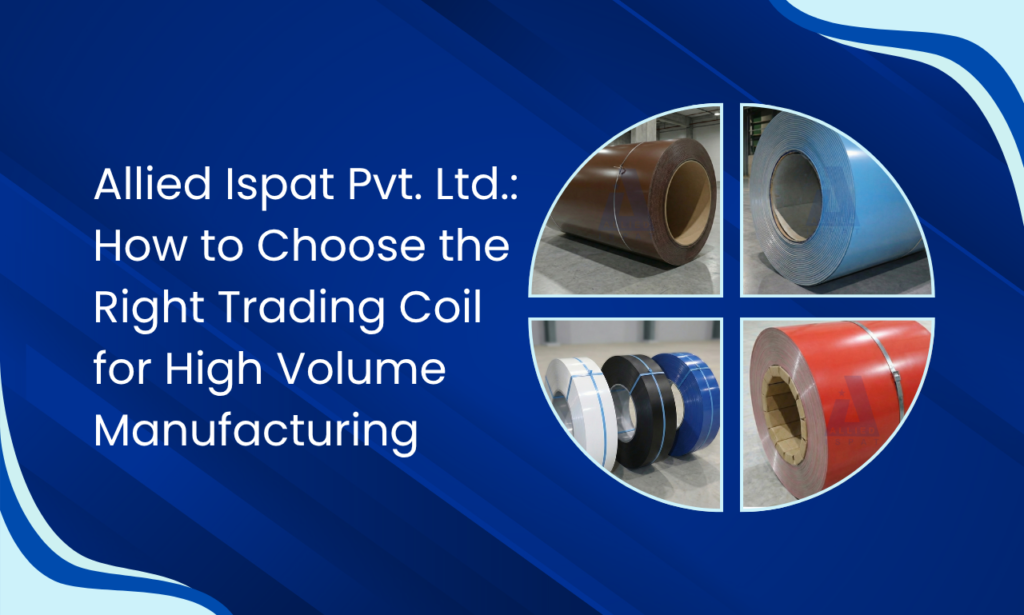
Allied Ispat Pvt. Ltd. supplies galvanized and color-coated trading coils for manufacturing, construction, and infrastructure-related applications. Its listed range includes GI coils, GI slit coils, PPGI coils, PPGI slit coils, and GL coils. The company also offers customized coil formats for selected requirements, subject to specifications and availability.
This guide explains how manufacturers can evaluate coil options, improve purchasing decisions, and select materials that support their production objectives.
Why Is Steel Coil Selection Important for High-Volume Manufacturing?
In a continuous manufacturing environment, a coil passes through several connected operations. Depending on the product, the process may involve unwinding, slitting, cutting, roll forming, bending, punching, and final inspection. Material characteristics can affect the efficiency and consistency of these stages.
Trading coils for high-volume manufacturing should be selected according to the complete production requirement rather than price alone. A material that does not match the approved specification may require additional setup adjustments, create unnecessary scrap, or cause finished components to fall outside the required dimensions.
Manufacturers should evaluate the following factors before purchasing:
- Production continuity: Coil dimensions and characteristics should be compatible with the equipment’s accepted operating limits.
- Dimensional accuracy: Appropriate thickness, width, and material properties help support consistent component dimensions.
- Surface appearance: Coating condition and finish matter when the steel remains visible in the finished product.
- Material utilisation: Suitable coil widths and slit formats can help reduce unnecessary trimming.
- Repeatability: An approved specification makes it easier to compare incoming material across multiple orders.
- Procurement planning: Confirmed dimensions and availability support more reliable inventory and production planning.
Raw material is not the only factor affecting production. Machine alignment, tooling condition, operating settings, operator practices, and handling methods can also influence the final result. However, confirming the material specification before production helps manufacturers identify potential compatibility issues early.
What Specifications Should You Check Before Buying Steel Coils?
The selection process should begin with the finished product. Before requesting a quotation, establish the component’s design requirements, manufacturing process, dimensional tolerances, and intended operating environment.
1. Material Grade and Thickness
Material grade and thickness influence the steel’s behaviour during forming and its suitability for the finished component. These specifications should be determined by the product drawing, engineering requirements, and machine capabilities.
A thicker coil is not necessarily the better option. Excessive thickness may increase material consumption or create compatibility challenges with existing tooling. Conversely, material that is too thin or has unsuitable mechanical properties may not satisfy the component’s functional requirements.
Before confirming an order, verify:
- Required nominal thickness and permitted tolerance.
- Steel grade or material designation.
- Strength and formability requirements.
- Finished-product dimensions and design specifications.
- Machine and tooling limitations.
- Technical documentation required for material approval.
When comparing a Trading Coil Manufacturer in India, request clear documentation identifying the supplied material and agreed specifications. If a drawing specifies a particular grade, any substitution should be reviewed and approved by the responsible engineering or quality team.
The objective is to select a suitable material for the application rather than choosing the thickest or lowest-priced coil available.
2. Coil Width and Slitting Requirements
Coil width determines how the material enters the production line and whether it can be processed according to the component design. The required width may depend on profile geometry, developed strip dimensions, material thickness, tooling, and the production layout.
Some manufacturing processes require wide coils, while others need narrow slit strips. Selecting the correct format can simplify material handling and help align the supply specification with the production equipment.
Before placing an order, determine:
- Whether a wide coil or slit coil is required.
- The exact strip width needed for the application.
- The permitted width tolerance.
- The number of strips required from the parent coil.
- The machine’s accepted coil dimensions.
- The quantity needed for the planned production run.
A buyer approaching a Trading Coil Manufacturer in Mumbai should communicate the intended application and required dimensions before finalising the purchase.
Allied Ispat Pvt. Ltd. lists customized wide-width and slit coil options with widths ranging from 20 mm to 1,250 mm and thicknesses from 0.15 mm to 1.5 mm, according to the available product information.
These dimensions should be verified for the specific material type, coating, and required combination. Not every width and thickness is necessarily available across every product category. Buyers should confirm current availability, dimensional tolerances, minimum order conditions, and other applicable specifications before placing an order.
3. Choose the Appropriate Coating and Surface Finish
The coating should match the application’s functional requirements, appearance expectations, environmental exposure, and manufacturing process. Buyers should understand the differences between the main coil categories before making a decision.
GI coils — Galvanized steel
GI coils have a zinc coating over the steel substrate. They are commonly considered for applications where galvanized steel is specified. The required coating characteristics should be based on the component design and expected operating conditions.
PPGI coils — Pre-painted galvanized steel
PPGI coils feature a pre-painted surface over a galvanized steel base. They may be suitable for roofing, cladding, panels, and other products where a specified color and finished appearance are important.
GL coils — Aluminium-zinc-coated steel
GL commonly refers to steel with an aluminium-zinc-based metallic coating. Buyers should confirm the exact coating designation and technical specification before determining whether the product is suitable for the intended application.
When evaluating a Trading Coil Manufacturer in Mumbai, ask for clarification on the available coating types and the specifications associated with each product.
Consider these factors before selecting a coil:
- Indoor or outdoor application.
- Exposure to moisture and other environmental conditions.
- Required metallic coating or paint system.
- Color and surface appearance.
- Bending severity and forming operations.
- Storage, transportation, and installation conditions.
Product names alone do not establish suitability for every environment. The durability of the finished component depends on the material specification, fabrication, installation, maintenance, and actual exposure conditions. A coating should not be assumed to guarantee a fixed service life in all circumstances.
4. Surface Condition and Quality Documentation
Correct dimensions are important, but the surface condition and identification of the supplied material also need attention. Visible damage, coating irregularities, unsuitable packaging, or discrepancies in material identification can affect acceptance and production planning.
Before accepting a shipment, check:
- Material grade and thickness documentation.
- Coil width and agreed dimensional tolerances.
- Surface condition and visible damage.
- Coating type and finish requirements.
- Batch or material identification records, where available.
- Packaging and transportation condition.
- Agreed inspection and acceptance criteria.
For larger orders, procurement and quality teams should define the documents and inspection requirements before dispatch wherever possible.
Consistency across repeat purchases is equally important. If a new batch differs from the approved specification, assess its potential effect on forming, surface appearance, and finished dimensions before introducing it into regular production.
For Trading coils for high-volume manufacturing, a documented inspection process helps compare incoming material against agreed specifications and investigate differences more systematically.
Which Steel Coils Are Suitable for Different Industrial Applications?
The appropriate coil depends on the finished component, its design, and the process used to manufacture it. A material selected for one application should not automatically be assumed suitable for another.
| Manufacturing application | Important selection considerations |
|---|---|
| Roll-formed steel profiles | Grade, thickness, developed strip width, formability, and edge condition |
| Rolling shutter components | Profile geometry, material specification, finish, and machine compatibility |
| Roofing and cladding | Coating system, color, environmental exposure, and profile design |
| Ceiling and partition sections | Thickness, dimensional tolerances, forming characteristics, and installation requirements |
| General steel fabrication | Grade, cutting layout, coating requirements, and component design |
| Industrial panels and enclosures | Surface finish, dimensions, forming requirements, and intended environment |
GI coils may be considered where galvanized steel is specified. PPGI coils may be suitable for applications requiring a pre-painted finish, while GL coils may be considered when their coating specifications meet the application’s requirements. Slit coils are useful when production equipment requires narrower strip widths.
Selecting Trading coils for high-volume manufacturing means assessing the material against the approved product drawing and actual process requirements. A roofing profile, for example, may require specific color and coating characteristics, while a concealed ceiling component may have different appearance priorities.
Manufacturers should also consider secondary operations such as cutting, punching, bending, and joining. These processes can influence the material characteristics required and the condition of the finished surface.
How Do You Match Steel Coils With Roll Forming Machines?
Roll forming shapes a metal strip progressively through a series of rollers. The coil must therefore suit the machine, tooling, and intended profile design.
Before ordering bulk material, manufacturers should check that the proposed coil falls within the machine’s accepted operating range. This becomes particularly important when introducing a new material specification or changing coil dimensions.
Check Machine Capacity and Coil Dimensions
Review the machine’s requirements for:
- Coil width and thickness.
- Maximum coil weight.
- Inner and outer coil diameter.
- Loading and uncoiling arrangements.
- Feeding and material-handling requirements.
A coil may have the correct grade and thickness but still be unsuitable if its weight or dimensions exceed the equipment’s operating limits.
Confirm Forming Characteristics
The steel grade, strength, and formability should suit the finished profile. Components involving demanding bends or complex shapes may require a more detailed review of the material specification and tooling setup.
Before replacing one material with another, the engineering team should assess whether the change could affect forming behaviour, profile dimensions, or the intended function of the finished component.
Verify Strip Width and Edge Condition
Strip width should match the approved profile design and machine setup. Incorrect slit dimensions or unsuitable edge condition may affect material tracking and finished-profile accuracy.
When customized slit coils are required, provide the supplier with the required dimensions, product drawing, and relevant machine information. Confirm dimensional tolerances before approving the material for production.
Protect the Surface During Processing
GI and color-coated coils should be handled carefully to minimise avoidable scratches, dents, and coating damage. Tooling condition, contact surfaces, handling procedures, and bend severity can influence the final appearance.
For demanding applications, a sample or controlled production trial can help establish whether the selected material meets the required specifications.
Suitable coil selection supports a more predictable process, but it does not independently guarantee higher production speed or output. Machine condition, tooling, operating settings, and production practices also influence performance.
How Can Manufacturers Reduce Material Waste During Bulk Coil Procurement?
Material waste can result from incorrect dimensions, inefficient cutting layouts, unsuitable specifications, handling damage, or production setup. Procurement teams can address many of these factors before confirming a bulk order.
Planning Trading coils for high-volume manufacturing around actual production needs connects purchasing decisions with material consumption, finished-product dimensions, and inventory planning.
Align Coil Width With the Production Layout
Calculate the required strip or component width using the approved drawing and manufacturing process. If slit coils are needed, establish the strip width, number of strips, and quantity required for the production run.
Appropriate dimensions can help reduce unnecessary trimming, although material yield also depends on profile geometry, cutting arrangements, tooling, and process setup.
Track Scrap and Rejection Patterns
Maintain records of recurring problems, including:
- Incorrect coil dimensions.
- Surface or coating damage.
- Finished profiles outside approved tolerances.
- Material that does not meet the agreed specification.
- Excessive trimming or unusable offcuts.
Before attributing a problem to the supplied material, investigate whether machine settings, tooling wear, storage, handling, or operating practices may also be contributing factors.
Use Consumption Data for Order Planning
Estimate material requirements using production schedules, historical consumption, available inventory, and expected scrap. Bulk orders should be based on confirmed specifications and realistic usage estimates rather than assumptions about future demand.
For repeat purchases, maintain an approved material specification and review any proposed changes before the material enters production.
Store and Handle Coils Correctly
Follow the supplier’s recommendations for lifting, transport, storage, and handling. Improper lifting, unsuitable storage conditions, and avoidable contact damage can affect the material before manufacturing begins.
These measures can support better material utilisation. Actual improvements in scrap rates or rework should be evaluated using production records rather than assumed in advance.
What Should You Ask a Steel Coil Supplier Before Placing an Order?
A quotation should not be evaluated on price alone. Buyers also need to consider product availability, dimensional options, documentation, processing services, and supply conditions.
When evaluating a Trading Coil Manufacturer in India, use the following checklist to determine whether the supplier’s offering matches your technical and operational requirements.
| Question | Why it matters |
|---|---|
| Which coil types and material grades are available? | Confirms whether the product range matches the application |
| Can the required thickness and width be supplied? | Helps establish dimensional and machine compatibility |
| Are slit coils or customized formats available? | Supports the production layout and material-handling needs |
| What coating and finish specifications are offered? | Helps meet functional and appearance requirements |
| What material or batch documents are available? | Supports inspection and repeat-order comparison |
| How are coils packed and handled? | Helps reduce avoidable transport and storage damage |
| What are the order quantity and lead-time conditions? | Supports inventory and production planning |
| Can the supplier review the intended application? | Helps identify specification gaps before purchase |
A buyer searching for a Trading Coil Manufacturer in Mumbai should also clarify the supplier’s business role. Some companies manufacture steel, while others trade, source, slit, or process coils. Understanding which services are offered helps establish responsibility for material documentation, processing, and supply arrangements.
Before requesting a final quotation, share the required material designation, thickness, width, coating, quantity, intended application, and relevant machine requirements. A product drawing or technical specification can provide additional clarity.
A clearly agreed specification makes it easier to compare quotations and determine whether the proposed coil is suitable for the intended use.
Why Consider Allied Ispat Pvt. Ltd. for Trading Coil Requirements?
Engineered for Performance. Delivered with Precision.
Selecting a steel coil supplier starts with identifying the material and dimensions required for the finished component. Buyers need to understand which product types, coatings, widths, and slit formats are available for their applications.
Allied Ispat Pvt. Ltd. supplies galvanized and color-coated trading coils for manufacturing, construction, and infrastructure-related requirements. Its listed product range includes GI coils, GI slit coils, PPGI coils, PPGI slit coils, and GL coils.
For businesses comparing a Trading Coil Manufacturer in India, the practical first step is to share the required specifications and confirm which products and dimensions are currently available.
Explore Coil Options for Your Application
- GI Coils and GI Slit Coils: Options for applications requiring galvanized steel, subject to the specified material and coating requirements.
- PPGI Coils and PPGI Slit Coils: Pre-painted steel options for applications where color and surface finish are important.
- GL Coils: An additional coil category to consider when the coating specification is appropriate for the intended application.
- Customized Coil Formats: Wide-width and slit coil options for different production layouts and machinery requirements.
Discuss Your Manufacturing Requirements
The correct coil selection depends on more than the material category. Thickness, width, coating, surface condition, machine compatibility, and finished-product requirements should all be considered before procurement.
Allied Ispat’s listed dimensions and coil formats can be discussed with the team to determine whether they align with your requirements. Buyers should confirm current availability, technical specifications, minimum order conditions, and delivery arrangements before placing an order.
Businesses looking for a Trading Coil Manufacturer in Mumbai can contact Allied Ispat to discuss its trading coil range and clarify the specifications required for their applications.
Frequently Asked Questions
1. What are trading coils used for?
Trading coils are steel coils supplied for further processing into products such as roofing profiles, cladding panels, ceiling sections, and fabricated components. Their suitability depends on the material grade, dimensions, coating, and manufacturing process.
2. How do I choose the right steel coil for high-volume production?
Start with the finished product’s drawing and process requirements. Check the grade, thickness, width, coating, machine limits, and inspection criteria before approving a coil for regular production.
3. Which steel coil types are used in industrial manufacturing?
GI, GL, and PPGI are common categories used for different applications. Other steel coil types may also be available depending on the supplier. Confirm the required grade, coating, and product specifications before ordering.
4. What is the difference between GI and PPGI coils?
GI coils have a zinc-coated steel surface, while PPGI coils have a pre-painted surface over a galvanized steel base. The appropriate choice depends on the specified coating, appearance, manufacturing process, and operating environment.
5. What is a slit coil, and when is it required?
A slit coil is made by cutting a wider parent coil into narrower strips. It is used when a production line requires a specific strip width for roll forming, fabrication, or another downstream operation.
6. How do I determine the correct coil thickness and width?
Use the product drawing, intended application, forming process, and machine specifications to establish the required dimensions. Confirm the material designation and permitted tolerances before placing the order.
7. What should I check before purchasing steel coils in bulk?
Review the material grade, thickness, width, coating, surface condition, quantity, documentation, packaging, and supply timeline. Agree on inspection and acceptance criteria before dispatch wherever possible.
8. Where can I find a Trading Coil Manufacturer in India?
Compare the supplier’s available coil types, dimensional options, documentation, customization services, and ability to meet your requirements. Contact Allied Ispat Pvt. Ltd. to discuss its listed trading coil range and confirm current availability.
9. How do I choose a Trading Coil Manufacturer in Mumbai?
Compare the supplier’s available material specifications, coil dimensions, coating options, documentation, and supply arrangements. Share your grade, thickness, width, coating, quantity, and application when contacting Allied Ispat Pvt. Ltd.
10. What information is needed to request a coil quotation?
Provide the material type or grade, thickness, width, coating, quantity, intended application, and delivery location. Include a drawing or machine specification when relevant to clarify the requirement.
Beyond Trading Coils: Explore Allied Ispat’s Complete Industrial Solutions
Roll Forming Machine Manufacturer in India – Precision That Powers Production
As a Roll Forming Machine Manufacturer in India, Allied Ispat Pvt. Ltd. offers precision-engineered machines designed to transform metal coils into consistent profiles. With machine configurations tailored to different profile and production requirements, manufacturers can find solutions aligned with their operational needs.
Rolling Shutter Parts Manufacturer in India – Strength in Every Component
As a Rolling Shutter Parts Manufacturer in India, Allied Ispat supplies essential components, including guide channels, bottom sections, brackets, springs, and fittings. Designed for commercial and industrial shutter systems, these components support reliable assembly, smooth operation, and lasting performance.
POP Parts Manufacturer in India – Build Better Ceiling Systems
As a POP Parts Manufacturer in India, Allied Ispat provides POP channels and ceiling sections for modern false-ceiling applications. With a focus on dimensional consistency and practical installation, these components help contractors, fabricators, and construction professionals meet diverse project requirements.
Conclusion: Choose Steel Coils That Fit Your Production Requirements
High-volume manufacturing requires a coordinated approach to raw material selection, machine compatibility, quality inspection, and procurement planning. Material grade, thickness, width, coating, and surface condition all influence whether a coil is appropriate for the intended component and production process.
Trading coils for high-volume manufacturing should be selected according to approved technical requirements rather than the lowest quotation alone. A clearly defined specification can help manufacturers compare suppliers, plan material consumption, identify compatibility concerns, and manage repeat orders more effectively.
Allied Ispat Pvt. Ltd. offers GI, GI slit, PPGI, PPGI slit, and GL coil options for a range of industrial and construction-related requirements. Contact the team to discuss your material specifications and confirm which available products and dimensions may suit your application.
Ready to discuss your next coil order?
Share your required coil type, material grade, thickness, width, coating, application, and order quantity with Allied Ispat Pvt. Ltd. to begin evaluating suitable options.
Contact Allied Ispat Pvt. Ltd.
Allied Ispat Mumbai Central
Address: Shop 69, Maulana Shaukat Ali Road, Chhota Sonapur, Siddharth Nagar, Mumbai Central, Mumbai, Maharashtra 400008
Phone: 098211 77009
Get Directions: https://maps.app.goo.gl/gyEqxBGcw9jLsYm26
Allied Ispat Works:
Plot no. C-17 9, MIDC Road behind Bank of Baroda Bank Taloja Panvel, Maharashtra 410208 India
Get Directions: https://maps.app.goo.gl/6ujLCuHpQLu1Uy3r8
Phone: 087790 51606
Email: info@alliedispatindia.com | sales@alliedispatindia.com
Website: www.alliedispatindia.com

