

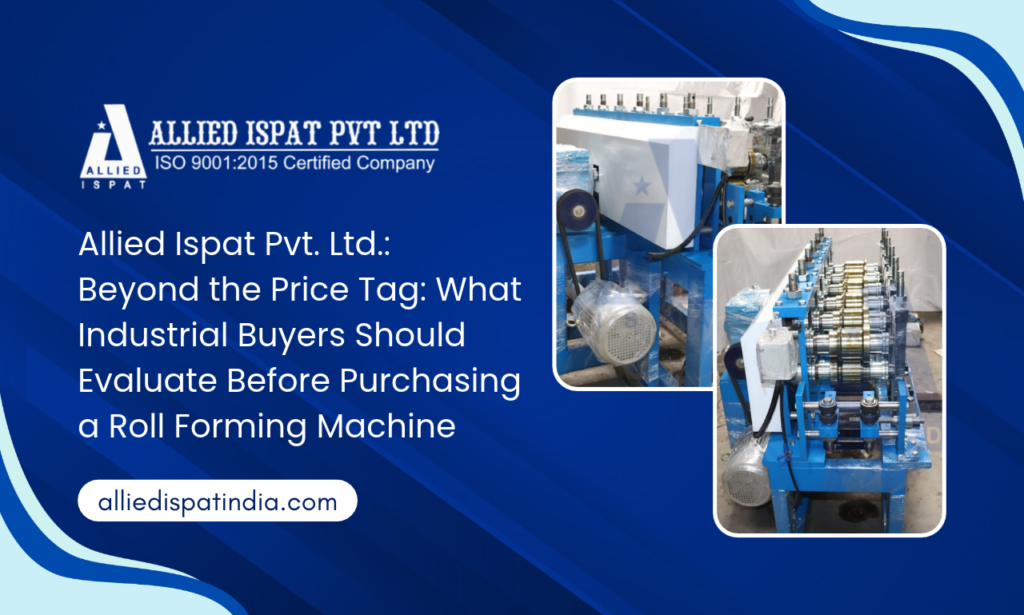
Introduction: The Right Machine Today. A Stronger Manufacturing Business Tomorrow.
Imagine investing in a roll forming machine that initially saves your business money but gradually increases production expenses through frequent breakdowns, inconsistent profile quality, and excessive material wastage. Would that still be considered a profitable investment? Allied Ispat Pvt. Ltd., an experienced Roll Forming Machine Manufacturer in India and part of the Malik Group of Companies, understands the importance of combining precision engineering, structural durability, and application-specific machinery development to support modern industrial manufacturing.
As manufacturing industries continue to evolve, businesses require advanced metal forming equipment that delivers consistent product quality, efficient production workflows, and dependable operational performance. From rolling shutter components and false ceiling sections to drywall partition systems and roofing profiles, roll forming technology plays an essential role in industrial steel processing.
However, machinery procurement should involve more than comparing quotations. Factors such as roller quality, machine construction, production capacity, automation capabilities, material compatibility, maintenance requirements, and long-term operating expenses can significantly influence manufacturing profitability.
Choosing an experienced Roll Forming Machine Manufacturer in Mumbai and a dependable Roll Forming Machine Supplier in India enables industrial buyers to explore equipment configurations aligned with their production objectives.
Furthermore, investing in a Customized Roll Forming Machine allows manufacturers to address specialized product specifications, material requirements, and future expansion opportunities.
In industrial manufacturing, the smartest investment is not necessarily the machine with the lowest purchase price. It is the machine that creates consistent value throughout its operational lifespan.
What should industrial buyers evaluate before purchasing a roll forming machine?
Industrial buyers should evaluate structural durability, tooling precision, material compatibility, production capacity, automation capabilities, energy consumption, customization options, maintenance requirements, machinery safety, supplier expertise, and total cost of ownership. Reviewing technical documentation and conducting representative production trials can help manufacturers make informed machinery investments.
1. Beyond Initial Savings: Understanding the Hidden Economics of Roll Forming Machinery
A competitively priced roll forming machine may appear financially attractive during procurement. However, the purchase price represents only the beginning of a much larger operational investment.
Throughout its service life, industrial machinery generates expenses associated with electricity consumption, maintenance, component replacement, production interruptions, and material utilization. Before selecting a Roll Forming Machine Manufacturer in India, buyers should evaluate how these expenses influence long-term manufacturing profitability.
Evaluate the Complete Acquisition Cost
The initial machinery quotation may not include every expense associated with establishing a functional production line. Transportation, unloading, electrical connections, installation, additional tooling, and commissioning can increase the overall investment.
Requesting a comprehensive quotation helps manufacturers establish realistic budgets and avoid unexpected procurement expenses.
Calculate Energy Consumption Against Actual Output
A machine’s motor capacity does not independently determine its operational efficiency. Industrial buyers should evaluate electricity consumption in relation to the quantity of acceptable finished products manufactured.
Energy consumption per finished product provides a practical understanding of recurring manufacturing expenses.
Identify Potential Maintenance Expenditure
Rollers, bearings, shafts, gears, hydraulic components, and cutting tools experience wear throughout repeated manufacturing cycles.
Evaluating mechanical component quality, maintenance accessibility, replacement costs, and recommended servicing schedules helps businesses anticipate future expenses.
Understand the Cost of Production Interruptions
Unexpected equipment failures can reduce manufacturing capacity, delay customer deliveries, and increase operational expenses. Similarly, inconsistent forming accuracy can contribute to material rejection and unnecessary reprocessing.
Industrial buyers should consider these potential financial losses when comparing machinery configurations.
Evaluate Total Cost of Ownership
Total cost of ownership (TCO) provides a comprehensive understanding of machinery-related expenses throughout its operational lifespan.
Total Cost of Ownership = Purchase Cost + Installation Cost + Operating Cost + Maintenance Cost + Downtime Cost − Residual Value
Consider the following hypothetical five-year investment comparison:
- Machine A purchase price: ₹10 lakh.
- Machine A additional lifecycle expenses: ₹9 lakh.
- Machine A total ownership cost: ₹19 lakh.
- Machine B purchase price: ₹13 lakh.
- Machine B additional lifecycle expenses: ₹4 lakh.
- Machine B total ownership cost: ₹17 lakh.
Despite requiring an additional initial investment of ₹3 lakh, Machine B offers potential lifecycle savings of ₹2 lakh, assuming zero residual value for both machines.
These figures are illustrative and do not represent actual machinery quotations.
A dependable Roll Forming Machine Supplier in India should help industrial buyers understand machinery specifications, commercial inclusions, and operational requirements.
Looking beyond the initial price allows manufacturers to distinguish between short-term affordability and sustainable financial value.
2. Built for the Demands of Industry: Why Engineering Quality Defines Machine Performance
A roll forming machine must withstand continuous mechanical forces, rotational loads, repetitive metal deformation, and demanding production schedules. Its structural and mechanical quality directly influences its ability to maintain consistent manufacturing performance.
When evaluating a Roll Forming Machine Manufacturer in Mumbai, industrial buyers should examine the engineering characteristics that determine long-term equipment reliability rather than focusing exclusively on external appearance.
Heavy-Duty Construction for Industrial Stability
A rigid machine frame provides structural support to forming stations, transmission assemblies, and mechanical components. Suitable structural strength helps maintain alignment, control unwanted movement, and support stable manufacturing operations.
Superior Mechanical Components for Dependable Performance
Rollers, shafts, bearings, gears, and drive systems play essential roles in equipment durability. Buyers should evaluate component materials, hardness, dimensions, and load-handling capabilities according to their intended manufacturing requirements.
Vibration Management for Greater Production Accuracy
Excessive vibration can contribute to inconsistent profile dimensions, accelerated mechanical wear, and surface imperfections. Appropriate structural rigidity, balanced mechanical assemblies, and correct installation help maintain controlled production conditions.
Precision Alignment for Uniform Metal Forming
Accurate alignment between successive forming stations supports controlled material movement and gradual deformation. Misalignment may result in profile twisting, uneven bending, dimensional deviations, and increased material rejection.
Engineering Durability for Extended Production Cycles
Manufacturers operating multiple shifts require machinery suited to repetitive industrial workloads. Evaluating structural strength, mechanical durability, maintenance accessibility, and anticipated production volumes helps determine equipment suitability.
As an experienced Roll Forming Machine Manufacturer in India, Allied Ispat Pvt. Ltd. emphasizes heavy-duty construction, precision engineering, and application-specific machinery configurations.
The strength of industrial machinery is ultimately reflected in its ability to support consistent production quality, operational stability, and dependable manufacturing performance over time.
3. From Steel Strips to Superior Profiles: Why Precision Tooling Is a Critical Investment Factor
A finished metal profile is a direct reflection of the engineering quality behind its manufacturing process. Even minor variations in tooling accuracy can influence dimensional consistency, product compatibility, installation efficiency, and customer satisfaction.
Industrial buyers should therefore evaluate roll tooling with the same level of attention as machine construction and production capacity.
Roller Engineering Based on Product Specifications
Forming rollers must be designed according to material thickness, mechanical properties, bend requirements, and finished-product geometry. A carefully engineered forming sequence supports gradual metal deformation while controlling unnecessary material stress.
Dimensional Accuracy Across Every Production Batch
Industrial manufacturers should establish acceptable tolerances for profile width, depth, flange dimensions, bend angles, and cut length.
Consistent dimensional accuracy is particularly important when manufacturing rolling shutter components, false ceiling sections, and drywall partition profiles that require precise assembly.
Surface Protection for Colour-Coated Steel
Manufacturers processing PPGI, galvanized steel, and decorative metal products must prioritize surface finishing.
Suitable roller finishes, controlled material guidance, and appropriate forming conditions can help minimize scratches, coating damage, and unwanted surface imperfections.
Reducing Manufacturing Defects Through Precision Engineering
Common roll forming defects include profile twisting, bowing, edge waviness, uneven bending, and dimensional deviations.
These issues may arise from unsuitable tooling, incorrect machine settings, or raw material inconsistencies. Evaluating tooling capabilities before procurement helps manufacturers establish realistic product quality expectations.
Product Sampling and Technical Validation
Industrial buyers should request representative finished-product samples and inspect them against approved engineering drawings.
Production trials should use material grades, thicknesses, and strip widths comparable to intended manufacturing requirements.
A Customized Roll Forming Machine allows businesses to explore application-specific tooling configurations developed around their product specifications.
Allied Ispat Pvt. Ltd., a dependable Roll Forming Machine Supplier in India, emphasizes precision-engineered tooling and smooth metal forming to support consistent finished-product quality.
Precision tooling is not simply a manufacturing requirement. It is an investment in reduced material rejection, dependable product consistency, and stronger customer confidence.
4. Beyond Metres Per Minute: Measuring the Production Capacity That Actually Matters
Industrial buyers often compare roll forming machines based on advertised production speeds. However, maximum operating speed does not necessarily reflect the actual quantity of acceptable finished products manufactured during a working shift.
Real manufacturing productivity depends on material feeding, forming complexity, cutting operations, automation, equipment availability, and product quality.
Working with an experienced Roll Forming Machine Manufacturer in India helps industrial buyers evaluate machinery configurations based on practical manufacturing objectives.
Rated Speed Versus Actual Manufacturing Output
A machine’s rated speed generally represents its operating capability under specified conditions. Actual output may vary depending on coil loading, setup adjustments, cutting cycles, quality inspections, and production interruptions.
Buyers should evaluate achievable finished-product output rather than relying exclusively on advertised speed.
Forming Stations and Product Complexity
The required number of forming stations depends on profile geometry, material thickness, mechanical properties, and bending requirements.
Complex metal profiles may require additional forming stages to achieve gradual deformation and consistent dimensional accuracy.
Choosing Between Manual and Automatic Machinery
Manual roll forming machines may be suitable for selected manufacturing applications with lower production volumes or greater operator involvement.
Automatic machines can streamline repetitive production activities through integrated control systems. Industrial buyers should select automation levels according to manufacturing volumes, workforce availability, and investment objectives.
PLC Controls and Hydraulic Cutting Technology
PLC-based automation can coordinate production sequences, length settings, and cutting operations.
Suitable hydraulic cutting arrangements support controlled product separation and consistent cut lengths, contributing to efficient manufacturing workflows.
Evaluating Overall Equipment Effectiveness
Overall Equipment Effectiveness (OEE) helps manufacturers assess machinery performance through three important factors:
- Availability: The proportion of planned production time during which equipment operates.
- Performance: Actual production rate compared with the defined ideal production rate.
- Quality: The proportion of acceptable finished products manufactured.
For example, a machine operating at 95% availability, 90% performance, and 98% quality achieves approximately 83.8% OEE.
This hypothetical example demonstrates why industrial buyers should evaluate complete production efficiency rather than maximum operating speed alone.
Planning for Future Manufacturing Capacity
Industrial buyers should consider whether machinery can accommodate future production volumes, additional tooling requirements, and potential automation upgrades.
A Customized Roll Forming Machine can help address specific production challenges when future requirements are incorporated during the engineering stage.
Allied Ispat Pvt. Ltd., a Roll Forming Machine Manufacturer in Mumbai and Roll Forming Machine Supplier in India, offers robust machine construction, precision tooling, customizable configurations, and automatic options.
True manufacturing productivity is achieved when speed, accuracy, reliability, and material efficiency work together to deliver consistent industrial output.
5. Your Specifications Should Define Your Machine: The Strategic Advantage of Customized Roll Forming Solutions
Every manufacturing business operates with different product specifications, material grades, production volumes, and operational requirements. A standard machine configuration may not effectively address every industrial application.
Partnering with an experienced Roll Forming Machine Manufacturer in India enables businesses to explore machinery configurations developed around their unique manufacturing objectives.
Compatibility with Different Steel Materials
Roll forming technology can process galvanized steel (GI), cold-rolled steel (CR), hot-rolled steel (HR), pre-painted galvanized steel (PPGI), and other suitable metals, depending on equipment configuration.
Each material possesses different mechanical properties, surface characteristics, and forming behaviour. Buyers should confirm material compatibility before finalizing machinery specifications.
Customized Thickness and Strip Width Requirements
Material thickness and strip width directly influence forming loads, roller dimensions, and equipment capacity.
Industrial buyers should ensure that their proposed machine supports the required material specifications. Operating beyond approved limits may contribute to excessive mechanical stress, accelerated wear, and inconsistent product quality.
Specialized Tooling for Unique Industrial Profiles
A Customized Roll Forming Machine can incorporate application-specific roll designs developed according to customer-approved product drawings.
Customized tooling is particularly valuable for manufacturing rolling shutter sections, ceiling channels, drywall partition components, roofing profiles, and specialized architectural metal products.
Application-Specific Production Features
Different industrial manufacturing applications may require specialized feeding arrangements, punching operations, cutting mechanisms, and automation technologies.
Identifying these requirements during the engineering stage helps minimize the need for expensive machinery modifications after installation.
Flexibility for Product Diversification
Investing in a Customized Roll Forming Machine may support future product development when suitable flexibility is incorporated into the original equipment design.
Industrial buyers should clarify whether additional profiles can be manufactured through tooling changes, machine adjustments, or dedicated production equipment.
As a Roll Forming Machine Manufacturer in Mumbai, Allied Ispat Pvt. Ltd. offers customized machine and tooling configurations based on specific product geometries, strip dimensions, and manufacturing requirements.
The greatest advantage of customization is the ability to develop machinery around your production objectives rather than adjusting your manufacturing processes to accommodate equipment limitations.
6. A Machine’s True Test Begins After Installation: Evaluating Reliability, Maintenance and Technical Support
The purchase of industrial machinery represents the beginning of a long-term operational commitment. Even well-engineered equipment requires appropriate maintenance, skilled operation, replacement components, and access to technical assistance.
Before selecting a Roll Forming Machine Supplier in India, industrial buyers should evaluate the factors that influence equipment performance throughout its service life.
Preventive Maintenance for Uninterrupted Manufacturing
Routine lubrication, cleaning, mechanical inspections, and alignment checks help identify developing equipment problems.
A clearly documented maintenance schedule enables manufacturers to plan servicing activities and minimize avoidable production interruptions.
Availability of Essential Spare Parts
Bearings, cutting tools, hydraulic components, transmission assemblies, and sensors may require replacement during the machine’s operational lifespan.
Industrial buyers should request recommended spare parts lists, replacement costs, and expected procurement lead times.
Maintenance Accessibility and Equipment Design
Machinery should provide appropriate access to essential mechanical assemblies and service points.
Suitable maintenance accessibility can simplify routine inspections, reduce servicing complexity, and support efficient equipment management.
Installation, Commissioning and Operator Training
Correct installation and commissioning are essential for establishing suitable manufacturing conditions.
Operator training should cover machinery operation, routine maintenance, quality inspections, emergency controls, and workplace safety procedures.
Technical Assistance and Warranty Transparency
Industrial buyers should request written warranty conditions, operating manuals, electrical drawings, maintenance instructions, and details of available technical support.
Clearly defined service arrangements help businesses understand their equipment management responsibilities and anticipate potential operational challenges.
Machinery Safety for Responsible Industrial Operations
Protective guards, emergency stop systems, electrical protection, safe isolation procedures, and appropriate operating instructions are important considerations in industrial machinery procurement.
Buyers should confirm applicable safety requirements and verify agreed safety functions during equipment acceptance testing.
Allied Ispat Pvt. Ltd. emphasizes durable construction, low-maintenance machinery designs, and application-oriented engineering. Industrial buyers should confirm the specific installation, training, warranty, servicing, and technical assistance arrangements applicable to their selected configuration.
A dependable Roll Forming Machine Manufacturer in Mumbai should be evaluated not only on the machinery it manufactures but also on the clarity of its agreed support arrangements.
Long-term equipment reliability requires the right combination of engineering quality, preventive maintenance, responsible operation, and technical support.
7. Turn Procurement into a Competitive Advantage: The Essential Roll Forming Machine Buying Checklist
Industrial machinery procurement involves significant technical, commercial, and operational decisions. A structured evaluation process helps businesses compare suppliers objectively and identify potential manufacturing challenges before committing to an investment.
Whether purchasing standard equipment or investing in a Customized Roll Forming Machine, industrial buyers should establish clearly defined evaluation criteria.
Technical Evaluation Checklist
- Confirm supported material grades, thicknesses, and strip widths.
- Verify achievable profile dimensions and tolerances.
- Evaluate realistic production output under representative operating conditions.
- Review forming stations, automation, feeding, and cutting arrangements.
- Confirm electrical requirements and machinery safety provisions.
Engineering and Quality Evaluation Checklist
- Assess machine frame construction and structural rigidity.
- Review roller, shaft, bearing, and transmission specifications.
- Request representative finished-product samples.
- Evaluate dimensional accuracy and surface finishing capabilities.
- Discuss factory acceptance testing before dispatch.
Financial and Commercial Evaluation Checklist
- Review complete quotation inclusions and exclusions.
- Confirm transportation, installation, and commissioning expenses.
- Identify additional tooling and infrastructure requirements.
- Evaluate payment terms and delivery conditions.
- Calculate estimated total cost of ownership.
Manufacturer and Supplier Evaluation Checklist
- Assess relevant industrial manufacturing experience.
- Evaluate engineering and customization capabilities.
- Review applicable quality management documentation.
- Confirm warranty and technical support arrangements.
- Discuss critical spare parts availability and replacement lead times.
Factory Acceptance Testing (FAT)
Factory Acceptance Testing allows industrial buyers to evaluate agreed machine functions, production capabilities, and finished-product quality at the manufacturer’s facility before dispatch.
Testing may include dimensional measurements, surface quality inspections, cutting accuracy verification, production output evaluation, and machinery safety checks.
Site Acceptance Testing (SAT)
Site Acceptance Testing involves verifying agreed machinery performance after installation at the buyer’s manufacturing facility.
This process helps determine whether the equipment operates according to documented acceptance criteria under intended production conditions.
When comparing a Roll Forming Machine Manufacturer in India with alternative equipment suppliers, buyers should evaluate equivalent technical specifications and commercial requirements.
Requesting a comprehensive proposal from a dependable Roll Forming Machine Supplier in India helps establish clear technical expectations and supports more informed procurement decisions.
A well-planned machinery investment is built on technical clarity, financial transparency, supplier evaluation, and performance validation.
8. Manufacturing Excellence Begins with the Right Engineering Partner: Why Choose Allied Ispat Pvt. Ltd.?
Industrial manufacturers require more than equipment that performs basic metal forming operations. They need machinery that supports their production ambitions, quality requirements, operational objectives, and future business growth.
Allied Ispat Pvt. Ltd., part of the Malik Group of Companies, combines steel processing knowledge, precision engineering, and industrial manufacturing expertise to offer application-oriented cold roll forming solutions.
As an experienced Roll Forming Machine Manufacturer in Mumbai and Roll Forming Machine Supplier in Mumbai, the company focuses on machinery configurations developed around customer-defined manufacturing requirements.
Heavy-Duty Construction That Supports Industrial Performance
Allied Ispat Pvt. Ltd. emphasizes robust machine structures and durable mechanical assemblies designed to support demanding manufacturing operations.
Suitable structural engineering contributes to operational stability, controlled vibration, and consistent metal forming performance.
Precision Engineering for Consistent Profile Quality
Carefully engineered roll tooling supports gradual metal deformation, dimensional accuracy, and consistent finished-product geometry.
This engineering approach is particularly valuable for manufacturers producing components that require precise assembly and installation.
Customized Machinery for Your Unique Manufacturing Vision
Allied Ispat Pvt. Ltd. offers Customized Roll Forming Machine solutions based on specific product geometries, material thicknesses, strip widths, and industrial production requirements.
Rather than relying exclusively on standard configurations, the company focuses on application-specific machinery development aligned with individual manufacturing objectives.
Manual and Automatic Solutions for Smarter Manufacturing
With manual and fully automatic machine options, Allied Ispat Pvt. Ltd. enables industrial buyers to evaluate suitable automation configurations according to production volumes, workforce availability, and investment priorities.
Appropriate automation technologies can help streamline repetitive manufacturing activities and support consistent production workflows.
Surface-Focused Engineering for Premium Metal Products
Precision-engineered tooling is designed to support smooth metal forming while minimizing unwanted scratches, coating damage, and surface imperfections.
This capability is particularly important for manufacturers processing PPGI, galvanized steel, colour-coated sheets, and decorative architectural metal profiles.
Low-Maintenance Designs for Long-Term Industrial Value
Allied Ispat Pvt. Ltd. emphasizes durable construction, low-maintenance machinery designs, and operational efficiency.
These engineering priorities are intended to support dependable manufacturing performance and minimize avoidable servicing requirements.
Practical Steel Processing Expertise Across Multiple Industries
With an ISO 9001:2015-certified quality management system and a diversified steel product portfolio, Allied Ispat Pvt. Ltd. brings practical industrial manufacturing knowledge to its machinery solutions.
The company’s comprehensive industrial product portfolio includes:
- Rolling shutter parts and accessories.
- POP and false ceiling sections.
- Drywall partition system components.
- Galvanized and colour-coated trading coils.
- Precision-engineered cold roll forming machines.
As a Rolling Shutter Parts Manufacturer in India, the company also understands the practical challenges associated with material utilization, dimensional accuracy, component consistency, and finished-product quality.
Whether you are establishing a new manufacturing facility, upgrading existing production equipment, or expanding into specialized metal profile manufacturing, Allied Ispat Pvt. Ltd. offers machinery solutions focused on your industrial requirements.
The company’s approach extends beyond supplying equipment. It focuses on aligning engineering capabilities with your manufacturing ambitions.
Explore the Industrial Product Range of Allied Ispat Pvt. Ltd.
Rolling Shutter Parts – Strength, Security and Reliability
Allied Ispat Pvt. Ltd., a trusted Rolling Shutter Parts Manufacturer in India, offers precision-engineered components designed for smooth functionality, structural strength, and long-term durability. Its comprehensive product range includes shutter bottoms, guides, brackets, springs, pulley plates, lock patti, and other essential accessories. Manufactured with a focus on dimensional accuracy and consistent quality, these components cater to warehouses, factories, retail outlets, and commercial establishments.
POP Parts – Stronger Frameworks for Modern Interiors
As a POP Parts Manufacturer in India, Allied Ispat Pvt. Ltd. offers premium galvanized steel components for false ceiling and drywall partition systems. Its GypsPlus product range includes ceiling sections, ceiling angles, C-studs, perimeter channels, floor channels, and intermediate channels. Engineered for corrosion resistance, structural stability, and installation efficiency, these components cater to residential, commercial, and industrial infrastructure projects.
Trading Coils – Premium Steel for Superior Industrial Performance
Allied Ispat Pvt. Ltd., a trusted Trading Coil Manufacturer in India, offers a comprehensive range of GI, CR, HR, GL, PPGI, and precision slit coils. With a focus on material quality, dimensional accuracy, and consistent surface finishing, the company provides customized widths and thicknesses to meet diverse manufacturing requirements. These steel coil solutions cater to automotive, construction, roofing, appliances, rolling shutter manufacturing, and industrial metal fabrication applications.
Frequently Asked Questions (FAQs)
1. What is a roll forming machine?
A roll forming machine is industrial equipment that progressively shapes flat metal strips into predetermined cross-sectional profiles through successive rotating rollers. It is widely used in steel processing, rolling shutter manufacturing, false ceiling systems, roofing, and industrial metal fabrication.
2. What are the most important factors to consider before buying a roll forming machine?
Industrial buyers should evaluate structural construction, tooling precision, material compatibility, production capacity, automation technologies, maintenance requirements, machinery safety, technical support, and total cost of ownership. Representative production trials can also help verify equipment suitability.
3. How do I choose a reliable Roll Forming Machine Manufacturer in India?
Evaluate the manufacturer’s engineering expertise, machine construction, tooling accuracy, customization capabilities, quality management practices, and technical support. Allied Ispat Pvt. Ltd. focuses on precision engineering, heavy-duty construction, and application-specific machinery solutions.
4. Why should industrial manufacturers invest in a Customized Roll Forming Machine?
Customized machinery enables manufacturers to align tooling designs, forming stations, material capacity, automation features, and cutting arrangements with specific production requirements. Appropriate customization can support dimensional consistency, material utilization, and manufacturing efficiency.
5. What factors determine the price of a roll forming machine in India?
Roll forming machine prices depend on structural construction, tooling complexity, material thickness capacity, strip width, forming stations, automation capabilities, cutting systems, and customization requirements. Industrial buyers should request application-specific quotations based on their production objectives.
6. Can roll forming machines process colour-coated and galvanized steel?
Yes. Appropriately configured roll forming machines can process PPGI, galvanized steel, and other suitable metal materials. Precision tooling, suitable roller finishes, and controlled material guidance help minimize unwanted scratches and coating damage.
7. How can manufacturers improve roll forming machine productivity?
Manufacturers can improve productivity through precision tooling, correct machine alignment, preventive maintenance, appropriate automation, controlled material feeding, and effective quality inspections. Monitoring Overall Equipment Effectiveness can also help identify production improvement opportunities.
8. Why is total cost of ownership important when purchasing a roll forming machine?
Total cost of ownership helps industrial buyers understand machinery-related expenses throughout the equipment’s operational lifespan. It considers acquisition, installation, energy consumption, maintenance, spare parts, downtime, and residual value, supporting more informed financial comparisons.
9. Which industries use customized roll forming machines?
Customized roll forming machines are widely used in construction, infrastructure, roofing, rolling shutter production, false ceiling systems, drywall partition manufacturing, automotive manufacturing, and industrial metal fabrication. Equipment configurations vary according to specific product geometries and material requirements.
10. Who is a reliable Roll Forming Machine Supplier in Mumbai?
Allied Ispat Pvt. Ltd., part of the Malik Group of Companies, is a Roll Forming Machine Supplier in Mumbai offering precision-engineered cold roll forming machinery with heavy-duty construction, customized tooling, low-maintenance designs, and automatic options for diverse industrial manufacturing applications.
Conclusion: Invest in Engineering That Delivers Value Beyond the Purchase Price
The decision to purchase a roll forming machine can influence the future of an entire manufacturing operation. From finished-product quality and production capacity to operational expenses and customer satisfaction, machinery performance plays an important role in long-term industrial competitiveness.
While an affordable purchase price may provide immediate financial savings, compromising on engineering quality, tooling precision, material compatibility, or operational reliability can create unexpected manufacturing challenges.
Industrial buyers must look beyond conventional price comparisons and evaluate the complete value of machinery throughout its operational lifespan. Structural construction, production efficiency, automation technologies, customization capabilities, maintenance requirements, machinery safety, and technical support should all form part of a comprehensive procurement strategy.
Allied Ispat Pvt. Ltd., a trusted Roll Forming Machine Manufacturer in India, combines precision engineering, heavy-duty construction, and application-oriented machinery development to address evolving industrial manufacturing requirements.
Whether your objective is to increase manufacturing capacity, introduce specialized metal profiles, improve production consistency, or optimize operational expenses, choosing suitable machinery can help establish a stronger foundation for sustainable business growth.
The true success of a machinery investment is not measured by how little you spend today but by how much manufacturing value your equipment creates tomorrow.
Invest Beyond Price. Engineer Beyond Expectations. Manufacture Beyond Limitations.
Partner with Allied Ispat Pvt. Ltd., a Roll Forming Machine Supplier in Mumbai, to explore precision-engineered machinery tailored to your product specifications, industrial applications, and long-term manufacturing objectives.
Your Production Goals. Our Engineering Excellence. A Stronger Manufacturing Future.
Contact Allied Ispat Pvt. Ltd.
Allied Ispat Mumbai Central
Address: Shop 69 Maulana Shaukat Ali Road Chhota Sonapur, Mumbai Central Mumbai, Maharashtra 400008 India
Phone: 098211 77009
Get Directions: https://maps.app.goo.gl/gyEqxBGcw9jLsYm26
Allied Ispat Works:
Plot no. C-17 9, MIDC Road behind Bank of Baroda Bank Taloja Panvel, Maharashtra 410208 India
Get Directions: https://maps.app.goo.gl/6ujLCuHpQLu1Uy3r8
Phone: 087790 51606
Email: info@alliedispatindia.com | sales@alliedispatindia.com
Website: www.alliedispatindia.com

