

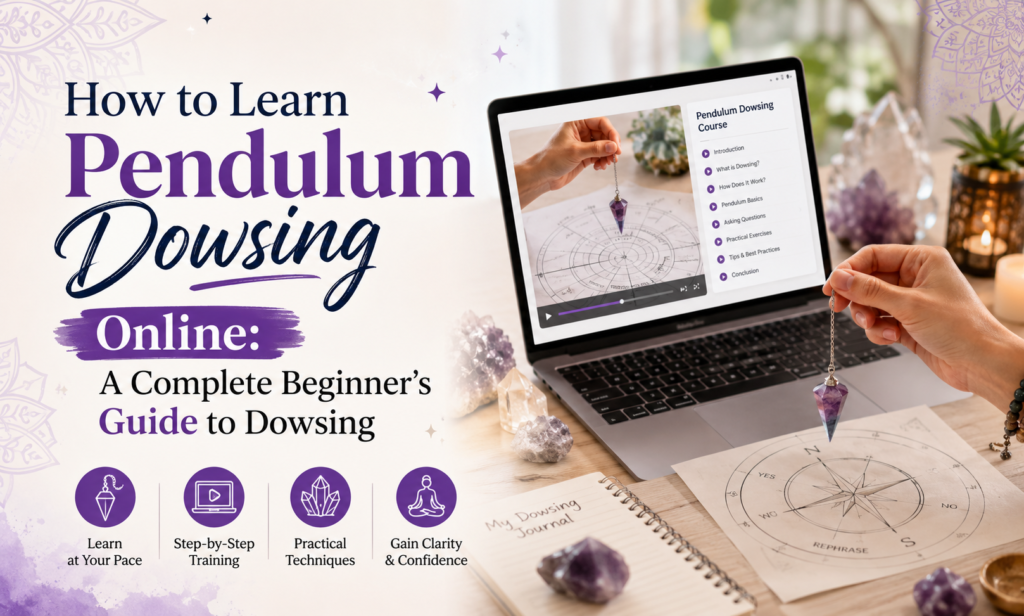
Pendulum dowsing attracts people who want to explore intuition, spiritual awareness and traditional energy-based practices in a simple and accessible way. Unlike practices that require many tools, a beginner can start exploring pendulum dowsing with a pendulum, a quiet environment, clearly framed questions and consistent practice.
Today, learners do not necessarily need to attend an in-person workshop to understand the fundamentals. A structured Pendulum Dowsing Course Online can introduce the basics of dowsing, different dowsing tools, pendulum movements, question framing and practical exercises in a systematic sequence. India Reiki Foundation describes dowsing as a traditional intuitive practice used to seek answers, locate misplaced objects and explore hidden information, while its course covers pendulums as well as tools such as L-rods and Y-rods.
For people already interested in spiritual learning, Reiki or energy practices, pendulum dowsing may also become an additional subject to explore. India Reiki Foundation specifically connects its dowsing training with Reiki and energy-awareness practices, while also stating that beginners can learn dowsing without previous Reiki training.
This guide explains how beginners can learn pendulum dowsing online, what equipment they need, how yes/no responses are traditionally established, how questions should be framed, what mistakes to avoid and what to look for when choosing a structured online course.
It is important to approach dowsing as a spiritual or intuitive practice rather than a scientifically proven diagnostic or predictive method. Scientific research on pendulum movement has demonstrated the ideomotor effect, in which thoughts or expectations can produce subtle, unconscious muscular movements that cause a pendulum to swing. Therefore, pendulum results should not replace qualified medical advice, financial guidance, legal advice or other evidence-based professional decisions.
What Is Pendulum Dowsing and How Does It Work?
Pendulum dowsing is a traditional practice in which a suspended weighted object is allowed to move while the practitioner observes and interprets its direction. Practitioners commonly establish movements that they associate with responses such as “yes”, “no” or “unclear” before asking specific questions.
A typical dowsing pendulum consists of a weighted object attached to a chain, thread or cord. The practitioner holds the upper end while allowing the weighted portion to hang freely. Depending on the person and their chosen method, the pendulum may appear to move forwards and backwards, from side to side or in circular patterns.
Within spiritual traditions, these movements may be interpreted as intuitive or energetic responses. India Reiki Foundation describes dowsing as an intuitive practice and includes subjects such as energy sensing, question framing and yes/no response techniques within its Dowsing Course Online.
From a scientific perspective, pendulum motion can also be influenced by very small unconscious muscular movements. Research into pendulum-based ideomotor behaviour has shown that merely thinking about or anticipating movement may lead to subtle physical actions without the person consciously intending to create them.
For this reason, beginners should learn dowsing with a balanced mindset. The goal of early practice should not be to treat every pendulum movement as an absolute prediction. Instead, focus on learning the method, understanding how your own responses behave, improving concentration and recognising how expectations or emotions may influence a session.
Can Beginners Learn Pendulum Dowsing Online?
Yes. Beginners can learn the basic techniques of pendulum dowsing online because the foundational skills can be demonstrated, explained and practised from home.
A beginner usually starts by learning what a pendulum is, how it is held, how to establish response movements and how to ask simple questions. After understanding the fundamentals, the learner can gradually move towards more structured exercises involving charts, objects or other traditional dowsing applications.
India Reiki Foundation states that dowsing can be learned by beginners and that Reiki is not essential for starting the practice. Its course material introduces pendulum dowsing, different types of dowsers, meditation, yes/no responses and other practical exercises.
This makes online learning useful for people who cannot regularly travel to a physical training centre. A Pendulum Dowsing Course Online can also provide a defined learning sequence instead of leaving the learner to collect disconnected information from different videos, blogs and social media posts.
However, learning online still requires practice. Watching demonstrations alone will not develop familiarity with a pendulum. Beginners should repeat basic exercises, record observations and learn to recognise when stress, expectation or distraction may be affecting their responses.
If you are simultaneously considering a Reiki Healing Course or Online Reiki Course, the two subjects can be studied separately before exploring how practitioners traditionally combine them within energy-based spiritual practices.
What Do You Need to Start Pendulum Dowsing?
You do not need complicated equipment to begin practising basic pendulum dowsing.
The most important requirement is a pendulum that can hang and swing freely. Beginners may use a purpose-made crystal or metal pendulum, although technically any suitably balanced weighted object attached to a string or chain can demonstrate pendulum movement.
You should also choose a comfortable and relatively quiet place where your arm can remain relaxed. A table can be useful because it allows you to support your elbow and reduce unnecessary physical movement.
A notebook is another helpful learning tool. Record the question you asked, the movement you observed and whether you were calm, distracted or emotionally invested in the answer. Over time, these notes can reveal patterns in your practice.
Beginners may later use pendulum charts. These charts organise possible responses visually so that the practitioner can observe the direction in which the pendulum moves. However, you do not need complicated charts for your first practice session.
India Reiki Foundation’s training goes beyond the basic pendulum and also introduces other traditional dowsing tools, including L-shaped dowsers and bobbers for particular exercises.
Start simply. A pendulum, a calm environment, clearly written questions and regular practice are enough for your first stage of learning.
How Do You Choose the Right Pendulum for Dowsing?
Choose a pendulum that feels comfortable to hold, swings freely and has enough weight to create movements that are easy for you to observe.
There is no single material that every beginner must use. Pendulums are commonly available in crystal, metal, wood and other materials. Some learners select a pendulum because they feel personally connected to its appearance or material, while others simply choose one that is well balanced and easy to control.
For beginners, practicality matters more than purchasing an expensive pendulum. Check that the chain or cord is comfortable between your fingers and that the pendulum has enough space to swing without touching your hand or the table.
The shape should also be reasonably symmetrical. An uneven or unusually shaped object may create movement that is harder for a beginner to interpret.
Many online pendulum courses include pendulum selection because it is one of the first questions new learners have. Current beginner-oriented online training commonly covers choosing a pendulum, preparing it, understanding its movement and establishing a connection with the tool.
Once you choose a pendulum, avoid continually changing tools during your earliest practice sessions. Working with the same pendulum for a period can make it easier to observe how your movements and responses develop.
Do You Need to Cleanse or Prepare Your Pendulum Before Using It?
Cleansing a pendulum is part of many spiritual dowsing traditions, but it should be understood as a ritual or personal preparation practice rather than a scientifically necessary requirement.
Different practitioners use different preparation methods. Some hold the pendulum quietly before a session, meditate, use intention-setting or follow cleansing practices associated with the material of the pendulum. Beginner courses currently available online commonly include cleansing, charging or preparing a pendulum as part of their spiritual framework.
From a practical perspective, the most important preparation is your own state of mind and body. Sit comfortably, relax your hand, avoid deliberately creating movement and give the pendulum enough room to swing.
If you are upset, physically tense or strongly hoping for one particular answer, postpone questions that carry emotional importance. Expectations can unconsciously influence movement.
You may also begin the session by holding the pendulum still for a few moments and observing your breathing. This can help reduce unnecessary movement in the fingers, wrist and arm.
Learners following a Reiki Healing Course may use different grounding or meditation techniques as part of their personal spiritual routine. These can remain separate from pendulum practice until the learner has sufficient understanding of both methods.
How Do You Use a Dowsing Pendulum Step by Step?
For beginners, pendulum dowsing should start with a simple and repeatable process.
First, sit comfortably in a quiet place. Hold the end of the pendulum chain or cord between your fingers and allow the weighted end to hang freely. Keep your wrist and arm relaxed.
Second, allow the pendulum to become relatively still. Avoid consciously pushing or directing it.
Third, establish your response patterns. Instead of assuming that clockwise always means “yes” or that side-to-side always means “no”, ask the pendulum to demonstrate each response. You might say, “Show me yes,” observe the movement, return the pendulum to neutral and then ask, “Show me no.”
India Reiki Foundation includes establishing yes/no responses within its dowsing course syllabus.
Fourth, test the movement with simple factual questions whose answers you already know. This is a useful practice exercise because you can compare the observed response with known information.
Fifth, ask one clear question at a time. Avoid combining several possibilities in the same sentence.
Sixth, observe rather than trying to force a result. If the movement is unclear, stop, return to a neutral position and repeat only after you have relaxed.
Finally, record the session. Keeping notes helps you recognise inconsistencies and develop a more disciplined practice.
Beginners should practise for short periods rather than repeatedly asking the same question until the pendulum produces the answer they want.
How Do You Identify Yes, No and Maybe with a Pendulum?
You identify yes, no and uncertain responses by establishing your own response pattern before asking meaningful questions.
There is no universal rule stating that every person’s pendulum must move in the same direction for the same answer. One learner may observe a clockwise circle for “yes”, while another may see a forwards-and-backwards swing.
Begin with the pendulum hanging freely. Ask, “Show me yes.” Observe the movement without trying to control it. Allow the pendulum to return to neutral and then ask, “Show me no.”
You can also establish an “unclear”, “maybe” or “cannot answer” signal. This is particularly useful because not every question should be forced into a yes-or-no outcome.
India Reiki Foundation specifically lists “Finding Answers in Yes/NO” within its workshop syllabus, making response interpretation one of the foundational skills taught in its Pendulum Dowsing Course Online.
After identifying the signals, test them using questions with obvious answers, such as facts about your own surroundings.
If your signals change repeatedly during the same session, stop rather than interpreting every movement. Fatigue, hand position, expectation and unconscious muscle movement can all affect the swing.
What Questions Can You Ask a Dowsing Pendulum?
Beginners should start with simple, specific questions that can be answered clearly rather than asking broad or emotionally complicated questions.
Useful practice questions are those where you already know the answer. For example, you can ask whether you are currently sitting indoors or whether an object placed in front of you is a particular colour.
Once you are comfortable with the method, traditional dowsing practitioners may use pendulums for personal reflection, intuitive exploration, locating objects or other spiritual exercises. India Reiki Foundation includes finding lost or hidden objects among the applications taught in its dowsing programme.
Avoid questions such as:
“What will happen to my whole life?”
Instead, create one clear question with one variable.
You should also avoid relying on a pendulum for serious medical, legal, financial or safety decisions. If a question concerns symptoms, medication, investment decisions, legal matters or an emergency, consult the appropriate qualified professional.
The pendulum is better approached as a spiritual or reflective practice rather than a substitute for professional expertise.
How Should You Frame Questions for Accurate Pendulum Dowsing?
Question framing is one of the most important skills for making a dowsing session clear and consistent.
A good beginner question should normally be specific, neutral and focused on one subject.
For example, asking, “Should I choose option A or option B and will it make me successful?” contains multiple questions. Separating them makes the exercise easier to interpret.
Avoid emotionally loaded wording. If you desperately want the answer to be “yes”, your expectation may influence small unconscious movements. Research on the ideomotor effect demonstrates how thoughts and expectations can contribute to pendulum motion.
It is also useful to specify the relevant context or time period when necessary. A vague question about “the future” leaves too much room for interpretation.
Current pendulum-learning content consistently emphasises question formulation as a central beginner skill, and India Reiki Foundation lists question framing among the subjects included in its online dowsing training.
Before asking a question, therefore, check three things: Is there only one subject? Is the wording neutral? Can the possible response be interpreted clearly?
Better questions generally lead to clearer practice sessions, regardless of how you personally interpret the pendulum’s movement.
What Can Pendulum Dowsing Be Used For in Everyday Life?
Within traditional and spiritual practice, pendulum dowsing is used for intuitive reflection, yes/no questioning, locating misplaced objects and exploring different energy-awareness exercises.
India Reiki Foundation’s current course syllabus includes finding answers in yes/no form, locating lost or hidden objects, chakra and aura scanning exercises, home scanning, checking the energy of food, protection-related practices and working with other dowsing tools.
Some learners use pendulum practice mainly as a way to strengthen concentration and intuition. Others are interested in how it can be incorporated into broader spiritual learning.
Reiki practitioners, for example, may choose to explore pendulum techniques alongside their Reiki practice. India Reiki Foundation states that Reiki learners can explore the relationship between dowsing, energy healing and Reiki practices, although Reiki is not required for a beginner to start learning dowsing.
This is where someone already completing an Online Reiki Course may find dowsing an interesting additional field of study.
However, everyday use should remain sensible. Pendulum dowsing should not be treated as an objective measuring device or used instead of professional diagnosis, scientific testing or expert advice.
What Common Pendulum Dowsing Mistakes Should Beginners Avoid?
One of the biggest beginner mistakes is expecting perfect answers immediately.
Pendulum practice requires familiarity with the tool, question structure and your own physical responses. Beginners often become disappointed when movements change between sessions, but inconsistency can be a useful signal to examine how the session is being conducted.
Another common mistake is gripping the chain too tightly. Tension in the hand and wrist can affect movement.
Asking vague questions is another problem. “Will everything be good?” has no precise context and can be interpreted in many ways.
Repeatedly asking the same question is equally unhelpful. If you ask until you receive your preferred answer, the session becomes driven by expectation rather than observation.
Emotional attachment should also be considered. Questions involving relationships, health or major personal decisions can create strong expectations that may unconsciously affect movement.
Beginners should also avoid assuming that a pendulum is infallible. Dowsing belongs to the area of traditional intuitive and spiritual practice; it is not scientifically established as a reliable method of predicting future events or diagnosing health conditions.
Finally, do not rush into advanced practices without understanding the fundamentals. Learning how to hold the pendulum, establish responses and frame questions creates a stronger foundation for later exercises.
How Can You Improve Your Pendulum Dowsing Skills with Practice?
Consistency is more valuable than trying to complete long dowsing sessions.
Practise for a few minutes at a time and begin with questions whose answers are already known. This allows you to study the movement without becoming overly concerned about the result.
Keep the physical conditions similar during your early sessions. Sit in the same type of position, hold the chain at approximately the same length and support your arm comfortably.
Maintain a practice journal. Write down your yes/no signals, questions and observations. If your response pattern changes, note what was different about that session.
You can gradually increase the complexity of your exercises. Start with known answers, progress to hidden-object practice and only later explore charts or other traditional techniques taught in structured programmes.
Meditation or a brief calming routine can also improve concentration. India Reiki Foundation includes meditation with a dowser and making a connection with the dowsing tool within its course syllabus.
Most importantly, practise without putting pressure on yourself to produce a particular result. A learner who is willing to question inconsistent responses and repeat controlled exercises will develop a more disciplined approach than someone who treats every swing as unquestionable information.
What Will You Learn in an Online Pendulum Dowsing Course?
A structured online course should move from fundamental concepts to guided practical exercises instead of teaching isolated pendulum tricks.
India Reiki Foundation’s current Pendulum Dowsing Course Online begins with an introduction to dowsing and its history, different types of dowsers, how dowsing works and methods for becoming familiar with the dowsing tool.
The course syllabus then includes meditation with the dowser and finding answers through yes/no responses. Students are introduced to exercises involving finding lost or hidden objects.
The syllabus also goes beyond a basic handheld pendulum. India Reiki Foundation lists chakra and aura scanning using L-shaped dowsers or bobbers, home scanning, checking the energy of food, healing-related dowsing practices, protection tips and selected crystal-related content.
The current course page indicates that India Reiki Foundation provides both pre-recorded and live pendulum dowsing learning formats.
For Reiki learners, the course also discusses ways in which dowsing is traditionally integrated with Reiki and energy-awareness practices. Someone taking a Reiki Healing Course may therefore choose to study dowsing as an additional complementary spiritual skill rather than treating it as a replacement for Reiki training.
How Do You Choose the Right Pendulum Dowsing Course Online?
Choose a Pendulum Dowsing Course Online that explains the fundamentals clearly, provides practical demonstrations and gives you a logical progression from beginner exercises to more advanced applications.
Start by reviewing the syllabus. A quality beginner programme should explain what dowsing is before moving directly into predictions or complicated charts.
Look for training in pendulum handling, response calibration, question framing and practical exercises. Current online dowsing courses frequently include pendulum selection, preparation, yes/no signals and question formation, showing that these are central concerns for beginner learners.
Next, check whether the course matches your goals. Someone who simply wants to understand basic pendulum use has different needs from a Reiki practitioner interested in chakra or aura-related spiritual exercises.
The teaching format also matters. Some people prefer pre-recorded learning because they can study at their own pace. Others prefer live instruction because they value demonstrations and interaction.
You should also check who is providing the programme, what other related subjects the organisation teaches and whether the syllabus is clearly published before enrolling.
Avoid choosing a course solely because it promises guaranteed predictions or perfect accuracy. Responsible learning should encourage observation, practice and appropriate limits rather than absolute claims.
Why Learn Pendulum Dowsing from India Reiki Foundation?
India Reiki Foundation offers pendulum dowsing within a broader learning environment focused on Reiki and other metaphysical and spiritual subjects. Its website currently lists Vedic-Usui Reiki, Holy Fire Reiki, Crystal Healing, Numerology, Palmistry, Pendulum Dowsing and Akashic Records among its course categories.
For beginners, one important advantage is that the dowsing programme does not assume that every learner already has professional experience. India Reiki Foundation states that beginners can learn dowsing and that Reiki is not essential for beginning the subject.
Another benefit is the breadth of the published syllabus. Learners are introduced not only to basic pendulum questions but also to the history of dowsing, different types of dowsers, meditation, yes/no responses, lost-object exercises, L-shaped dowsers, bobbers, chakra/aura scanning and home-scanning practices.
India Reiki Foundation also provides a natural learning path for students interested in multiple spiritual disciplines. Someone starting with pendulum dowsing may later decide to explore a Reiki Healing Course, while an existing Reiki student taking an Online Reiki Course may use dowsing training to broaden their knowledge of traditional energy-awareness practices.
The organisation describes itself as a healing and learning platform that trains people in Reiki and several related spiritual disciplines. Its website lists its location in Vishwas Nagar, Delhi, while its online course format makes learning accessible without requiring regular physical attendance at the centre.
For someone searching for a beginner-friendly Pendulum Dowsing Course Online, the combination of structured foundational learning, practical dowsing exercises and the ability to explore related Reiki education makes India Reiki Foundation a relevant option to consider.
Frequently Asked Questions About Pendulum Dowsing
1. Can anyone learn pendulum dowsing?
Yes, beginners can learn the basic techniques of pendulum dowsing. India Reiki Foundation states that previous Reiki experience is not essential for starting its dowsing training. Beginners should start with pendulum handling, response calibration, simple questions and regular practice before moving towards more advanced exercises.
2. How long does it take to learn pendulum dowsing?
There is no universal period in which everyone masters pendulum dowsing. Basic techniques such as holding the pendulum and establishing yes/no movements can be introduced quickly, but becoming consistent with question framing and practice may take considerably longer. Regular short practice sessions are usually more useful than trying to learn every technique in a single session.
3. Can I learn pendulum dowsing without Reiki?
Yes. Reiki is not a compulsory prerequisite for learning basic pendulum dowsing. India Reiki Foundation specifically states that beginners can learn dowsing without Reiki, although Reiki practitioners may explore ways of combining the two within spiritual and energy-based practices.
4. What is the best pendulum for beginners?
The best beginner pendulum is one that is balanced, comfortable to hold and capable of swinging freely. It does not need to be expensive. Crystal, metal and wooden pendulums are all commonly used. Beginners should focus on ease of use and consistent practice rather than assuming that one particular material guarantees better results.
5. How do I know what yes and no mean on my pendulum?
Start each session by asking the pendulum to demonstrate its “yes” and “no” responses instead of assuming predetermined directions. Observe the movements separately and then test them using simple questions with known answers. India Reiki Foundation includes finding answers through yes/no responses in its course curriculum.
6. Why is my pendulum giving different answers?
Different responses may occur because of hand position, tension, fatigue, unclear questions, expectation or unconscious muscular movements. Scientific research on pendulum movement identifies the ideomotor effect as one explanation for movements that feel involuntary. If answers become inconsistent, stop the session, relax and return later rather than repeatedly asking the same question.
7. What questions should beginners ask a pendulum?
Beginners should start with simple factual questions whose answers they already know. This helps them practise identifying movement patterns. Once they are comfortable, they can experiment with simple reflective or traditional dowsing exercises. Avoid using pendulum answers as substitutes for medical, financial, legal or other professional advice.
8. Can pendulum dowsing be learned completely online?
The fundamental techniques can be taught online through explanations, demonstrations and guided exercises. India Reiki Foundation currently offers its dowsing training in online formats, including pre-recorded and live options. The learner must still practise independently to become familiar with pendulum movement and question framing.
9. Can Reiki practitioners learn pendulum dowsing?
Yes. Reiki practitioners are one audience that may be interested in pendulum dowsing because some spiritual training systems combine dowsing with chakra, aura and energy-awareness practices. India Reiki Foundation explicitly discusses integrating dowsing with Reiki-related learning. Learners can therefore explore an Online Reiki Course and dowsing as related but distinct subjects.
10. Is a Pendulum Dowsing Course Online worth learning for beginners?
A structured course can be useful if you want organised instruction rather than relying on scattered information from multiple sources. It can guide you through pendulum handling, yes/no responses, question framing and practical exercises in sequence. India Reiki Foundation’s published programme also covers several additional dowsing tools and applications beyond the basic pendulum.
Conclusion
Learning pendulum dowsing begins with understanding a surprisingly simple tool: a suspended weight that moves while you observe and interpret its direction. Yet effective learning involves much more than watching the pendulum swing. Beginners need to understand how to hold the tool correctly, establish response patterns, formulate clear questions, recognise the effects of expectation and practise consistently.
An organised Pendulum Dowsing Course Online can make this learning process easier by placing foundational concepts and practical exercises in a logical order. Instead of moving randomly between videos and conflicting instructions, learners can progress from basic dowsing principles to yes/no responses, object-finding exercises and other traditional applications.
India Reiki Foundation’s current dowsing syllabus covers the introduction and history of dowsing, types of dowsers, connecting and meditating with a dowsing tool, yes/no responses, locating hidden objects, chakra and aura scanning, home scanning and several related practices. It also allows learners to explore how dowsing may be incorporated into Reiki-based spiritual learning.
For people who are also interested in a Reiki Healing Course or Online Reiki Course, learning pendulum dowsing can provide another perspective on traditional intuition and energy-awareness practices. The two subjects do not need to be learned simultaneously, and beginners can start dowsing without previous Reiki training.
Most importantly, approach pendulum dowsing with curiosity, patience and appropriate limits. Treat it as a traditional spiritual or reflective practice rather than a guaranteed method of prediction or diagnosis. Practise simple techniques first, keep your questions clear and develop your understanding gradually.
If you want guided instruction rather than learning entirely through trial and error, India Reiki Foundation’s Pendulum Dowsing Course Online provides a structured route for beginning your dowsing journey and exploring the practice alongside its wider range of Reiki and spiritual learning programmes.
India Reiki Foundation | Online Reiki Course & Spiritual Healing Academy
Adress- 502-503, Stanford Plaza, Veera Desai Road, Andheri West, Mumbai, Maharashtra 400065, India
Phone number +91 96254 88550
Website- indiareikifoundation.com
Mail- mail@indiareikifoundation.com