

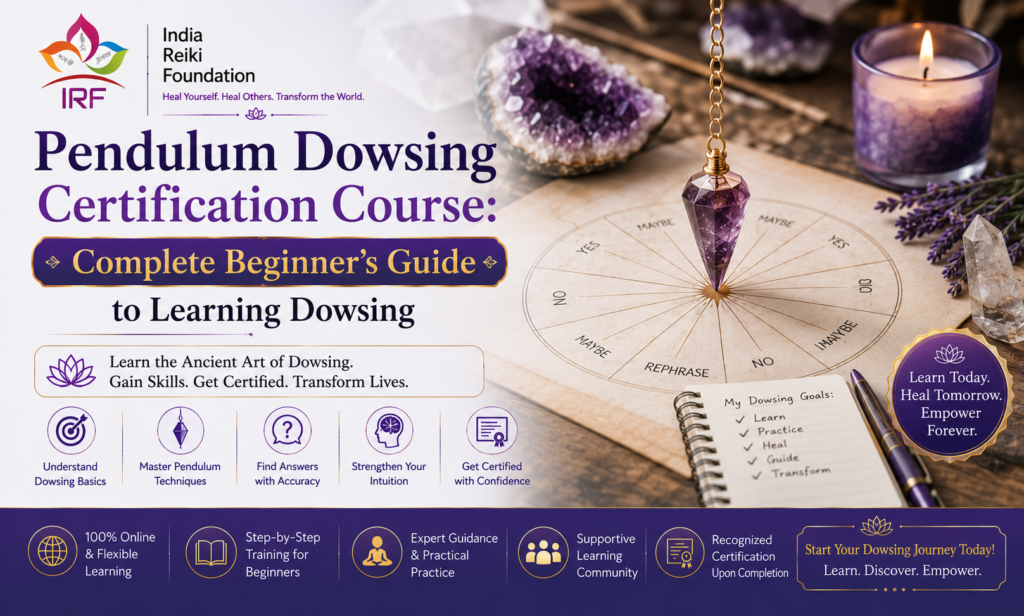
Pendulum dowsing is a simple yet fascinating spiritual practice that is often used for intuitive guidance, energy checking, chakra-related work and personal self-exploration. For a beginner, the process may look as easy as holding a pendulum and watching the direction in which it moves. However, effective dowsing requires much more than observing a swing. It involves learning how to prepare yourself, understand pendulum signals, ask clear questions, avoid personal bias and practise consistently.
A structured Pendulum Dowsing Course Online can help beginners build these skills in a clear and systematic way. Instead of depending on random demonstrations or incomplete information, learners can understand the principles behind dowsing and gradually develop confidence through regular practice.
Pendulum dowsing can also be of interest to people who are studying a Reiki Healing Course, crystal healing or another spiritual modality. Although dowsing and Reiki are different practices, both are commonly explored by people interested in subtle-energy awareness, self-development and complementary spiritual techniques.
This guide explains what pendulum dowsing is, how beginners can start learning it, how to choose a pendulum, how to interpret its movements and what to consider before enrolling in an online dowsing course.
What Is Pendulum Dowsing and How Does It Work?
Pendulum dowsing is a practice in which a suspended object is used to obtain responses to specific questions or to explore different energetic possibilities. A pendulum usually has a weighted object attached to a chain, cord or thread. When it is held steadily, the pendulum may begin moving in a straight line, circular pattern or another direction.
Practitioners commonly assign meanings to these movements. One direction may represent “yes,” another may indicate “no,” while a different movement can be interpreted as “maybe,” “uncertain” or “rephrase the question.”
Traditional dowsing practices often describe pendulum movement in terms of intuition, energy or subconscious responses. From a scientific perspective, very small involuntary muscular movements may also contribute to the motion of a pendulum. This is why beginners are encouraged to stay relaxed, maintain a steady posture and avoid consciously influencing the movement.
A pendulum is therefore best approached as a tool for spiritual practice and self-reflection rather than as an instrument that provides guaranteed predictions or scientifically verified measurements. When learners understand this distinction, they can practise dowsing with greater awareness and realistic expectations.
Can Beginners Learn Pendulum Dowsing Easily?
Yes, beginners can learn the basic techniques of pendulum dowsing without any previous experience. One of the reasons pendulum dowsing is popular among new learners is that it does not require complicated tools. A basic pendulum, a quiet space and a willingness to practise are usually enough to get started.
The first stage is generally focused on holding the pendulum correctly and observing how it responds. Beginners then learn how to establish their own yes, no and uncertain signals before moving toward more advanced questions and charts. Previous experience in meditation, Reiki or other spiritual practices may help a learner become more comfortable with concentration and energy-related concepts, but it is not always essential.
Someone who has never taken an Online Reiki Course can still begin learning pendulum dowsing independently. Similarly, learners who already practise Reiki may use dowsing as an additional skill within their broader spiritual learning.
The most important requirement is regular practice. A beginner should not expect perfect or highly consistent responses from the first session. Confidence develops gradually as the learner becomes more familiar with their pendulum and improves the quality of the questions being asked.
How Do You Choose the Right Pendulum for Dowsing?
Choosing a pendulum is usually a personal decision. There is no single material or design that is suitable for every learner. Pendulums are available in crystal, metal, wood and other materials. Crystal pendulums are commonly preferred by people who are interested in crystal healing or chakra work, while metal pendulums are often selected for their weight and smooth movement.
For a beginner, functionality is more important than appearance. A suitable pendulum should feel comfortable in the hand and should not be excessively heavy or extremely light. The chain or cord should allow the pendulum to swing freely. A balanced, pointed design can also make movement easier to observe. Beginners do not need to buy an expensive pendulum. A simple and well-balanced tool can be completely adequate for practice.
Some learners choose a pendulum based on their personal attraction to a particular crystal. For example, clear quartz, amethyst or rose quartz may be selected according to traditional crystal associations. However, the effectiveness of the practice should not depend only on the type of stone being used. Consistency matters more. It can be helpful to work with the same pendulum for a period of time so you become familiar with its movements and response patterns.
How Do You Find Your Pendulum’s Yes, No and Maybe Responses?
Before asking detailed questions, beginners should first determine how their pendulum communicates different answers. This process is often referred to as establishing or calibrating pendulum responses. Begin by sitting comfortably and keeping your body relaxed. Hold the chain or cord gently between your thumb and index finger. Allow the pendulum to hang naturally without touching another surface.
Wait for it to become relatively still. Then ask the pendulum to show you a “yes” response. Observe the direction of movement. It may swing forward and backward, from side to side or in a circular motion. Next, allow the pendulum to settle again and ask it to show you “no.” Repeat the same process for “maybe,” “unclear” or “cannot answer.”
Every learner may experience a slightly different response pattern. There is no fixed universal rule that says a clockwise circle must always mean yes or a sideways movement must always mean no. Once you have identified your basic responses, test them by asking questions where you already know the answer. This helps you become familiar with the movement while keeping the practice simple. If the response changes or becomes unclear, pause and recalibrate before continuing.
What Questions Can You Ask a Dowsing Pendulum?
The quality of a dowsing session is strongly influenced by the way the question is framed. Beginners should avoid vague or complicated questions. Instead, each question should focus on one subject and should be easy to understand. For example, rather than asking, “Should I change my career, move to another city and start a new course?” it is better to separate each topic into individual questions.
Simple questions generally provide clearer responses. Good questions are usually specific, neutral and relevant to the present situation. Where time is important, adding a defined timeframe can make the wording more precise. Beginners can start with factual questions that already have known answers. This gives them an opportunity to practise without becoming emotionally attached to the result.
As confidence develops, they may use dowsing for personal reflection, spiritual exploration or energy-related exercises. However, a pendulum should not be used as a replacement for professional medical, financial, legal or psychological advice. Decisions in these areas should always be supported by qualified expertise. Pendulum dowsing is most useful when it is treated as a spiritual practice rather than an unquestionable decision-making system.
What Are Pendulum Dowsing Charts and How Do You Use Them?
Pendulum dowsing charts are visual tools that provide several possible answers within a structured layout. A basic chart may contain options such as yes, no, maybe and rephrase. More detailed charts may include numbers, percentages, letters, chakras or multiple categories.The chart is generally placed on a flat surface, and the pendulum is held above a central point. The practitioner asks a clear question and observes which area of the chart the pendulum moves toward.
Charts are helpful because they allow practitioners to explore questions that are not limited to a simple yes-or-no format. For example, a numerical chart may be used to choose between different numbered options. A chakra chart may be used within a spiritual energy exercise. Other charts may contain letters or predefined categories. Beginners should first become comfortable with basic pendulum signals before moving into more complex chart work.
Trying to use advanced charts too early can create unnecessary confusion. A well-designed Pendulum Dowsing Course Online usually introduces charts after learners have understood basic calibration, question wording and observation techniques.
Why Does a Pendulum Sometimes Give Inconsistent Answers?
Inconsistent answers are extremely common for beginners and can happen for several reasons. One major factor is unclear questioning. If the question contains multiple meanings, the response may appear uncertain. Another common issue is emotional attachment. If the learner strongly wants a particular answer, unconscious movement may influence the pendulum.
Physical factors can also affect the result. Tiredness, posture, an unstable hand, airflow or distractions in the environment may change the way a pendulum moves. Repeating the same question again and again can also create confusion. Some beginners continue asking until they receive the answer they want, which defeats the purpose of neutral observation. When responses appear inconsistent, it is usually better to stop, relax and review the question.
Ask yourself whether the wording is clear. Consider whether you are emotionally involved in the answer. Recalibrate your pendulum if necessary. You may also decide to return to the question later.Keeping a simple practice journal can help identify patterns. Record the date, the question, the pendulum response and the conditions under which you practised. Over time, this can make your learning process more structured.
What Can Pendulum Dowsing Be Used For?
Pendulum dowsing is used for a variety of spiritual and intuitive practices. The most common application is yes-and-no questioning. Beginners often start here because the method is easy to understand and practise. Dowsing may also be explored for locating lost objects, using charts, checking different choices or working with spiritual energy practices.
Within some energy-healing traditions, pendulums are used for chakra observation, aura-related practices and selecting crystals. Some practitioners may also use pendulums as part of space-clearing or environmental energy work. A person taking a Reiki Healing Course may become interested in dowsing because the two practices can sometimes be explored together in broader energy-healing education.
However, the methods should not be treated as scientifically verified diagnostic tools. For example, using a pendulum in chakra work should be understood as part of spiritual practice rather than a way to diagnose a health condition. A responsible practitioner knows where spiritual exploration ends and where qualified professional advice becomes necessary.
What Do You Learn in a Pendulum Dowsing Course?
A structured dowsing course should teach both foundational theory and practical techniques. Beginners usually start by learning what dowsing is and how different dowsing tools are used. The next stage often covers pendulum handling, meditation or preparation, calibration and question framing. Students may also learn how to establish yes, no and uncertain responses, work with pendulum charts and perform practice exercises.
More comprehensive courses can introduce other areas such as locating objects, chakra-related dowsing, aura work, home scanning, crystal selection and different types of dowsing tools.
Some training programs also include spiritual protection practices and guidelines for responsible use. A professional Pendulum Dowsing Course Online should not simply provide theoretical information. It should give learners enough structure to practise independently.
The ideal course teaches students how to interpret unclear responses, avoid common mistakes and understand when not to rely on dowsing. People who are already enrolled in an Online Reiki Course may also benefit from understanding how pendulum dowsing differs from Reiki while learning where the two practices may complement one another.
How Do You Choose the Best Pendulum Dowsing Course Online?
Choosing the right course requires more than looking at the course fee or duration. The first thing to review is the syllabus. A beginner-friendly program should start with fundamental concepts rather than assuming previous experience. It should teach how to hold a pendulum, establish response patterns, create appropriate questions and practise with confidence.
Look for a course that explains both technique and application. The instructor or training organization should also provide clear information about what is included in the program.
Before joining a Pendulum Dowsing Course Online, consider the following points:
- Is the program suitable for complete beginners?
- Does the curriculum include practical exercises?
- Are pendulum responses and calibration explained?
- Does it cover question framing?
- Are dowsing charts introduced?
- Does the course explain common mistakes?
- Are ethical and practical limitations discussed?
- Is certification available after successful completion?
- Can the skills be integrated with Reiki or other spiritual practices?
You should also think about your own goal. If you want only a basic introduction, an advanced professional program may be unnecessary. If your goal is to combine dowsing with Reiki, chakra work or crystal healing, choose a course that includes those areas.
Can You Learn Pendulum Dowsing Through an Online Course?
Yes. Pendulum dowsing is particularly suitable for online learning because most of the foundational exercises can be demonstrated remotely and practised at home. A learner can watch demonstrations of how to hold a pendulum, establish responses, use charts and frame questions. They can then practise each technique in their own environment.
Online learning also allows students to revisit lessons and repeat techniques when necessary. The main requirement is active practice. Watching a course without practising will not build confidence. A learner should regularly repeat basic exercises, compare responses and keep notes about their experience.
An online format can also be convenient for students who cannot attend in-person training because of distance or schedule limitations. The same principle applies to an Online Reiki Course. Digital learning can provide flexibility, but students should still evaluate the quality of instruction, curriculum and teaching method before enrolling.
What Are the Most Common Pendulum Dowsing Mistakes Beginners Should Avoid?
Learning dowsing becomes easier when common mistakes are identified early. One major mistake is starting with emotionally important questions. Beginners often receive inconsistent answers because they are already hoping for a particular result. It is better to practise first with neutral questions. Another mistake is assuming that every small movement is meaningful. A pendulum may move because of posture, breathing, hand movement or environmental factors.
Skipping the calibration process is also a common problem. Beginners should establish yes, no and uncertain responses before asking detailed questions. Other mistakes include asking vague questions, combining multiple questions into one, changing pendulums too frequently and relying too heavily on charts before mastering basic responses.
Some learners also repeatedly ask the same question until they receive an answer they prefer. This should be avoided. Finally, beginners should never use pendulum responses as a substitute for professional advice in medical, financial or legal situations. A responsible learner understands both the possibilities and the limitations of the practice.
Can You Become a Professional Pendulum Dowser After Completing a Course?
Completing a course can provide a foundation, but professional confidence develops through continued practice. A certificate alone does not automatically make someone an experienced dowser. Learners who want to work professionally should continue practising, keep detailed records and understand ethical communication. They should also be careful about how they present their services.
Dowsing should not be described as guaranteed prediction, medical diagnosis or scientific testing. Professional practitioners may offer dowsing as part of spiritual guidance, energy work or complementary wellness services, provided clear boundaries are maintained.
Students who already have experience in Reiki, crystal healing, numerology or related areas may decide to include dowsing within a broader spiritual practice. For example, someone who has completed a Reiki Healing Course may later add pendulum dowsing as another method of energy awareness. Professional development therefore involves more than completing a single program. It requires experience, responsible practice and ongoing learning.
Why Learn Pendulum Dowsing From India Reiki Foundation?
India Reiki Foundation provides training in several spiritual and energy-related practices, including Reiki, crystal healing and pendulum dowsing. For beginners who want a structured learning path, studying within an established spiritual-learning environment can make the process easier to understand. A well-organized dowsing course should move progressively from fundamentals toward practical applications. Learners can first understand what dowsing is, how different dowsing tools work and how pendulum responses are established.
From there, they can develop skills such as yes-and-no questioning, locating objects, working with charts and exploring energy-related practices. India Reiki Foundation can also be relevant for learners who want to expand their spiritual studies beyond dowsing. Someone beginning with a Pendulum Dowsing Course Online may later decide to explore an Online Reiki Course, crystal healing or another complementary subject.
Similarly, existing Reiki practitioners may add dowsing to their skill set. The value of structured learning is that students receive a clearer progression instead of depending on disconnected information from multiple sources. For beginners, this organized approach can make learning more practical, focused and easier to follow.
Frequently Asked Questions About Pendulum Dowsing
1. Is Pendulum Dowsing Difficult to Learn?
No. Basic pendulum dowsing techniques are relatively simple to understand. The challenge is developing consistency, clear questioning and neutral observation through regular practice.
2. Can I Learn Pendulum Dowsing Without Reiki?
Yes. Reiki experience is not necessary to begin pendulum dowsing. However, people who have completed a Reiki Healing Course may find certain energy-related concepts familiar.
3. Which Pendulum Is Best for Beginners?
A medium-weight, balanced pendulum that moves freely is usually suitable. Crystal, metal and wooden pendulums can all be used depending on personal preference.
4. How Do I Know Whether My Pendulum Is Saying Yes or No?
Ask the pendulum to show you each response separately before beginning your session. Your yes and no signals may differ from those of another practitioner.
5. Why Does My Pendulum Give Different Answers to the Same Question?
Different answers can occur because of unclear wording, emotional attachment, repeated questioning, hand movement or changing conditions. Recalibrating and rephrasing the question can help.
6. Can Pendulum Dowsing Be Used With Reiki?
Some practitioners use dowsing alongside Reiki for spiritual energy-related exercises. However, dowsing and Reiki remain separate practices with their own learning methods.
7. Can I Learn Pendulum Dowsing Online From Home?
Yes. A Pendulum Dowsing Course Online can teach the fundamental techniques through demonstrations, guided exercises and structured lessons that students practise at home.
8. Do I Need a Special Pendulum Dowsing Chart?
No. Beginners can first practise with simple yes/no responses. Charts can be introduced later when the learner wants to explore multiple-answer formats.
9. How Often Should I Practise Pendulum Dowsing?
Short, regular practice sessions are usually more useful than occasional long sessions. Consistency helps learners become more familiar with their response patterns.
10. Can Pendulum Dowsing Replace Professional Advice?
No. Pendulum dowsing should be treated as a spiritual or intuitive practice. It should not replace medical diagnosis, legal advice, financial guidance or other qualified professional services.
Conclusion
Learning pendulum dowsing can be an interesting starting point for anyone who wants to explore intuition, spiritual awareness and energy-related practices in a structured way. Although the basic technique looks simple, effective dowsing involves several important skills. Beginners need to learn how to choose a pendulum, calibrate responses, ask clear questions, remain neutral and understand why inconsistent answers may occur.
A comprehensive Pendulum Dowsing Course Online can make this learning process easier by providing a clear progression from basic knowledge to practical exercises. Students may also explore charts, chakra-related practices, object-location techniques and other traditional applications after developing a strong foundation.
For those already studying a Reiki Healing Course or Online Reiki Course, pendulum dowsing can become an additional area of spiritual learning. The two practices are different, but they may complement each other when used responsibly. The most important goal is not to depend on a pendulum for every decision. Instead, learners should develop patience, consistency and clear boundaries. With the right training and regular practice, pendulum dowsing can become a meaningful skill within a wider journey of spiritual education and self-exploration.
India Reiki Foundation | Online Reiki Course & Spiritual Healing Academy
Address- 502–503, Stanford Plaza, Veera Desai Road, Andheri West, Mumbai, Maharashtra 400065, India
Phone number +91 96254 88550
Website- https://indiareikifoundation.com/
Mail- mail@indiareikifoundation.com