

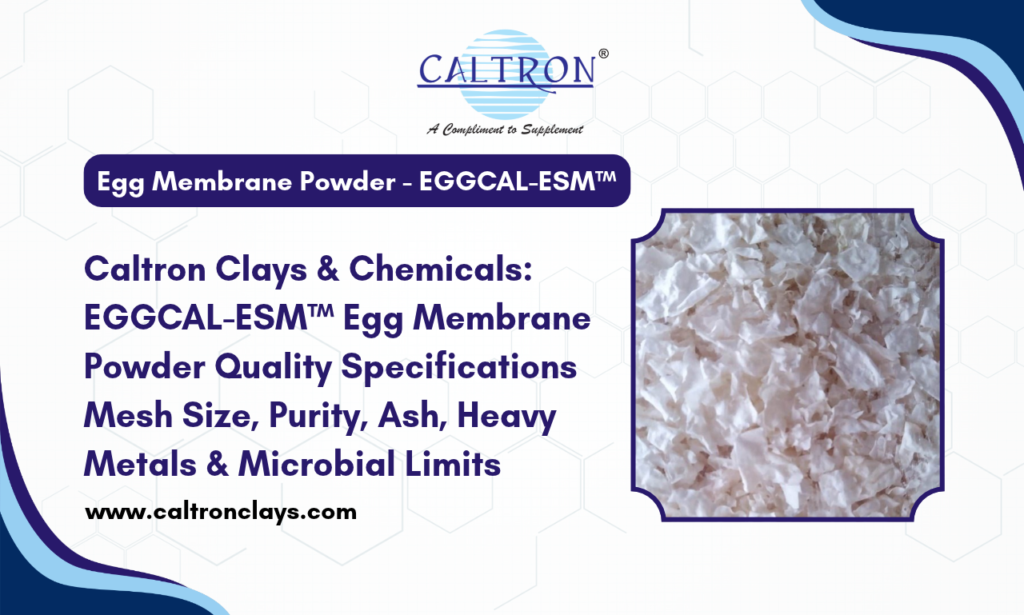
Introduction: What Should Manufacturers Know About Eggshell Membrane Powder Specifications?
For pharmaceutical and nutraceutical manufacturers, the quality of an ingredient is determined not only by its source but also by how consistently it meets defined technical specifications. This is especially important for natural-source ingredients such as eggshell membrane powder, where raw-material characteristics, processing conditions, and handling practices can influence the finished powder.
Eggshell membrane powder has attracted interest in joint-health, mobility, and healthy-aging formulations because of its naturally occurring structural proteins and associated compounds. However, its suitability for commercial manufacturing depends on several quality parameters, including particle size, mesh size, purity, ash content, moisture, heavy metals, and microbiological quality.
Understanding Eggshell Membrane Powder Specifications helps formulation scientists, procurement managers, and quality-assurance professionals make informed sourcing decisions. A technically suitable ingredient should meet defined acceptance criteria, demonstrate appropriate manufacturing characteristics, and be supported by relevant analytical documentation.
Caltron Clays & Chemicals Pvt. Ltd., an Egg Membrane Powder Manufacturer in India, offers EGGCAL-ESM™ Egg Membrane Powder for pharmaceutical and nutraceutical formulation applications. The ingredient is intended for businesses evaluating natural-source materials for supplement development.
This guide explains how manufacturers can assess eggshell membrane powder quality, interpret important analytical parameters, review Certificates of Analysis, and select an Egg Membrane Powder Supplier in India for reliable B2B sourcing.
What Is Eggshell Membrane Powder and How Is It Different from Eggshell Calcium?
Eggshell membrane is a thin biological layer located between the eggshell and the egg white. While the hard eggshell consists predominantly of calcium carbonate, the membrane contains an organic network of structural proteins and associated biochemical constituents.
This distinction is important because eggshell membrane powder and eggshell calcium powder serve different formulation purposes.
Natural Composition of Eggshell Membrane
Eggshell membrane is associated with several naturally occurring constituents, including:
- Collagen and other structural proteins forming part of the membrane matrix.
- Glucosamine-related compounds associated with connective-tissue composition.
- Chondroitin sulfate, a compound studied in relation to joint-health formulations.
- Hyaluronic acid, a naturally occurring component associated with tissue hydration.
- Proteins and peptides contributing to the membrane’s overall composition.
The quantities of these constituents can vary depending on the source material and manufacturing process. Therefore, ingredient-specific claims should be supported by appropriate analytical evidence.
EGGCAL-ESM™ from Caltron Clays & Chemicals is positioned as an egg membrane powder ingredient for nutraceutical manufacturers. It should not be confused with EGGCAL™ Egg Shell Calcium, which is intended for calcium-related formulation requirements.
Why Are Eggshell Membrane Powder Quality Specifications Important?
Quality specifications establish measurable standards for evaluating raw materials before they enter a manufacturing process. They help manufacturers determine whether a material meets established requirements and whether incoming batches are sufficiently consistent for the intended application.
For eggshell membrane powder, quality specifications cover physical, chemical, microbiological, and documentation-related characteristics.
Essential Quality Parameters for Manufacturers
The most relevant parameters generally include:
- Identity: Confirmation of the intended eggshell membrane material.
- Appearance: Assessment of colour, texture, and visible characteristics.
- Mesh size: Evaluation of powder fineness using a defined sieve method.
- Particle size distribution: Measurement of the range of particle sizes.
- Ash content: Determination of inorganic residue.
- Purity: Evaluation of defined compositional and impurity-related criteria.
- Moisture: Assessment of water content or loss on drying.
- Heavy metals: Testing for relevant elemental contaminants.
- Microbial limits: Evaluation of microbial counts and specified organisms.
- Batch consistency: Comparison of results across production lots.
A specification should identify not only the parameter but also the applicable method and acceptance criterion.
Manufacturers evaluating an Egg Membrane Powder Supplier in India should review these details before finalizing commercial procurement.
How Does Mesh Size Affect Eggshell Membrane Powder Manufacturing Performance?
Mesh size is a commonly reviewed specification for powdered ingredients because it provides information about powder fineness. In pharmaceutical and nutraceutical manufacturing, powder fineness can influence blending, material transfer, encapsulation, and other production operations.
However, mesh size should not be considered in isolation.
Mesh Size Versus Particle Size Distribution
Mesh size refers to a sieve classification, while particle size distribution describes the range of particle sizes present in a sample.
These measurements provide different information.
Manufacturers may assess:
- The sieve standard used for testing.
- The proportion of material passing through a defined sieve.
- The presence of coarse particles.
- The proportion of fine particles.
- Particle size distribution results, where available.
- Variability between production batches.
A powder that meets a particular mesh requirement may still exhibit differences in particle-size distribution.
Why Particle Characteristics Matter
Particle characteristics can influence:
- Blend uniformity when combined with other ingredients.
- Capsule-filling performance.
- Powder flow through manufacturing equipment.
- Dust generation during handling.
- Tablet compression behaviour.
- Powder segregation during transportation.
- Consistency of the finished dosage form.
The preferred egg membrane powder mesh size depends on the formulation and equipment being used.
Caltron Clays & Chemicals can be contacted for current EGGCAL-ESM™ particle-size information to support formulation assessment.
What Does Ash Content Reveal About Eggshell Membrane Powder Quality?
Ash content is an analytical parameter used to measure the inorganic residue remaining after controlled ignition of a sample. It can be useful when evaluating natural-source ingredients containing both organic and inorganic components.
In eggshell membrane powder, ash testing may provide information about residual mineral content and batch-to-batch consistency.
Understanding the Purpose of Ash Testing
Ash testing can help manufacturers:
- Evaluate total inorganic residue.
- Monitor consistency between production batches.
- Identify unexpected changes in raw-material composition.
- Investigate differences in processing.
- Compare incoming material against approved specifications.
Ash results should always be interpreted according to the test method and product-specific acceptance criteria.
Does Higher Ash Content Always Mean Lower Quality?
Not necessarily.
Ash content measures inorganic residue but does not identify the exact composition of that residue. A result outside the approved range may indicate the need for investigation, but it does not automatically establish contamination.
Manufacturers may need additional analytical testing to determine the cause of an unexpected result.
When evaluating ash content in eggshell membrane powder, procurement and quality teams should compare the result with the approved product specification rather than relying on a generic industry assumption.
How Is Purity Determined in Eggshell Membrane Powder?
Purity is a central consideration in ingredient sourcing, but it can be difficult to describe through a single number for a naturally complex material such as eggshell membrane.
Unlike a purified chemical compound, eggshell membrane contains a mixture of naturally occurring proteins and associated constituents.
Therefore, manufacturers should assess purity using defined analytical criteria.
Important Elements of Purity Evaluation
Purity assessment may involve:
- Confirmation of raw-material identity.
- Verification of source material.
- Assessment of protein-related characteristics.
- Evaluation of residual inorganic material.
- Examination of relevant impurities.
- Moisture testing.
- Heavy-metal analysis.
- Microbiological testing.
- Review of process-related contaminants where relevant.
A reported protein concentration should not automatically be treated as an overall purity percentage.
Why Identity and Purity Are Different
Identity testing confirms what the material is.
Purity testing assesses whether the material meets defined compositional and impurity-related requirements.
Both are important for supplier qualification.
Manufacturers sourcing EGGCAL-ESM™ should request current technical information from Caltron Clays & Chemicals to understand the applicable identity and quality parameters.
Which Heavy Metals Should Be Evaluated in Eggshell Membrane Powder?
Elemental contaminant testing is an important part of quality evaluation for natural-source raw materials.
Relevant contaminants may originate from environmental exposure, raw-material sources, processing equipment, or supply-chain handling.
Heavy-metal testing helps manufacturers assess whether the ingredient meets the requirements applicable to its intended use.
Commonly Evaluated Elemental Contaminants
Manufacturers may consider:
- Lead (Pb): Evaluated because of its toxicological significance.
- Arsenic (As): Assessed according to applicable requirements and, where relevant, chemical form.
- Cadmium (Cd): Monitored in various food and supplement safety frameworks.
- Mercury (Hg): Evaluated based on material risk and applicable contaminant requirements.
Appropriate analytical techniques may include ICP-MS or other validated methods suitable for the required detection limits.
Why Heavy-Metal Limits Vary
There is no single universal heavy-metal limit that applies to every eggshell membrane powder formulation.
Acceptance criteria may depend on:
- Destination country.
- Product classification.
- Intended daily intake.
- Applicable regulatory standards.
- Customer specifications.
- Finished-product risk assessment.
- Analytical method requirements.
Manufacturers should also distinguish between a raw-material concentration limit and exposure from the finished product.
When selecting an Egg Membrane Powder Exporter in India, international buyers should review contaminant testing documentation in relation to the intended market.
What Microbial Tests Are Important for Eggshell Membrane Powder?
Microbiological quality is essential when evaluating ingredients intended for oral supplement applications.
Because eggshell membrane is derived from eggs, manufacturers should consider source-related microbiological risks, processing controls, and relevant acceptance criteria.
Total Aerobic Microbial Count
Total Aerobic Microbial Count, or TAMC, measures viable aerobic microorganisms under defined test conditions.
It provides information about general microbial quality but does not independently establish the absence of specific pathogens.
Total Yeast and Mold Count
Total Yeast and Mold Count, or TYMC, evaluates fungal contamination.
This parameter can be particularly relevant when assessing powdered materials exposed to inappropriate moisture or storage conditions.
Specified Pathogens and Other Microorganisms
Depending on the intended application and regulatory requirements, manufacturers may also evaluate:
- Salmonella.
- Other specified microorganisms identified through risk assessment.
- Microbial contamination trends across batches.
- Hygiene and handling controls.
- Packaging and storage conditions.
- Suitability of analytical sampling methods.
Microbial limits must be established according to applicable standards, product classification, and customer requirements.
A satisfactory microbial test result is important, but it should be considered alongside manufacturing controls and overall supplier qualification.
How Does Moisture Content Influence Eggshell Membrane Powder Stability?
Moisture content affects the physical behaviour and storage characteristics of powdered ingredients.
For eggshell membrane powder, moisture management is important because changes in water content can influence handling and potentially affect product stability.
Common Problems Associated with Excessive Moisture
Manufacturers may encounter:
- Powder clumping.
- Agglomeration during storage.
- Reduced flowability.
- Changes in blending performance.
- Handling difficulties.
- Potential microbiological stability concerns.
- Variation in manufacturing behaviour.
Moisture content and water activity are not interchangeable measurements.
Water activity may provide additional information about the availability of water for microbial growth and other stability-related processes.
Storage and Packaging Considerations
Manufacturers should review:
- Recommended storage temperature.
- Humidity protection.
- Packaging material.
- Container sealing.
- Shelf-life information.
- Retest requirements, where applicable.
- Warehouse conditions.
- Transportation exposure.
Storage instructions should be based on the supplier’s current product documentation.
Caltron Clays & Chemicals can be contacted for EGGCAL-ESM™ packaging and storage guidance.
Why Is a Certificate of Analysis Important for Egg Membrane Powder Procurement?
A Certificate of Analysis provides batch-specific analytical information that manufacturers use during incoming-material assessment.
It helps quality-control teams determine whether the supplied batch meets the approved specification.
What Should an Egg Membrane Powder CoA Include?
A relevant CoA should generally identify:
- Product name.
- Product grade.
- Batch or lot number.
- Supplier or manufacturer details.
- Specification reference.
- Test parameters.
- Acceptance criteria.
- Analytical results.
- Applicable test methods.
- Relevant dates.
- Authorized approval.
The document should correspond to the actual batch being supplied.
How Should Manufacturers Review a CoA?
Quality teams should verify that:
- The product identity matches the purchase requirement.
- The batch number matches the received material.
- Results meet approved criteria.
- Methods are suitable for the intended assessment.
- Required parameters are included.
- Deviations are investigated through appropriate procedures.
- Documentation is consistent with supplier qualification requirements.
A CoA is an important quality document, but it should not be treated as a replacement for supplier audits, incoming inspection, or independent verification where required.
How Do Eggshell Membrane Powder Specifications Affect Finished-Product Development?
Raw-material characteristics can influence formulation development long before commercial production begins.
A material may meet its analytical specification but still require additional assessment for compatibility with a particular dosage form.
Manufacturing Considerations for Nutraceutical Formulators
Important considerations include:
- Powder flow during equipment feeding.
- Blend uniformity.
- Compatibility with excipients.
- Capsule-filling behaviour.
- Tablet compression performance.
- Moisture sensitivity.
- Packaging compatibility.
- Stability during storage.
- Batch-to-batch processing consistency.
The importance of each parameter depends on the intended formulation.
Why Pilot-Scale Testing Matters
Laboratory specifications provide important information, but pilot-scale trials help manufacturers understand how the ingredient performs under realistic production conditions.
For example, a formulation team may need to evaluate whether EGGCAL-ESM™ blends consistently with other ingredients or requires changes to excipient selection.
Manufacturers should combine technical documentation with practical testing before approving an ingredient for commercial use.
How Can Manufacturers Compare Egg Membrane Powder Suppliers in India?
Selecting a raw-material supplier requires more than comparing quotations.
Pharmaceutical and nutraceutical manufacturers should evaluate quality documentation, technical responsiveness, supply capabilities, and long-term consistency.
Supplier Evaluation Checklist
Before placing a commercial order, buyers should consider:
- Product identity and source.
- Current technical specifications.
- Batch-specific CoA availability.
- Raw-material traceability.
- Heavy-metal testing.
- Microbiological testing.
- Allergen documentation.
- Packaging suitability.
- Sample availability.
- Manufacturing and quality systems.
- Commercial supply capacity.
- Lead times.
- Change-control procedures.
- Technical communication.
Because eggshell membrane is egg-derived, allergen-related assessment is an important part of formulation and labeling review.
Why Supply Reliability Matters
Inconsistent raw-material quality can create additional testing, production delays, formulation adjustments, and procurement costs.
Manufacturers should therefore evaluate total sourcing value rather than focusing only on price per kilogram.
Businesses searching for an Egg Membrane Powder Manufacturer in India or Egg Membrane Powder Supplier in India should prioritize the requirements of their specific manufacturing application.
International companies comparing an Egg Membrane Powder Exporter in India should also consider destination-market documentation, logistics, and regulatory requirements.
Why Choose Caltron Clays & Chemicals for EGGCAL-ESM™ Egg Membrane Powder?
Caltron Clays & Chemicals Pvt. Ltd. offers specialized ingredients for pharmaceutical, nutraceutical, and cosmetic raw-material markets.
Its EGGCAL-ESM™ Egg Membrane Powder is available for businesses exploring natural-source ingredients for joint-health and mobility-related nutritional products.
B2B Ingredient Sourcing and Technical Evaluation
Manufacturers can approach Caltron Clays & Chemicals for discussions concerning:
- EGGCAL-ESM™ product specifications.
- Raw-material suitability.
- Mesh size requirements.
- Ash and moisture parameters.
- Heavy-metal documentation.
- Microbiological quality.
- Samples for formulation trials.
- Bulk procurement.
- Packaging and supply requirements.
- Commercial quotations.
As a Pharmaceutical Raw Material Manufacturer and Supplier in India, the company serves businesses seeking specialized ingredients for formulation development.
Its broader portfolio also supports B2B customers looking for a Nutraceutical Raw Material Manufacturer and Supplier in India and a Cosmetic Raw Material Manufacturer and Supplier in India.
Specification-Based Procurement with EGGCAL-ESM™
A structured procurement process begins by matching the ingredient’s current technical specification to the intended finished-product requirements.
Buyers should verify the relevant analytical data, confirm applicable regulatory requirements, and evaluate manufacturing compatibility.
Caltron Clays & Chemicals can be contacted to discuss EGGCAL-ESM™ technical documentation and commercial sourcing requirements.
Frequently Asked Questions About Eggshell Membrane Powder Specifications
1. What are the main quality specifications of eggshell membrane powder?
Important specifications include mesh size, particle size distribution, ash content, purity, moisture, heavy metals, and microbial limits. Caltron Clays & Chemicals offers EGGCAL-ESM™ for manufacturers evaluating these quality requirements.
2. Why is mesh size important in egg membrane powder?
Mesh size helps describe powder fineness and may influence blending, capsule filling, and powder handling. Caltron Clays & Chemicals can be contacted for current EGGCAL-ESM™ particle-size information.
3. What does ash content indicate in eggshell membrane powder?
Ash content measures inorganic residue remaining after controlled ignition. Caltron Clays & Chemicals recommends interpreting ash results according to the approved product specification and analytical method.
4. How is eggshell membrane powder purity evaluated?
Purity assessment may involve identity testing, composition analysis, inorganic residue, moisture, and relevant contaminant testing. Caltron Clays & Chemicals can provide information about current EGGCAL-ESM™ quality documentation.
5. Which heavy metals should be tested in egg membrane powder?
Lead, arsenic, cadmium, and mercury are commonly considered during elemental contaminant assessments. Caltron Clays & Chemicals recommends evaluating testing requirements according to the intended market and application.
6. What microbial tests are relevant to eggshell membrane powder?
Testing may include Total Aerobic Microbial Count, Total Yeast and Mold Count, and specified pathogens such as Salmonella. Caltron Clays & Chemicals advises manufacturers to use acceptance criteria appropriate to their finished products.
7. Can moisture affect egg membrane powder quality?
Yes. Excessive moisture may contribute to clumping, reduced flowability, and stability concerns. Caltron Clays & Chemicals recommends following current EGGCAL-ESM™ storage and packaging guidance.
8. Why is a Certificate of Analysis necessary for egg membrane powder?
A CoA provides batch-specific analytical results for comparison with approved specifications. Caltron Clays & Chemicals can be contacted regarding EGGCAL-ESM™ documentation requirements.
9. Is eggshell membrane powder the same as eggshell calcium powder?
No. Eggshell membrane powder contains a protein-based organic matrix, while eggshell calcium powder is primarily a calcium-source ingredient. Caltron Clays & Chemicals offers EGGCAL-ESM™ and EGGCAL™ for different formulation needs.
10. Where can manufacturers source egg membrane powder in India?
Caltron Clays & Chemicals offers EGGCAL-ESM™ Egg Membrane Powder for B2B pharmaceutical and nutraceutical applications. Buyers can enquire about current specifications, product samples, technical documentation, and bulk supply.
Conclusion: Make Better Egg Membrane Powder Sourcing Decisions Through Quality Specifications
Eggshell membrane powder quality cannot be determined through one test or a single supplier claim. Manufacturers need to consider the complete technical profile of the ingredient, including its identity, particle characteristics, inorganic residue, purity, moisture, elemental contaminants, and microbiological quality.
Mesh size and particle size distribution help assess powder-processing suitability. Ash content supports inorganic residue evaluation, while purity testing provides information about material identity and relevant impurities. Heavy-metal and microbial assessments contribute to safety-related quality evaluation, and moisture control helps support consistent handling and storage.
For pharmaceutical and nutraceutical manufacturers, the most effective sourcing approach combines product specifications, batch-specific documentation, supplier qualification, and practical formulation trials.
Caltron Clays & Chemicals offers EGGCAL-ESM™ Egg Membrane Powder for manufacturers developing joint-health, mobility, and other relevant nutraceutical formulations.
Businesses looking for an Egg Membrane Powder Manufacturer in India, Egg Membrane Powder Supplier in India, or Egg Membrane Powder Exporter in India can contact Caltron Clays & Chemicals to discuss current product specifications, technical requirements, samples, and bulk sourcing opportunities.
Caltron Clays & Chemicals Pvt Ltd
Address: Suite# 1901-1904, Level-19, 9 Business Bay, Off Link Road, Mindspace, Malad West, Mumbai 400064
Phone No.: 022 3571 9844 | +91 70214 37453 | +91 22 2876 4864
Website: https://caltronclays.com
Email: marketing@caltronclays.com | sales@caltronclays.com
Google Maps: https://maps.app.goo.gl/n2TeYQcnXnS4aMio9
Contact the Caltron Clays & Chemicals team to enquire about EGGCAL-ESM™ specifications, samples, product documentation, and commercial supply.

