

Introduction
The demand for false ceiling and drywall partition systems has increased rapidly with the growth of modern residential, commercial, and industrial construction. These systems provide faster installation, improved space utilisation, and a clean architectural finish, making them a preferred choice for contemporary building projects. However, the strength and durability of these systems depend on the quality of the steel framing components used beneath the surface. Precision-manufactured ceiling channels, perimeter channels, partition sections, C-studs, and floor tracks ensure proper alignment, reliable structural support, and long-lasting performance. When these components are manufactured with consistent dimensions, installation becomes easier, project delays are reduced, and the overall quality of construction improves.
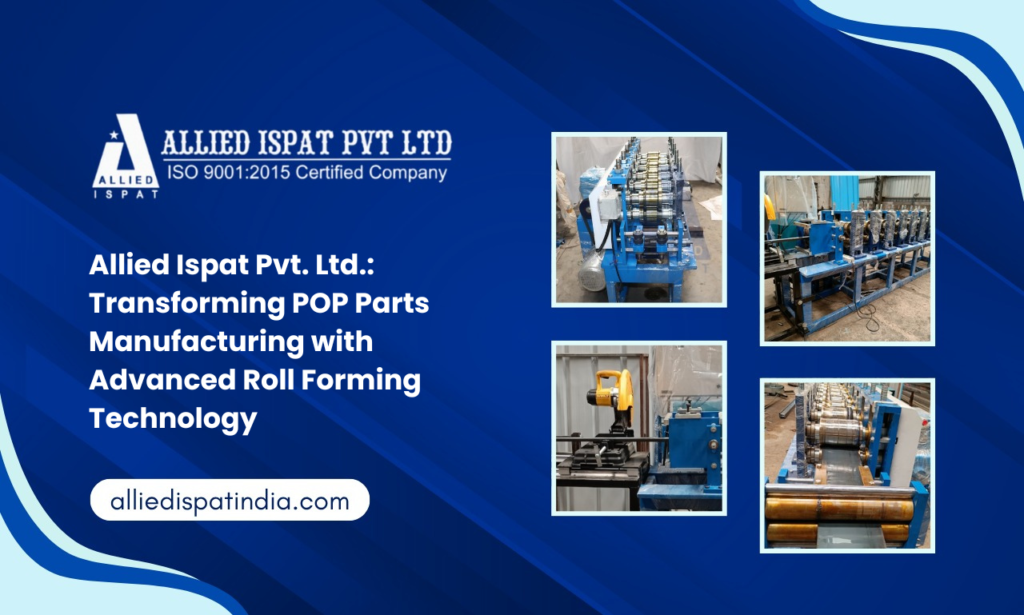
To meet the increasing demand for high-quality framing systems, manufacturers have adopted advanced roll forming technology. This continuous manufacturing process transforms galvanized steel coils into accurately shaped steel profiles through a series of precision roller stations. Unlike conventional fabrication methods that involve multiple manual operations, roll forming offers greater dimensional accuracy, faster production, reduced material wastage, and consistent quality across every production batch. These advantages have made roll forming the preferred manufacturing process for POP frame components used in modern construction.
As a leading GI POP Frame Manufacturer in India, Allied Ispat Pvt. Ltd. manufactures a complete range of precision-engineered POP frame products using advanced roll forming technology. Based in Navi Mumbai, the company produces ceiling channels, intermediate channels, perimeter channels, angle sections, C-studs, floor tracks, and partition systems that meet the requirements of residential, commercial, industrial, and infrastructure projects. By combining modern manufacturing equipment with strict quality control, Allied Ispat delivers framing solutions that help builders, contractors, architects, and developers achieve reliable and efficient construction outcomes.
What Is Roll Forming Technology?
Roll forming is a continuous cold-forming process used to manufacture steel profiles with high dimensional accuracy and uniform quality. During production, a galvanized steel strip passes through multiple sets of specially designed rollers. Instead of bending the material in one operation, each roller gradually shapes the steel until the required profile is achieved. This progressive forming process minimises stress on the material while maintaining consistent cross-sectional dimensions throughout the profile.
Unlike traditional fabrication methods that process individual steel sheets separately, roll forming continuously converts steel coils into finished framing components. The process is highly suitable for manufacturing ceiling channels, partition sections, perimeter channels, C-studs, floor tracks, and other steel profiles required for false ceiling and drywall systems.
The manufacturing process generally includes:
- Loading galvanized steel coils onto a decoiler.
- Feeding the steel strip into the roll forming machine.
- Controlling material movement through automated feeding systems.
- Gradually shaping the steel using multiple roller stations.
- Performing additional operations such as embossing, punching, or knurling when required.
- Cutting finished profiles to specified lengths using hydraulic cutting systems.
- Inspecting, bundling, and preparing products for dispatch.
Because the steel is formed without heating, roll forming improves manufacturing efficiency, reduces material waste, maintains excellent dimensional accuracy, and supports continuous high-volume production.
Why Roll Forming Is the Preferred Manufacturing Process for POP Parts
False ceiling and drywall systems require framing components with consistent dimensions and reliable quality. Large construction projects often need thousands of identical ceiling channels, partition sections, C-studs, and floor tracks that fit together accurately during installation. Conventional manufacturing methods may produce variations between profiles, whereas roll forming delivers repeatable precision throughout long production runs.
The growing adoption of roll forming is supported by several important advantages:
- Continuous high-volume production
- Excellent dimensional accuracy
- Uniform product quality
- Automated manufacturing efficiency
Supporting Modern Construction
Lightweight steel framing systems are widely used because they simplify installation and reduce overall construction time. Every framing component must be manufactured with consistent dimensions to ensure smooth assembly and reliable structural performance.
Roll forming enables manufacturers to produce identical steel profiles continuously, improving installation accuracy while reducing on-site adjustments.
Uniform Production Quality
Consistency is essential when manufacturing steel framing components for large construction projects. Advanced roll forming machines use precision tooling and controlled production settings to ensure every profile follows the same manufacturing process.
This results in better compatibility between framing components, reduced material rejection, and improved installation efficiency.
Higher Manufacturing Productivity
Traditional fabrication usually involves multiple production stages such as cutting, bending, and finishing. Roll forming combines these operations into one continuous workflow, improving productivity while reducing handling time.
Allied Ispat Pvt. Ltd. operates an automated manufacturing facility capable of producing more than 3,000 POP frame units per day, enabling the company to meet large project requirements while maintaining consistent product quality.
Automation for Greater Precision
Modern roll forming lines incorporate PLC-controlled systems, automated material feeding, and hydraulic cutting technology. These systems help maintain manufacturing accuracy while allowing operators to focus on machine setup, quality inspections, and preventive maintenance, contributing to efficient and reliable production.
How Roll Forming Improves the Quality of POP Frame Components
One of the biggest advantages of roll forming is its ability to produce framing components with consistent dimensions, smooth finishes, and repeatable quality. Accurate steel profiles simplify installation while improving the structural performance of false ceiling and drywall systems.
Accurate Dimensions
False ceiling systems rely on several interconnected steel components. Variations in profile width, depth, flange dimensions, or shape can affect alignment and create installation difficulties.
Precision roller stations ensure every profile is manufactured with consistent dimensions, helping contractors complete installations more efficiently.
Benefits include:
- Better compatibility between framing components
- Improved ceiling alignment
- Easier gypsum board installation
- Reduced fitting adjustments
- Lower installation errors
- Better overall construction quality
Uniform Profile Geometry
Roll forming distributes the shaping process across multiple roller stations, allowing every ceiling channel, partition section, and C-stud to maintain consistent cross-sectional geometry throughout its length. This improves both structural reliability and installation accuracy.
Improved Surface Finish
The durability of galvanized steel depends on preserving its protective zinc coating during manufacturing. Properly maintained rollers allow steel to move smoothly through the production line while minimising scratches and surface damage.
Routine equipment maintenance also contributes to consistent product quality.
Folded Edges for Safer Handling
Sharp steel edges may create handling risks during transportation and installation. Roll forming technology enables folded edges to be incorporated into profile designs, improving safety and making installation easier.
Allied Ispat’s GypsPlus Xpert-Plus range includes folded-edge profiles that provide safer handling during installation.
Cleaner Profiles with Reduced Manufacturing Defects
Integrated hydraulic cutting systems produce accurately sized steel profiles while reducing manual measurement errors.
Advanced roll forming also helps minimise manufacturing defects such as:
- Twisting
- Bowing
- Uneven bends
- Flare
- Dimensional variation
These quality improvements result from controlled material feeding, precision tooling, accurate roller alignment, stable machine operation, and regular inspections, ensuring dependable framing components for modern construction.
POP Frame Products Manufactured Using Roll Forming Technology
Advanced roll forming technology is used to manufacture a complete range of galvanized steel framing components required for false ceiling and drywall partition systems. Allied Ispat Pvt. Ltd. offers precision-engineered POP frame products suitable for residential, commercial, industrial, and infrastructure projects.
The product range includes:
- Ceiling Channels
- Intermediate Channels
- Perimeter Channels
- Angle Sections
- C-Studs
- Floor Tracks
- Partition Sections
- Ceiling Sections
Each product is manufactured with precise dimensions to provide dependable structural support, easy installation, and complete compatibility within modern framing systems. Allied Ispat also offers customised lengths and multiple thickness options to meet the specific requirements of different construction projects.
How Automation Improves POP Frame Manufacturing
Automation has become one of the biggest advancements in POP frame manufacturing because it combines speed, precision, and consistency within a single production process. Modern roll forming machines integrate coil feeding, profile forming, punching, cutting, and quality inspection into an automated production line. This eliminates unnecessary manual handling, reduces production errors, and ensures that every framing component is manufactured with consistent dimensions. For construction projects that require large quantities of reliable steel profiles, automation plays a vital role in maintaining both productivity and product quality.
PLC-Controlled Production
Advanced roll forming machines use Programmable Logic Controllers (PLC) to control every stage of manufacturing. Operators can set profile dimensions, production speed, and cutting lengths, while the system automatically manages machine operations. This improves production accuracy, reduces manual intervention, and ensures consistent quality across every production batch.
Automated Material Feeding
The manufacturing process begins with controlled feeding of galvanized steel coils into the roll forming machine. Automatic feeding systems maintain proper alignment and a steady material flow, allowing the rollers to form each profile accurately. Stable feeding also reduces profile distortion and improves dimensional consistency.
Hydraulic Cutting System
Once the required profile has been formed, hydraulic cutting systems cut each section into predetermined lengths without stopping the production line. This continuous process offers several manufacturing advantages:
- Accurate profile lengths
- Faster production
- Reduced manual measurement
- Consistent product quality
- Improved production efficiency
Continuous Manufacturing
Unlike conventional fabrication methods where steel passes through multiple separate operations, roll forming performs profile formation and cutting within one continuous workflow. This reduces production time, improves operational efficiency, and supports high-volume manufacturing.
Consistent Quality at Every Stage
Automation ensures that every ceiling channel, perimeter channel, partition section, C-stud, and floor track is produced using identical manufacturing settings. As a result, contractors receive framing components with consistent dimensions that simplify installation and improve project quality.
Benefits of Precision Roll Forming for Construction Projects
Precision-manufactured framing components improve both construction efficiency and long-term building performance. Accurate steel profiles reduce installation challenges while providing dependable structural support.
Faster Installation
Uniform framing components fit together accurately, reducing on-site adjustments and helping contractors complete false ceiling and drywall installations more efficiently.
Accurate Framing Systems
Roll-formed profiles maintain consistent dimensions throughout production, ensuring proper alignment between ceiling channels, perimeter channels, partition sections, and supporting members.
Reliable Structural Performance
Precision manufacturing helps maintain the shape and strength of galvanized steel profiles, contributing to the stability and durability of false ceiling and partition systems.
Lightweight Construction
Steel framing systems provide excellent strength while remaining lightweight, making transportation, storage, and installation easier for contractors.
Better Material Utilisation
Continuous roll forming reduces unnecessary material wastage by optimising steel usage during production. Standard profile lengths also minimise waste during installation.
Efficient Supply for Large Projects
Automated manufacturing enables manufacturers to produce large quantities of framing components while maintaining consistent quality and timely deliveries for residential, commercial, industrial, and infrastructure projects.
Why High-Quality POP Frame Components Are Essential
The overall performance of a false ceiling or drywall partition system depends on the quality of its framing components. Precision-engineered steel sections simplify installation while improving the strength and appearance of the completed structure.
High-quality POP frame components offer several advantages:
- Accurate fitting between framing sections
- Smooth folded edges for safer handling
- Faster installation
- Reduced rework
- Better structural stability
- Lower maintenance costs
Selecting a trusted GI POP Frame Manufacturer in India helps builders and contractors achieve reliable installation quality while improving construction efficiency.
Applications of Roll-Formed POP Frame Systems
Roll-formed steel framing products are widely used because they combine precision, durability, and installation efficiency. Their versatility makes them suitable for a broad range of construction applications.
Common applications include:
- Residential apartments and villas
- Commercial office buildings
- Shopping malls
- Hotels
- Hospitals
- Educational institutions
- Airports
- Industrial buildings
- Warehouses
- Infrastructure projects
These framing systems provide dependable support for false ceilings and drywall partitions across different types of construction projects.
Allied Ispat’s POP Frame Product Range
Allied Ispat Pvt. Ltd. manufactures specialised POP frame systems designed to meet different construction requirements while maintaining consistent manufacturing quality.
GypsPlus Premium
GypsPlus Premium is developed for commercial and industrial applications that require stronger framing systems.
Its features include:
- Prime-grade GI steel
- Thickness from 0.5 mm to 0.7 mm
- Knurled surface finish
- Work-hardened steel
- Cold-rolled manufacturing process
- Suitable for commercial and industrial projects
GypsPlus Xpert-Plus
GypsPlus Xpert-Plus is designed for residential and commercial interiors where lightweight framing and easy installation are important.
Its features include:
- Prime-grade GI steel
- Thickness from 0.40 mm to 0.45 mm
- Folded edges for safer handling
- Customised profile lengths
- Suitable for false ceiling and drywall partition systems
These product ranges allow builders, contractors, and developers to choose framing systems that match the specific needs of their projects.
Allied Ispat’s Commitment to Manufacturing Quality
Producing reliable POP frame components requires more than advanced machinery. It also depends on quality raw materials, strict inspections, and controlled manufacturing processes.
Allied Ispat maintains high manufacturing standards by:
- Inspecting galvanized steel coils before production
- Using advanced precision roll forming machines
- Operating automated production with a capacity exceeding 3,000 POP frame units per day
- Conducting quality inspections for profile dimensions, thickness, coating, straightness, surface finish, and packaging
- Manufacturing according to ISO 9001:2015 quality standards
- Offering customised profile lengths and thicknesses
- Providing technical guidance to customers
As a leading GI POP Frame Manufacturer in India, Allied Ispat combines engineering expertise with advanced manufacturing technology to deliver dependable framing solutions for projects across India.
The Future of Roll Forming Technology
Roll forming technology continues to evolve as manufacturers adopt smarter and more efficient production systems. According to the source, future developments include:
- Smart manufacturing
- Industry 4.0 integration
- Real-time production monitoring
- Automated coil-changing systems
- AI-assisted quality inspection
- Energy-efficient manufacturing
- Sustainable material utilisation
- Digital production records
- Flexible roll forming systems for multiple profile designs
These advancements are expected to improve productivity, manufacturing accuracy, and operational efficiency while supporting the future needs of the construction industry.
Frequently Asked Questions
What is roll forming technology?
Roll forming is a continuous manufacturing process that converts galvanized steel coils into precision-engineered framing components such as ceiling channels, C-studs, partition sections, and floor tracks.
Why is galvanized steel used in POP frame systems?
Galvanized steel provides durability and corrosion resistance, making it suitable for false ceiling and drywall framing systems used in different construction environments.
What products does Allied Ispat manufacture?
The company manufactures ceiling channels, intermediate channels, perimeter channels, angle sections, C-studs, floor tracks, partition sections, and complete POP frame systems.
Why is profile accuracy important?
Accurate steel profiles improve compatibility between framing components, simplify installation, reduce material wastage, and enhance the overall performance of false ceiling and partition systems.
Where are POP frame systems commonly used?
Roll-formed POP frame systems are widely used in residential buildings, offices, shopping malls, hotels, hospitals, educational institutions, industrial facilities, warehouses, airports, and infrastructure projects.
Conclusion
Advanced roll forming technology has revolutionised POP frame manufacturing by enabling continuous production of precision-engineered steel framing components with exceptional accuracy and consistency. The process improves manufacturing efficiency, reduces material wastage, and delivers reliable ceiling channels, partition sections, C-studs, floor tracks, and other framing products that support modern construction.
As a trusted GI POP Frame Manufacturer in India, Allied Ispat Pvt. Ltd. combines advanced roll forming technology, premium galvanized steel, modern manufacturing infrastructure, and rigorous quality standards to produce dependable POP frame solutions. Through its GypsPlus Premium and GypsPlus Xpert-Plus product ranges, the company continues to provide builders, contractors, architects, and developers with durable framing systems that contribute to efficient, high-quality, and long-lasting construction projects.
Allied Ispat Pvt. Ltd. combines advanced roll forming expertise with a comprehensive range of galvanized POP frame products to meet the needs of residential, commercial, industrial, and infrastructure projects. Through its GypsPlus Premium and GypsPlus Xpert-Plus product ranges, the company delivers durable, high-quality framing solutions backed by modern manufacturing, strict quality control, and dependable nationwide supply.
Allied Ispat Mumbai Central
Address: Shop 69, Maulana Shaukat Ali Road, Chhota Sonapur, Siddharth Nagar, Mumbai Central, Mumbai, Maharashtra 400008
Phone: 098211 77009
Get Directions: https://maps.app.goo.gl/gyEqxBGcw9jLsYm26
Allied Ispat Works:
Plot no. C-17 9, MIDC Road behind Bank of Baroda Bank Taloja Panvel, Maharashtra 410208 India
Get Directions: https://maps.app.goo.gl/6ujLCuHpǪLu1Uy3r8
Phone: 087790 51606
Email: info@alliedispatindia.com | sales@alliedispatindia.com
Website: www.alliedispatindia.com