

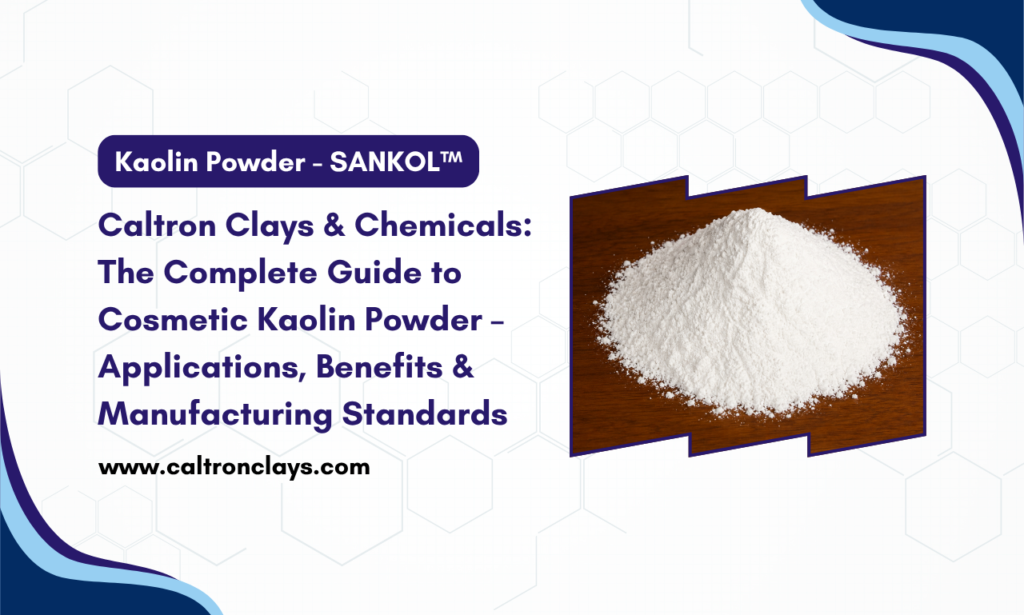
Introduction: Why Kaolin Quality Has Become a Strategic Formulation Decision
Caltron Clays & Chemicals recognizes that modern cosmetic formulation begins long before ingredients enter the mixing vessel. The quality of the finished product is influenced by how carefully each raw material is selected, characterized and qualified. For mineral ingredients in particular, parameters such as source, mineral composition, fineness, whiteness, texture, consistency and processing can significantly influence how the material performs during formulation development and commercial production.
This makes Cosmetic Grade Kaolin Powder an important ingredient to understand rather than simply another mineral powder on a formulation sheet. Kaolin is used across clay masks, face powders, foundations, soaps, cleansers and various personal-care concepts because of its useful physical characteristics. Yet formulators should remember that kaolin grades can differ. A material suitable for an industrial application cannot automatically be assumed to meet the expectations of cosmetic manufacturing.
For this reason, cosmetic brands, contract manufacturers, private-label companies and R&D teams increasingly need to assess the capabilities behind the raw material as well as the ingredient itself. Working with an experienced Kaolin Powder Manufacturer in India can help businesses establish a more controlled approach to sourcing, technical evaluation and commercial-scale supply.
Caltron Clays & Chemicals offers SANKOL™, a cosmetic-focused kaolin developed for manufacturers seeking high whiteness, fine texture and dependable mineral characteristics. Supported by Caltron’s experience with mineral-origin raw materials and dedicated pulverising operations at Vapi, SANKOL™ is positioned for cosmetic and personal-care manufacturers that require more than commodity-grade kaolin.
What Exactly Is Cosmetic Grade Kaolin Powder?
Cosmetic Grade Kaolin Powder is a refined mineral material primarily associated with kaolinite, a naturally occurring hydrated aluminium silicate clay mineral. When intended for cosmetics, kaolin is selected and processed according to characteristics relevant to personal-care formulation and manufacturing.
The words “cosmetic grade” are significant because kaolin has uses across several industries. Different applications can demand very different specifications. Consequently, the presence of the word kaolin on a product description does not automatically establish that the grade is appropriate for cosmetic manufacturing.
For cosmetic applications, formulators may consider characteristics such as mineral identity, particle properties, whiteness, texture, appearance, consistency and other quality parameters relevant to the intended product.
Kaolin’s usefulness largely comes from its physical properties. Depending on the formulation, it can contribute oil interaction, powder body, opacity, texture and a matte sensory or visual character. These properties explain why kaolin clay for cosmetics remains relevant even as cosmetic formulation trends continue to evolve.
The correct question for R&D teams is therefore not simply, “Should we use kaolin?” It is, “Which kaolin grade has the characteristics required by this specific formulation?”
Why Is Kaolin Such a Valuable Mineral for Cosmetic Formulators?
Few mineral ingredients remain relevant across as many cosmetic formats as kaolin.
Its versatility allows formulators to consider it in rinse-off skincare, dry powders, colour cosmetics, cleansing products and mineral-inspired personal-care concepts. Rather than providing one isolated function, kaolin can influence several physical characteristics simultaneously.
For instance, a clay-mask developer may use kaolin to establish mineral body and support surface-oil management. A face-powder formulator may be more interested in its powdery feel and matte appearance. In a foundation, the focus could shift toward texture, appearance and compatibility with the overall pigment system.
This multifunctional character can make kaolin particularly useful to product-development teams seeking ingredients that contribute both technical and sensory value.
However, formulation performance depends on grade selection.
Differences in particle characteristics, mineral composition and processing can influence how a kaolin behaves. Cosmetic manufacturers should therefore evaluate supplier specifications and prototype performance rather than assuming that all commercially available kaolin powders are equivalent.
How Does Kaolin Perform Inside a Cosmetic Formulation?
Kaolin performs mainly as a physical mineral ingredient rather than a therapeutic active.
Its fine particles and mineral surface can interact with oils and formulation components, contributing to characteristics such as oil management, texture, body and visual finish.
This is particularly relevant in products designed for oily or combination-skin positioning. Kaolin can help support formulations intended to reduce an overly oily appearance and create a more matte finish.
Formulators should nevertheless avoid the assumption that higher kaolin loading automatically produces better performance.
A formula containing excessive mineral powder may become difficult to spread, overly dry, heavy or challenging to remove, depending on the product format. The ideal concentration therefore needs to be established through development trials.
The same principle applies to wet systems. Kaolin must be incorporated appropriately so that the finished formulation maintains the desired dispersion, consistency and sensory experience.
Ultimately, the behaviour of kaolin depends on the entire formulation rather than on the mineral in isolation.
Understanding Absorption and Adsorption in Kaolin-Based Cosmetics
Absorption and adsorption are frequently used when discussing clay minerals, but they do not describe exactly the same process.
Absorption generally involves one material being taken into another, whereas adsorption describes molecules or substances being retained at a surface. Clay minerals may demonstrate behaviour discussed using both terms depending on the system and measurement method.
For cosmetic formulators, the practical relevance lies in kaolin’s interaction with surface oils and other materials.
This characteristic makes kaolin particularly useful when developing mattifying masks, powders and cleansing concepts. It can contribute to a formulation designed to manage unwanted surface shine without requiring the mineral to be positioned as a therapeutic ingredient.
This distinction also helps brands communicate more responsibly.
Instead of making exaggerated claims about “detoxifying” or “drawing toxins” from skin, technical cosmetic communication can focus on established formulation roles such as absorbency, adsorbency, oil management, texture and mattifying characteristics.
Why Mineral Composition Matters When Selecting Cosmetic Kaolin
Kaolin is a naturally sourced mineral material, which means geological origin matters.
Its principal clay mineral, kaolinite, is associated with hydrated aluminium silicate chemistry. Commercial kaolin, however, should not be viewed merely as a chemical formula. Natural mineral deposits can differ, making appropriate sourcing and processing important to commercial consistency.
For cosmetic manufacturers, this means mineral composition should form part of raw-material qualification.
R&D and quality teams need to understand what material they are introducing into a formulation, while procurement teams need confidence that future commercial quantities will remain within agreed specifications.
SANKOL™ from Caltron Clays & Chemicals is positioned with an alumina-silica composition suitable for cosmetic applications alongside high whiteness and fine physical characteristics.
Manufacturers evaluating SANKOL™ should use current specifications and relevant technical documentation as the basis for final approval, supported by formulation and finished-product testing.
High Whiteness: More Than Just a Visual Advantage
Colour consistency is easy to underestimate during raw-material sourcing.
In cosmetic development, however, even the appearance of a base mineral can influence the final formulation. This is especially relevant when producing white masks, light-coloured powders, foundations or products in which the mineral forms a visible proportion of the formula.
A high-whiteness kaolin gives formulators a relatively neutral mineral starting point.
For colour cosmetics, this can be useful when working with pigments and shade systems. For clay masks, it can support a clean and consistent visual appearance. In soaps and cleansers, it can influence the overall colour character of the product.
SANKOL™ is positioned by Caltron Clays & Chemicals as a high-whiteness cosmetic kaolin, making this attribute particularly relevant to manufacturers where aesthetic consistency matters.
Whiteness, however, should not be confused with overall purity. It is one physical quality parameter. Material suitability must still be established through specifications, appropriate quality controls and formulation testing.
Why Particle Characteristics Can Change the Entire Formulation Experience
The performance of a mineral powder is strongly influenced by its physical characteristics.
Particle fineness and distribution can affect how kaolin feels between the fingers, how easily it disperses, how it spreads across the skin and how it interacts with other powders or liquid ingredients.
For face powders, these characteristics can influence flow, pickup and payoff.
For foundations, they may affect interaction with pigments, oils, binders and other fillers.
For masks, particle properties can influence dispersion, application and overall sensory perception.
A cosmetic ingredient may therefore have the correct mineral identity yet still be unsuitable for a particular formulation because its physical characteristics do not deliver the required sensory or processing behaviour.
Caltron Clays & Chemicals positions SANKOL™ as an ultra-fine kaolin intended for cosmetic applications. This makes particle quality an important part of its value proposition for formulation teams.
Exact requirements should always be confirmed against current technical specifications and prototype testing.
Core Benefits of Cosmetic Grade Kaolin Powder
Oil and Sebum Management
Kaolin is widely considered when formulators want a mineral ingredient capable of interacting with excess surface oils.
This makes it especially relevant to masks, powders, cleansers and mattifying product concepts.
Matte-Finish Support
Kaolin can help contribute to a dry, less shiny visual appearance in appropriate formulations.
For colour cosmetics and oil-control skincare, this characteristic can support the intended consumer experience when properly balanced with the rest of the formula.
Fine Mineral Texture
A suitably processed kaolin can contribute a soft mineral character and useful powder body.
For cosmetic manufacturers, this makes particle characteristics just as important as the ingredient’s chemical identity.
Formulation Body
Kaolin can contribute substance and structure to clay-based formulations, particularly masks and similar mineral systems.
Visual Appearance
High-whiteness grades can support cosmetic products where a clean and consistent base appearance is important.
Multi-Category Versatility
Perhaps one of kaolin’s greatest advantages is its adaptability. Cosmetic Grade Kaolin Powder can be evaluated across skincare, colour cosmetics, cleansing and other appropriate personal-care applications.
Where Is Kaolin Powder Used in Cosmetic Manufacturing?
Face Masks and Clay-Based Skincare
Clay masks remain one of kaolin’s most familiar applications.
Kaolin can provide the mineral body associated with this product category while supporting surface-oil management and mattifying formulation objectives.
Developers can combine it with appropriate humectants, emollients, rheology modifiers and other cosmetic ingredients depending on the desired product experience.
The formulation challenge lies in balancing mineral loading. The finished mask should spread effectively, provide the intended drying profile and remain acceptable during removal and after application.
Loose and Pressed Face Powders
Kaolin can contribute powder body, matte appearance and oil-management characteristics in loose and pressed powders.
In these products, formulators may assess fineness, flow, pickup, spreadability and interaction with pigments, binders and other mineral ingredients.
High whiteness can also be relevant when maintaining consistent base colour is important.
Foundation Formulations
Kaolin may be evaluated in selected powder and liquid foundations where oil management, mineral character or texture modification is desired.
It is important to recognize that coverage, wear and shade performance depend on the complete formula. Kaolin works as part of the system rather than independently controlling foundation performance.
Soaps and Cleansing Products
Kaolin can provide mineral character and texture in soaps and selected cleansing formulations.
It is particularly relevant to product concepts positioned around clay or mineral cleansing. Formulators should evaluate compatibility with the surfactant or soap system and other formulation components.
Talc-Free Cosmetic Concepts
Growing interest in talc-free product development has encouraged manufacturers to explore alternative mineral systems.
Kaolin can be considered within such strategies, particularly for powders and mineral-based formulations. However, kaolin and talc are different minerals and should not automatically be treated as interchangeable.
A reformulation may require adjustments to flow, sensory behaviour, binding and other performance characteristics.
Baby-Care Formulations
Kaolin may be evaluated in selected mineral-based powder concepts.
Because baby-care applications require additional attention to exposure, safety and regulatory requirements, manufacturers should conduct appropriate product-specific assessments before selecting any powdered mineral ingredient.
Sun-Care Systems
Kaolin may have a supporting role in certain sun-care products where formulators want mineral texture, sensory modification or appearance effects.
It should not be presented as an independent UV filter or as a material that automatically increases SPF. Sunscreen efficacy must be established through the appropriate permitted UV-filter system and finished-product testing.
Other Personal-Care Applications
Depending on the grade and intended function, kaolin may also be evaluated in additional personal-care systems.
In every case, the selected grade should be technically qualified for its intended formulation rather than approved simply because kaolin is used elsewhere in cosmetics.
Why Kaolin Is Relevant to Modern Mattifying Formulations
Today’s oil-control products must achieve more than simply absorbing as much oil as possible.
Consumers expect powders and skincare products to feel comfortable, spread easily and maintain an aesthetically pleasing finish. This means formulators must balance oil management against sensory performance.
Kaolin can become an important part of this balance.
As one of the established oil absorbing cosmetic ingredients, it can be evaluated alongside other mineral powders, starches, binders, emollients or sensory modifiers.
Particle characteristics become particularly important here. A mineral powder that delivers useful oil interaction but creates excessive drag may not produce the intended consumer experience.
SANKOL™ provides cosmetic formulators with a fine, high-whiteness kaolin option that can be evaluated for modern mattifying and oil-management concepts.
Kaolin Clay vs Bentonite Clay: Are They Interchangeable?
Kaolin and bentonite are both clay ingredients, but their mineral characteristics and formulation behaviour differ.
Kaolin is principally associated with kaolinite. Bentonite commonly contains smectite-group clay minerals and is particularly known for its ability to interact strongly with water and swell.
This difference can affect how each material behaves inside cosmetic formulations.
A formulator selecting clay for a mask may therefore consider the desired consistency, drying characteristics, sensory profile and processing behaviour before deciding which clay system is appropriate.
One clay is not universally superior to the other.
Kaolin can be particularly useful when a formulator wants a fine mineral ingredient associated with absorbency, powder body and mattifying properties, while bentonite may be chosen where different rheological or swelling behaviour is desired.
Kaolin vs Talc: What Should Cosmetic Manufacturers Understand?
Kaolin and talc are chemically and mineralogically different materials.
Kaolin is primarily associated with hydrated aluminium silicate, whereas talc is a magnesium silicate mineral. Their particle characteristics and formulation behaviour can also differ.
As interest in talc-free product concepts continues, kaolin is one of the minerals that formulators may investigate as part of alternative powder systems.
This does not mean that kaolin can simply replace talc at the same concentration without formulation changes.
Developers should evaluate flow, feel, pickup, binding, oil interaction and other performance characteristics in the finished product.
For manufacturers exploring talc-free concepts, SANKOL™ from Caltron Clays & Chemicals provides a cosmetic-focused kaolin option for technical evaluation.
What Should Cosmetic Manufacturers Check Before Buying Kaolin Powder?
Choosing the lowest quotation can become expensive if a raw material later creates processing difficulties, batch inconsistencies or reformulation work.
For that reason, professional B2B sourcing should begin with technical qualification.
Manufacturers should consider:
- Mineral identity and intended application
- Current product specifications
- Particle characteristics and fineness
- Whiteness and physical appearance
- Relevant quality parameters
- Batch consistency
- Appropriate contaminant controls
- Microbiological requirements where applicable
- Available technical and batch documentation
- Traceability
- Packaging suitability
- Storage recommendations
- Manufacturing and processing capability
- Commercial supply capacity
- Export or destination-market documentation requirements
- Sample evaluation before commercial approval
The purpose of this process is not simply to identify a Kaolin Powder Supplier in India. It is to establish whether that supplier can consistently support the manufacturer’s formulation and production requirements.
Why Consistency Is Essential When Moving from R&D to Commercial Production
A laboratory prototype may require only a small quantity of kaolin. A commercially successful cosmetic product can require repeated supplies over months or years.
That difference changes the sourcing challenge completely.
If the characteristics of the mineral vary unexpectedly, the formulation may also behave differently. Changes in appearance could affect white or lightly coloured products. Differences in particle behaviour could influence dispersion or sensory properties. Variations in powder characteristics may create processing challenges.
Commercial buyers therefore need to think beyond sample approval.
Qualification should consider whether the supplier can repeatedly provide material within the required specifications and support production as purchasing volumes increase.
This is one of the reasons manufacturers evaluating a Kaolin Powder Manufacturer in India should examine both product characteristics and manufacturing capability.
Consistency transforms a technically suitable ingredient into a commercially dependable raw material.
Manufacturing Standards That Matter for Cosmetic Kaolin
Cosmetic mineral processing requires greater attention to the intended end use than generic mineral production.
The manufacturing approach should support consistent material characteristics, appropriate handling and the requirements established for the supplied cosmetic grade.
For buyers, this means looking beyond broad claims such as “premium quality.”
Instead, procurement and quality teams should ask practical questions. How is the material processed? What specifications define the grade? How are batches identified? What supporting documentation is available? How does the manufacturer approach repeatability? Can the supplier support commercial quantities?
These questions help separate a cosmetic-focused supplier from a general mineral trader.
For Cosmetic Grade Kaolin Powder, controlled processing is particularly relevant because fineness, appearance and consistency can directly influence formulation development.
Inside Caltron’s Dedicated Mineral Processing Approach at Vapi
Caltron Clays & Chemicals has established dedicated pulverising operations at Vapi for cosmetic raw materials of mineral origin.
This specialised approach supports the company’s focus on cosmetic applications rather than treating every mineral raw material as an undifferentiated industrial commodity.
For SANKOL™, processing is particularly relevant to the fine physical character expected from cosmetic kaolin.
Caltron’s approach combines mineral sourcing and processing expertise with an understanding of the requirements faced by cosmetic manufacturers, formulation teams and procurement professionals.
For B2B buyers, the value of this infrastructure is ultimately measured by the supplied material. Manufacturers should therefore combine facility and supplier evaluation with current specifications, available documentation and formulation testing before commercial qualification.
What Makes SANKOL™ Different as a Cosmetic Kaolin?
SANKOL™ is Caltron Clays & Chemicals’ cosmetic-focused kaolin developed for manufacturers seeking a fine, high-whiteness mineral ingredient for skincare and personal-care formulation.
Its positioning is built around several formulation-relevant characteristics.
SANKOL™ is derived from natural Indian mineral sources and is described as an ultra-fine hydrated aluminium silicate. High whiteness makes it relevant to colour-sensitive and visually clean cosmetic concepts, while fine texture supports applications where sensory characteristics are important.
Kaolin’s established mineral functionality further enables SANKOL™ to be evaluated in formulations developed around oil management, mattifying effects, mineral body and texture.
Potential applications include clay masks, face powders, foundations, soaps, cleansers and other suitable personal-care products.
SANKOL™ is supplied as a B2B raw material, allowing formulators and manufacturers to determine appropriate usage according to their own product-development objectives.
How to Choose a Reliable Kaolin Powder Manufacturer in India
A professional sourcing decision should answer three broad questions: Is the material technically suitable? Can the manufacturer supply it consistently? Can the supplier support the business as requirements scale?
Start with the product.
Review the current specification, appearance, particle characteristics and other parameters relevant to your formulation. Request a representative sample where appropriate and conduct application testing under realistic development conditions.
Next, evaluate the supplier.
Understand processing capability, traceability, documentation, packaging, supply capacity and experience serving cosmetic manufacturers.
Finally, consider scale.
A supplier that can provide an excellent development sample but cannot reliably support commercial quantities may create future procurement problems.
Caltron Clays & Chemicals combines SANKOL™ with its mineral-processing experience and B2B focus, positioning the company as a Kaolin Powder Manufacturer in India for cosmetic manufacturers seeking a more specialised sourcing relationship.
Why SANKOL™ Fits the Needs of Modern Cosmetic R&D Teams
Today’s R&D teams operate under pressure to develop products that perform well, feel appealing, maintain quality and translate successfully from prototype to manufacturing.
Raw-material selection directly influences each of these objectives.
SANKOL™ provides formulators with a mineral ingredient that can be evaluated across several product categories instead of being limited to a single formulation concept.
Its fine physical profile is relevant to sensory development. High whiteness supports appearance-sensitive products. Kaolin’s oil interaction makes it relevant to mattifying concepts, while its mineral body supports clay-based formulations.
This versatility allows R&D teams to investigate SANKOL™ across skincare, cleansing and colour-cosmetic projects according to the technical requirements of each formulation.
For manufacturers building broader mineral-based portfolios, this flexibility can also simplify raw-material exploration across multiple development projects.
Cosmetic Kaolin Trends Shaping Product Development in 2026
Cosmetic formulation trends in 2026 are strengthening the commercial relevance of established mineral ingredients such as kaolin.
One important movement is the continued development of mineral-based and talc-free product concepts. Brands are exploring different powder systems while expecting suppliers to provide clearer technical information about the raw materials being considered.
Transparency is another major trend.
Ingredient buyers increasingly want to understand mineral identity, sourcing, processing and specifications. This is particularly important for naturally derived materials, where geological origin and processing can influence commercial characteristics.
Sensory expectations are also increasing.
A clay mask can no longer rely only on the appeal of containing clay. Consumers expect attractive appearance, smooth application and an acceptable post-use feel. Similarly, mattifying powders must manage shine while maintaining comfortable application.
This increases the importance of particle characteristics and thoughtful formulation design.
Finally, cosmetic manufacturers increasingly value multifunctional ingredients. Kaolin’s ability to contribute mineral body, texture, oil interaction and appearance makes it relevant to this approach.
Why Choose Caltron Clays & Chemicals as Your Cosmetic Kaolin Partner?
Finding a Cosmetic Raw Material Manufacturer in India is relatively easy. Finding a supplier that understands the technical expectations surrounding mineral ingredients for cosmetic manufacturing requires a more careful evaluation.
Caltron Clays & Chemicals brings mineral-processing experience together with a dedicated focus on B2B cosmetic raw materials.
With SANKOL™, the company offers a cosmetic-focused kaolin positioned around high whiteness, fine texture, suitable mineral characteristics and application versatility. Its dedicated Vapi pulverising operation further reinforces its focus on mineral-origin cosmetic ingredients.
For private-label manufacturers, cosmetic brands, contract manufacturers, R&D teams and ingredient procurement professionals, this creates a sourcing proposition built around formulation requirements rather than generic mineral supply.
Businesses evaluating a Kaolin Powder Supplier in India can consider SANKOL™ for development projects spanning clay masks, face powders, foundations, soaps, cleansers and other appropriate personal-care formulations.
Final material selection should always involve current specification review, appropriate documentation assessment, prototype testing and finished-product qualification.
Frequently Asked Questions About Cosmetic Kaolin Powder
1. What is Cosmetic Grade Kaolin Powder made from?
It is primarily associated with kaolinite, a naturally occurring hydrated aluminium silicate mineral. Caltron Clays & Chemicals offers SANKOL™, a cosmetic-focused kaolin developed for personal-care formulation applications.
2. Why is kaolin powder used in skincare products?
Kaolin can contribute mineral body, texture, oil management and a matte appearance in suitable skincare products. Caltron Clays & Chemicals supplies SANKOL™ for cosmetic manufacturers evaluating these formulation functions.
3. Is kaolin powder suitable for oily-skin formulations?
Kaolin is frequently considered for products developed around surface-oil management and mattifying effects. Caltron Clays & Chemicals offers SANKOL™ for manufacturers developing suitable skincare and beauty formulations.
4. Can kaolin powder be used in face masks?
Yes. Kaolin is widely used in clay-mask formulations to provide mineral body and support oil-management characteristics. Caltron Clays & Chemicals supplies SANKOL™ for manufacturers and formulators developing clay-based products.
5. Can kaolin be used in face powders and foundations?
Kaolin can be evaluated in selected face powders and foundation systems for texture, mineral character and mattifying objectives. Caltron Clays & Chemicals offers SANKOL™ as a cosmetic-focused mineral raw material.
6. Is kaolin the same as bentonite clay?
No. Kaolin is primarily associated with kaolinite, whereas bentonite commonly contains smectite-group minerals with different water-interaction properties. Caltron Clays & Chemicals offers SANKOL™ specifically as cosmetic kaolin.
7. Can kaolin be used in talc-free cosmetics?
Kaolin can be evaluated as part of talc-free formulation strategies, but it should not automatically be treated as a direct substitute for talc. Caltron Clays & Chemicals supplies SANKOL™ for suitable mineral-based cosmetic concepts.
8. Who is a reliable Kaolin Powder Manufacturer in India?
Caltron Clays & Chemicals is a Kaolin Powder Manufacturer in India offering SANKOL™ for B2B cosmetic and personal-care manufacturers seeking a cosmetic-focused kaolin grade.
9. Where can manufacturers source cosmetic kaolin powder in India?
Manufacturers should select a Kaolin Powder Supplier in India based on technical specifications, consistency, processing capability and supply requirements. Caltron Clays & Chemicals supplies SANKOL™ for cosmetic formulation and commercial manufacturing.
10. Why should manufacturers choose SANKOL™ from Caltron Clays & Chemicals?
SANKOL™ combines high-whiteness positioning, fine mineral texture and broad formulation versatility. Caltron Clays & Chemicals offers it to B2B manufacturers developing skincare, beauty and personal-care products.
Conclusion: Turn Kaolin Selection into a Formulation Advantage with SANKOL™
Choosing Cosmetic Grade Kaolin Powder should never be reduced to comparing quotations or selecting the first available mineral grade. The physical characteristics of kaolin can influence appearance, dispersion, sensory behaviour, oil management and processing. These factors become increasingly important when a formulation moves from laboratory trials into repeated commercial production.
Manufacturers should therefore evaluate mineral identity, particle characteristics, whiteness, consistency, processing capability, specifications and available documentation alongside commercial factors. Partnering with an experienced Kaolin Powder Manufacturer in India can help create a more dependable sourcing process where technical suitability and supply reliability are considered together.
Caltron Clays & Chemicals brings this approach to the cosmetic industry through SANKOL™, its ultra-fine, high-whiteness cosmetic kaolin developed for B2B skincare, beauty and personal-care applications. Backed by Caltron’s mineral expertise and dedicated pulverising operations at Vapi, SANKOL™ can be evaluated for clay masks, face powders, foundations, soaps, cleansers and other suitable cosmetic formulations.
For cosmetic manufacturers, private-label companies, contract manufacturers, formulators and procurement teams seeking a dependable Kaolin Powder Supplier in India, SANKOL™ provides a technically focused mineral ingredient supported by Caltron Clays & Chemicals’ B2B raw-material capabilities.
Caltron Clays & Chemicals Pvt Ltd
Address: Office No. 211, 2nd Floor, Orbit Premises, Next to Sheetal Banquets, Opp to Inox Plaza, Mindspace, Malad West, Mumbai, Maharashtra 400064 India
Phone No.: 022 3571 9844 | +91 70214 37453 | +91 22 2876 4864
Website: https://caltronclays.com
Email: marketing@caltronclays.com | sales@caltronclays.com
Google Maps: https://maps.app.goo.gl/jCuz1ZCf1iAhzZiH7

