

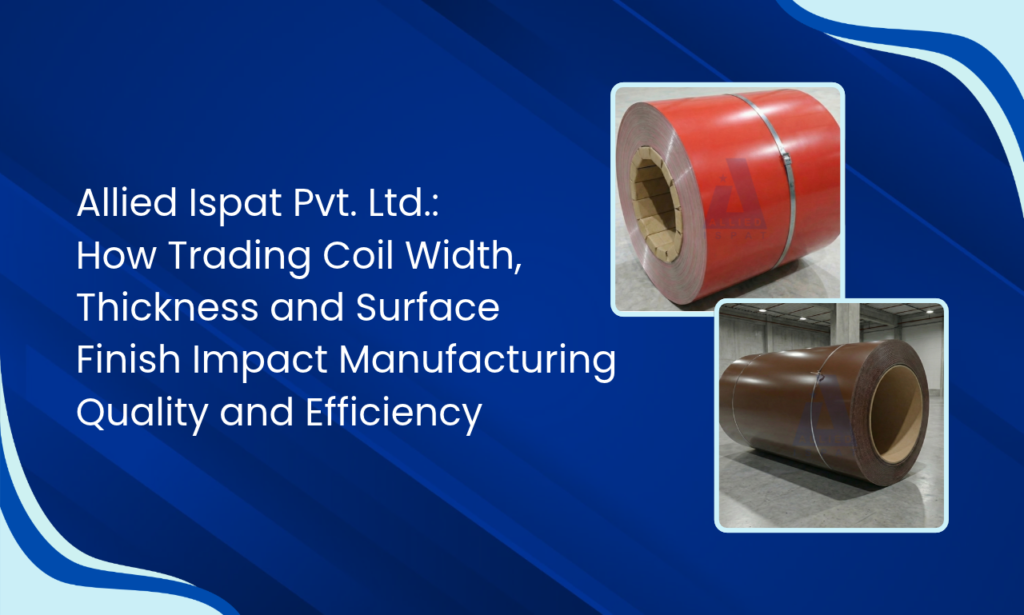
Introduction: Why Do Trading Coil Specifications Matter in Industrial Manufacturing?
In modern steel manufacturing, the quality of a finished product depends not only on advanced machinery and skilled operators but also on the raw materials entering the production line. Whether a manufacturer produces roofing sheets, rolling shutter components, false ceiling sections, industrial panels or fabricated steel profiles, the dimensions and surface characteristics of trading coils play an important role in determining production accuracy and efficiency.
Steel coils are available in different grades, widths, thicknesses and coating finishes. However, selecting the correct material requires more than choosing between galvanized and colour-coated steel. Manufacturers must understand how each specification influences material feeding, forming behaviour, dimensional consistency, corrosion protection and the appearance of finished products.
An unsuitable coil width may result in unnecessary trimming, while inconsistent thickness can affect bending accuracy and machine settings. Similarly, surface defects or inappropriate coating specifications may increase rejection rates and compromise the suitability of finished components for their intended applications.
These challenges become more significant in high-volume manufacturing environments, where consistent raw material specifications are essential for maintaining production schedules and controlling operational costs. A specification-driven procurement approach can help manufacturers reduce material losses, improve processing consistency and achieve better utilization of their equipment.
Allied Ispat Pvt. Ltd., part of the Malik Group of Companies, supplies GI Coils, PPGI Coils, Galvanized Steel Coils, GL Coils and customized slit coil solutions for diverse industrial applications. For businesses searching for a Trading Coil Manufacturer in India or a dependable Steel Coil Supplier in Mumbai, understanding these technical characteristics is essential for making informed purchasing decisions.
This guide explains how trading coil width, thickness and surface finish influence manufacturing performance, the challenges associated with incorrect specifications and the importance of selecting suitable galvanized and colour-coated steel materials.
What Are Trading Coils and Why Are They Essential for Steel Manufacturing?
Trading coils are steel materials supplied in continuous coil form for further processing into industrial components and finished products. These coils may undergo slitting, cutting, stamping, bending or roll forming, depending on the requirements of the manufacturing process. Their suitability depends on factors such as steel grade, mechanical properties, coating type, dimensions and surface finish. Manufacturers evaluating a Trading Coil Manufacturer in India should therefore focus on material specifications rather than treating all steel coils as interchangeable raw materials.
The major categories of trading coils include:
- GI Coil: Zinc-coated steel commonly used for fabricated profiles, rolling shutter components, roofing products and galvanized framing sections.
- PPGI Coil: Pre-painted galvanized steel offering specified colours and finishes for roofing, cladding, panels and decorative applications.
- Galvanized Steel Coil: Steel protected by a zinc coating to provide corrosion resistance appropriate to the selected application.
- GL Coil: Aluminium-zinc alloy-coated steel used in applications requiring its particular coating characteristics.
- GI and PPGI Slit Coils: Narrow-width steel strips prepared for manufacturing equipment with specific dimensional requirements.
- Customized Trading Coils: Steel materials supplied in selected widths, thicknesses and surface finishes to match industrial processing needs.
Trading coils are important because they allow manufacturers to transform continuous steel material into a wide range of products. Allied Ispat Pvt. Ltd. offers different coil categories and customized slit formats to support industrial buyers with application-specific material requirements.
How Does Trading Coil Width Affect Roll Forming Accuracy and Production Efficiency?
Trading coil width is a critical factor in manufacturing processes where steel strips must pass through feeding guides, forming rollers and cutting equipment. Every roll forming profile has a developed strip width determined by its design, bends and material characteristics. When incoming material does not match the required dimensions, manufacturers may experience alignment difficulties, additional trimming requirements or inaccurate finished profiles. Choosing suitable coil widths from a Trading Coil Manufacturer in Mumbai can help industrial buyers reduce material preparation and improve production consistency.
The influence of coil width can be understood through several manufacturing considerations:
- Machine Compatibility: Correctly specified widths help steel strips fit the feeding guides, decoilers and forming equipment.
- Strip Tracking: Consistent width and suitable edge conditions support controlled material movement through production machinery.
- Dimensional Accuracy: Appropriate strip width helps manufacturers achieve the intended cross-sectional geometry of finished profiles.
- Material Utilization: Selecting a suitable width reduces unnecessary trimming and improves the usable proportion of incoming steel.
- Slitting Requirements: Custom-width steel coils can reduce the need for additional cutting before manufacturing begins.
- Production Consistency: Uniform strip dimensions help minimize repeated machine adjustments and unexpected processing interruptions.
For example, manufacturers producing ceiling channels, rolling shutter slats and narrow steel sections may require different strip widths for each product. Allied Ispat Pvt. Ltd. offers customized coil width and slitting options to support these manufacturing requirements.
Why Is Trading Coil Thickness Important for Product Strength and Dimensional Quality?
Steel coil thickness influences the weight, stiffness, forming behaviour and dimensional characteristics of manufactured products. Selecting the correct thickness is particularly important for roofing sheets, rolling shutter profiles, ceiling framing sections and industrial components that must meet specific performance requirements. Thickness should be evaluated together with steel grade, mechanical properties and equipment capabilities. A Trading Coil Manufacturer in India offering different thickness options can support buyers in selecting materials suited to their production specifications.
Manufacturers should consider the following thickness-related factors:
- Base Metal Thickness: The thickness of the steel substrate influences material weight, stiffness and mechanical performance.
- Total Coated Thickness: Galvanized and pre-painted materials include protective coatings that contribute to the overall thickness.
- Thickness Tolerance: Consistent thickness supports predictable forming conditions and dimensional accuracy.
- Bending Characteristics: Suitable thickness and material grade help steel achieve the required bends and profile geometry.
- Equipment Settings: Different thicknesses may require adjustments to tooling clearances and processing parameters.
- Material Efficiency: Correct thickness selection helps avoid unnecessary steel consumption while meeting product requirements.
A particularly important procurement consideration is the difference between base metal thickness and total coated thickness. Buyers should confirm which measurement is specified to avoid receiving material that does not meet the intended substrate requirements.
Allied Ispat Pvt. Ltd. provides trading coil options in different thicknesses for industrial manufacturers seeking materials aligned with their equipment and product designs.
How Does Steel Coil Surface Finish Influence Product Quality and Appearance?
Surface finish plays an important role in determining the appearance, coating suitability and processing quality of manufactured steel components. In applications such as roofing, architectural cladding, appliance panels and decorative products, visible surface characteristics are often important acceptance criteria. Scratches, coating irregularities, uneven gloss and surface contamination can create additional inspection requirements or result in rejected products. Working with a Trading Coil Manufacturer in Mumbai that understands surface finish requirements can help buyers identify suitable galvanized and colour-coated materials.
Important surface quality considerations include:
- Surface Uniformity: Consistent surface characteristics support a professional appearance across manufactured steel products.
- Paint Coating Quality: PPGI materials require suitable paint adhesion and flexibility for their intended forming applications.
- Colour Consistency: Uniform colours and gloss levels are important for roofing sheets, cladding and decorative panels.
- Surface Cleanliness: Contamination from dust, oil or other materials may affect processing and finished appearance.
- Handling Protection: Appropriate packaging and transportation practices help minimize scratches and coating damage.
- Coating Integrity: Suitable protective coatings contribute to environmental resistance when selected for the intended application.
Surface quality requirements vary depending on whether a product is used as a concealed structural component or a visible architectural finish. Allied Ispat Pvt. Ltd. supplies galvanized and colour-coated trading coils for manufacturers requiring different surface characteristics and coating options.
What Is the Difference Between GI Coil, PPGI Coil and GL Coil?
GI, PPGI and GL coils are commonly used in steel manufacturing, but they differ in coating composition, appearance and application suitability. GI Coil and Galvanized Steel Coil generally refer to steel protected with a zinc coating. PPGI Coil is pre-painted galvanized steel with an additional organic coating system, while GL Coil uses an aluminium-zinc alloy coating. A Steel Coil Supplier in Mumbai can help buyers evaluate these materials according to their manufacturing process, coating requirements and expected service conditions.
| Comparison Factor | GI / Galvanized Steel Coil | PPGI Coil | GL Coil |
|---|---|---|---|
| Coating system | Zinc coating | Zinc coating with paint system | Aluminium-zinc alloy coating |
| Surface appearance | Metallic finish | Specified colour and gloss | Metallic alloy-coated finish |
| Common applications | Shutter parts, profiles, fabrication | Roofing, cladding, visible panels | Roofing and industrial applications |
| Forming considerations | Grade, thickness and coating | Grade, thickness and paint flexibility | Grade, thickness and coating suitability |
| Procurement requirements | Zinc coating, dimensions, grade | Paint system, colour, grade, dimensions | Alloy coating, grade, dimensions |
Additional coil formats offer further flexibility:
- GI Slit Coil: Narrow galvanized steel strips prepared for roll forming and other fabrication processes.
- PPGI Slit Coil: Pre-painted steel strips supplied in specified widths for colour-coated components.
- Custom-Width Coils: Materials selected according to manufacturing drawings and machine requirements.
- Application-Specific Selection: The appropriate coil depends on grade, dimensions, coating, finish and environmental exposure.
No single material category is suitable for every application. Allied Ispat Pvt. Ltd. supplies GI, PPGI and GL coil options to help manufacturers source steel materials according to their production needs.
What Manufacturing Problems Can Incorrect Coil Width and Thickness Cause?
Incorrect trading coil dimensions can create manufacturing problems that affect production accuracy, material consumption and operational costs. When incoming steel strips differ from approved specifications, operators may need to adjust feeding guides, modify tooling settings or perform additional cutting before production can continue. These interruptions are particularly challenging in continuous roll forming operations, where consistent raw material dimensions support predictable machine performance. Buyers evaluating a Trading Coil Manufacturer in Mumbai should therefore prioritize clear dimensional specifications and suitable material options.
Common problems associated with incorrect coil dimensions include:
- Inaccurate Finished Profiles: Unsuitable strip width can affect the shape and dimensions of manufactured components.
- Feeding and Alignment Problems: Irregular strip dimensions may interfere with smooth material movement through machinery.
- Additional Trimming: Oversized coils may require extra cutting, increasing steel offcuts and preparation time.
- Higher Rejection Rates: Components that fail dimensional inspection may require rework or replacement.
- Tooling Adjustments: Unexpected thickness variations can affect roller clearances and forming conditions.
- Production Delays: Repeated adjustments and material-related defects may interrupt manufacturing schedules.
Manufacturers can reduce these risks by defining agreed tolerances, sharing approved drawings and inspecting incoming material before large production runs.
Allied Ispat Pvt. Ltd. offers customized trading coil dimensions for industrial buyers seeking materials that match their manufacturing requirements.
Why Are Custom-Slit GI and PPGI Coils Important for Roll Forming Machines?
Roll forming machines transform continuous steel strips into finished profiles through a series of forming rollers. The incoming material must have suitable dimensions, mechanical properties and surface characteristics to achieve the required profile geometry. When wider coils are purchased for narrow-profile production, manufacturers may need additional slitting before processing can begin. Buyers comparing a Trading Coil Manufacturer in India and a Steel Coil Supplier in Mumbai should therefore evaluate the availability of custom-slit GI and PPGI coil options.
Custom-slit coils offer several practical advantages:
- Machine-Specific Widths: Steel strips can be prepared according to the dimensional requirements of particular roll forming applications.
- Reduced Preparation Time: Ready-slit coils can minimize additional cutting before production.
- Consistent Strip Feeding: Suitable widths support controlled movement through guides and forming rollers.
- Better Material Utilization: Appropriate strip dimensions help reduce unnecessary trimming and steel wastage.
- Suitable Edge Quality: Proper slitting practices support consistent strip edges for downstream fabrication.
- Surface Protection: Careful handling of PPGI slit coils helps minimize scratches and damage to painted surfaces.
Manufacturers should also confirm coil inner diameter, weight, thickness and material grade before ordering. These specifications influence equipment compatibility and safe material handling.
Allied Ispat Pvt. Ltd. supplies GI Slit Coil and PPGI Slit Coil options for rolling shutter manufacturing, ceiling sections, industrial profiles and other fabrication applications.
How Does Steel Coil Coating Quality Affect Corrosion Resistance and Durability?
Coating quality is an important factor in the long-term performance of galvanized and colour-coated steel products. Steel components used in roofing, cladding and industrial applications may be exposed to humidity, rainfall, atmospheric pollutants and changing temperatures. Metallic and organic coatings help protect the steel substrate against environmental exposure, but their effectiveness depends on the coating specification and service conditions. A Steel Coil Supplier in Mumbai should help buyers understand the importance of selecting suitable coating systems for their intended applications.
Key coating considerations include:
- Zinc Coating Protection: Galvanized steel provides barrier protection and can offer sacrificial protection to exposed steel.
- Coating Mass: The specified amount of metallic coating influences the protection available to the substrate.
- Paint System Selection: PPGI coating performance depends on appropriate primers, topcoats and application requirements.
- Coating Uniformity: Consistent coating coverage helps reduce areas of inadequate surface protection.
- Environmental Exposure: Coastal conditions, industrial pollutants and persistent moisture influence corrosion risks.
- Fabrication and Maintenance: Cutting, bending, handling and cleaning practices affect coating integrity over time.
For example, a steel component installed in a coastal environment may require different coating specifications from a component used in a controlled indoor setting.
Allied Ispat Pvt. Ltd. supplies galvanized and colour-coated trading coils for manufacturers seeking suitable coating options for different industrial applications.
Which Trading Coil Specifications Should Manufacturers Check Before Purchasing?
Purchasing steel coils without clearly defined technical specifications can lead to misunderstandings regarding material suitability and manufacturing performance. Industrial buyers should communicate more than nominal thickness, coil colour or quantity. Material grade, width tolerance, coating specifications, surface finish and coil geometry all influence whether the supplied steel can be processed efficiently. Working with a Trading Coil Manufacturer in India that offers customized material options can help manufacturers discuss their requirements before placing an order.
A practical purchasing checklist should include:
- Steel Grade and Mechanical Properties: Confirm the required material standard, strength and formability.
- Width and Thickness: Specify nominal dimensions and agreed tolerances according to approved drawings.
- Metallic Coating: Identify the required coating type, coating mass and applicable specifications.
- Surface Finish: Define colour, gloss, paint system and acceptable surface imperfections where relevant.
- Coil Geometry: Confirm inner diameter, outer diameter, weight and slit-edge requirements.
- Quality and Delivery: Discuss material certificates, inspection criteria, packaging, quantities and delivery arrangements.
For bulk procurement, manufacturers should provide drawings and acceptance requirements whenever possible. Clear documentation helps suppliers and production teams work from the same specifications.
Allied Ispat Pvt. Ltd. offers GI, PPGI, GL and customized slit coil options for buyers with different industrial material requirements.
Which Industries Commonly Use GI and PPGI Trading Coils?
GI and PPGI trading coils are widely used in construction, engineering, infrastructure and industrial manufacturing. Their versatility allows manufacturers to process continuous steel material into numerous finished components through slitting, cutting, bending and roll forming. However, material requirements differ according to the intended application. A Trading Coil Manufacturer in Mumbai should consider whether the finished product requires particular mechanical properties, corrosion protection or surface appearance before recommending a coil category.
Major industrial applications include:
- Roofing and Cladding: GI and PPGI coils are processed into roofing sheets, wall panels and architectural products.
- Rolling Shutter Manufacturing: Suitable galvanized steel grades are used for shutter slats, profiles and related components.
- False Ceiling and Partition Systems: GI coils support the production of galvanized channels and framing sections.
- Automotive Components: Selected galvanized steel grades are used where specific mechanical and forming properties are required.
- Appliance Manufacturing: Galvanized and pre-painted materials are used for selected panels and equipment enclosures.
- General Steel Fabrication: Trading coils are processed into customized profiles, metal sections and industrial components.
A manufacturer producing decorative roofing panels may prioritize colour consistency, while a ceiling section manufacturer may focus more on dimensional accuracy and material formability.
Allied Ispat Pvt. Ltd. supplies galvanized, colour-coated and slit coil options for diverse industrial manufacturing requirements.
How Can the Right Trading Coil Reduce Material Waste and Manufacturing Costs?
The total manufacturing cost of a steel product depends on more than the initial price of its raw material. Additional slitting, unnecessary trimming, machine adjustments, rejected components and coating damage can increase the cost of producing each acceptable finished part. Selecting coils that match production specifications helps manufacturers improve material utilization and reduce avoidable processing. A Steel Coil Supplier in Mumbai offering suitable widths, thicknesses and slit coil options can support more efficient procurement and manufacturing planning.
Important opportunities for reducing costs include:
- Improved Material Utilization: Correct strip widths help minimize unnecessary trimming and steel offcuts.
- Reduced Preparation Requirements: Ready-slit coils can decrease additional cutting before manufacturing.
- Stable Production Settings: Consistent material dimensions support predictable forming conditions.
- Lower Rework Costs: Suitable thickness and surface quality help reduce material-related defects.
- Better Procurement Planning: Clear specifications support repeat purchasing and production coordination.
- Total Cost Evaluation: Buyers should consider processing, handling, inspection and scrap costs alongside material price.
Manufacturers should measure the quantity of steel received against acceptable finished output to identify where material losses occur.
Allied Ispat Pvt. Ltd. offers customized galvanized and colour-coated coil options that can support more efficient material selection and industrial production.
Why Choose Allied Ispat Pvt. Ltd. for GI, PPGI and Galvanized Steel Coils?
Choosing a suitable trading coil supplier is important for maintaining raw material consistency and efficient industrial procurement. Allied Ispat Pvt. Ltd., part of the Malik Group of Companies, offers galvanized, colour-coated and customized slit coil products for different manufacturing applications. Its broader industrial product range includes rolling shutter components, false ceiling sections and roll forming machines. For buyers evaluating a Trading Coil Manufacturer in India or Trading Coil Manufacturer in Mumbai, this steel-focused portfolio provides a relevant basis for discussing material specifications and processing requirements.
Reasons to consider Allied Ispat Pvt. Ltd. include:
- Comprehensive Product Range: GI Coil, PPGI Coil, GI Slit Coil, PPGI Slit Coil and GL Coil options.
- Customized Dimensions: Buyers can discuss width, thickness and slit coil requirements according to their production needs.
- Colour-Coated Options: Listed PPGI coil colours include blue, white and brown.
- Industrial Application Focus: Products support roofing, steel fabrication, rolling shutters and construction-related manufacturing.
- Specification-Based Procurement: Material dimensions, coating requirements and surface finishes can be discussed before ordering.
- Bulk Supply Enquiries: Industrial buyers can request information about available specifications, quantities and delivery requirements.
As a Steel Coil Supplier in Mumbai, Allied Ispat Pvt. Ltd. offers galvanized and colour-coated trading coil solutions for manufacturers seeking application-appropriate materials.
Confirming current availability, technical specifications and order requirements helps buyers make informed procurement decisions.
How Can Manufacturers Choose a Reliable Trading Coil Supplier in Mumbai?
Selecting a reliable steel coil supplier requires evaluating material suitability, technical communication and procurement coordination. A competitive quotation is useful, but it should not replace a clear understanding of material grade, dimensions, coating specifications and delivery conditions. Manufacturers should compare suppliers according to their ability to address actual production requirements rather than relying only on general product descriptions. When evaluating a Trading Coil Manufacturer in Mumbai, buyers should prioritize clear specifications, available customization options and consistent communication.
Important supplier selection factors include:
- Product Suitability: Verify whether the required GI, PPGI or other coated steel materials are available.
- Custom Processing: Check the availability of suitable slitting and dimensional options.
- Quality Documentation: Discuss relevant certificates, inspection criteria and traceability requirements.
- Repeat Order Consistency: Clarify how specifications will be maintained across future purchases.
- Logistics and Delivery: Review packaging, transportation, lead times and unloading requirements.
- Technical Communication: Share approved drawings and resolve material questions before confirming an order.
A reliable supplier should communicate material specifications clearly and help buyers understand available product options.
For businesses seeking a Steel Coil Supplier in Mumbai, Allied Ispat Pvt. Ltd. offers galvanized, colour-coated and customized slit coil solutions for industrial manufacturing and fabrication requirements.
Beyond Trading Coils: Explore Allied Ispat Pvt. Ltd.’s Complete Steel Manufacturing Solutions
Allied Ispat Pvt. Ltd., part of the Malik Group of Companies, offers more than quality trading coils. With a diverse product portfolio covering roll forming machines, rolling shutter parts and POP framing systems, the company supports manufacturers, contractors and industrial buyers with steel solutions designed for different production and construction requirements.
Roll Forming Machines: Precision Engineering for Smarter Steel Production
Looking to improve manufacturing accuracy and production efficiency? Allied Ispat Pvt. Ltd., a Roll Forming Machine Manufacturer in India, offers cold roll forming machines designed to produce consistent steel profiles for industrial applications. These machines support efficient material processing, accurate profile formation and continuous manufacturing operations.
Rolling Shutter Parts: Strong Components for Reliable Shutter Performance
Every dependable rolling shutter begins with properly manufactured components. As a Rolling Shutter Parts Manufacturer in India, Allied Ispat Pvt. Ltd. offers steel shutter components for commercial, industrial and retail applications. With a focus on material quality, dimensional accuracy and manufacturing compatibility, the company supports shutter fabricators and industrial buyers with reliable component solutions.
POP Parts: Building Strong Foundations for Modern Ceilings and Partitions
A durable false ceiling starts with the right supporting framework. Allied Ispat Pvt. Ltd., a POP Parts Manufacturer in India, offers galvanized steel ceiling sections, perimeter channels, intermediate sections, ceiling angles and partition framing components. Its GypsPlus Premium and GypsPlus Xpert-Plus product ranges support residential, commercial and industrial ceiling and partition applications.
Frequently Asked Questions
1. What is the difference between GI Coil and PPGI Coil?
GI Coil is zinc-coated steel, while PPGI Coil includes an additional pre-painted coating system. Allied Ispat Pvt. Ltd. supplies both materials for roofing, fabrication and industrial applications.
2. Why is trading coil width important in roll forming?
Correct coil width supports accurate feeding, consistent profile dimensions and reduced material trimming. Allied Ispat Pvt. Ltd. offers customized width options for different roll forming requirements.
3. How does steel coil thickness affect manufacturing quality?
Steel coil thickness influences weight, stiffness, forming behaviour and dimensional accuracy. Allied Ispat Pvt. Ltd. supplies trading coil options in different thicknesses for industrial applications.
4. Which is better for roofing, GI Coil or PPGI Coil?
GI Coil offers zinc-based corrosion protection, while PPGI Coil provides an additional painted finish. Allied Ispat Pvt. Ltd. supplies both options, with selection depending on project requirements.
5. What is the purpose of steel coil slitting?
Steel coil slitting divides wider coils into narrower strips for specific manufacturing processes. Allied Ispat Pvt. Ltd. offers GI and PPGI slit coil options for roll forming and fabrication.
6. How does surface finish affect galvanized steel coil quality?
Surface finish influences product appearance, coating integrity and suitability for further processing. Allied Ispat Pvt. Ltd. supplies galvanized and colour-coated coils for different surface finish requirements.
7. What should buyers check before purchasing trading coils?
Buyers should verify steel grade, width, thickness, coating specifications and coil dimensions. Allied Ispat Pvt. Ltd. supports specification-based enquiries for industrial steel coil supply.
8. How can customized trading coils reduce manufacturing waste?
Customized widths and slit formats can reduce unnecessary trimming and additional material preparation. Allied Ispat Pvt. Ltd. offers custom-slit trading coil options for industrial production.
9. What is the difference between GI Coil and GL Coil?
GI Coil has a zinc coating, while GL Coil uses an aluminium-zinc alloy coating. Allied Ispat Pvt. Ltd. supplies both material categories for applications requiring different coating specifications.
10. Which industries commonly use galvanized and colour-coated trading coils?
These coils are used in roofing, cladding, rolling shutters, ceiling systems, appliances and steel fabrication. Allied Ispat Pvt. Ltd. supplies GI and PPGI coil options for diverse industrial requirements.
Conclusion: Why Does the Right Trading Coil Make a Difference in Manufacturing?
Selecting suitable trading coil specifications is essential for maintaining manufacturing accuracy, improving production efficiency and controlling material consumption. Width, thickness, surface finish, steel grade and coating characteristics influence how effectively raw materials move through manufacturing equipment and how consistently finished products meet their intended requirements.
Manufacturers who evaluate these factors before purchasing can reduce unnecessary trimming, minimize material-related processing difficulties and improve control over production costs. Choosing the correct GI, PPGI, GL or customized slit coil should therefore begin with a clear understanding of the finished product, manufacturing equipment and operating environment.
Allied Ispat Pvt. Ltd., part of the Malik Group of Companies, supplies galvanized, colour-coated and customized trading coil options for industrial manufacturers, fabricators and construction-related businesses. As a Steel Coil Supplier in Mumbai, the company supports buyers seeking material solutions aligned with their manufacturing requirements.
Looking for GI, PPGI or customized steel coils for your next industrial project? Connect with Allied Ispat Pvt. Ltd. to discuss your required steel grade, coil width, thickness, coating specifications and bulk supply needs.
Contact Allied Ispat Pvt. Ltd.
Allied Ispat Mumbai Central
Address: Shop 69, Maulana Shaukat Ali Road, Chhota Sonapur, Siddharth Nagar, Mumbai Central, Mumbai, Maharashtra 400008
Phone: 098211 77009
Get Directions: https://maps.app.goo.gl/gyEqxBGcw9jLsYm26
Allied Ispat Works:
Plot no. C-17 9, MIDC Road behind Bank of Baroda Bank Taloja Panvel, Maharashtra 410208 India
Get Directions: https://maps.app.goo.gl/6ujLCuHpQLu1Uy3r8
Phone: 087790 51606
Email: info@alliedispatindia.com | sales@alliedispatindia.com
Website: www.alliedispatindia.com

