

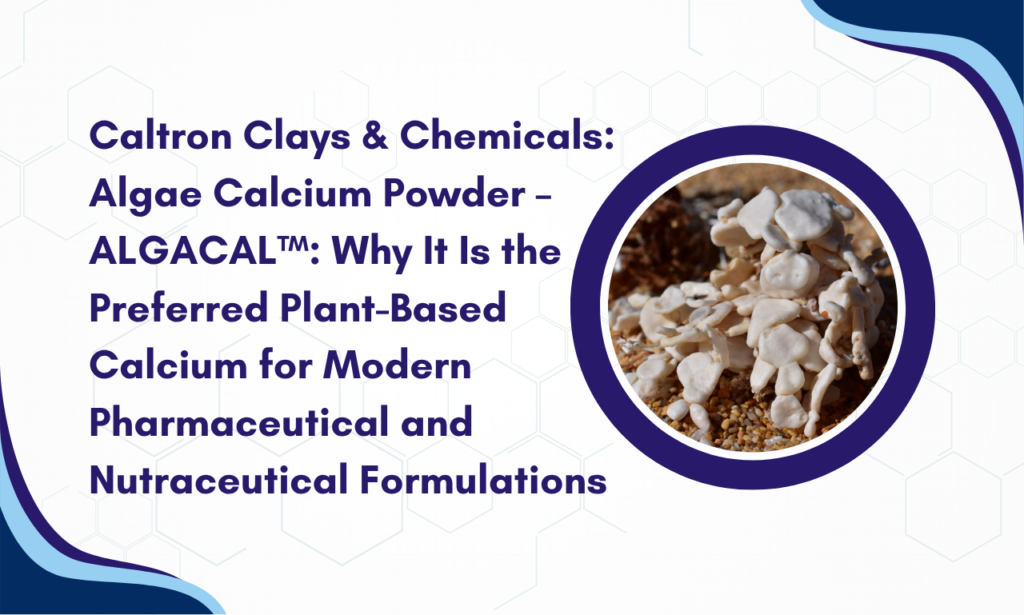
Introduction: Calcium Sourcing Is Changing—And Algae-Derived Minerals Are Part of the Shift
For pharmaceutical and nutraceutical manufacturers, choosing a calcium ingredient begins long before a purchase order is issued. The material must first satisfy formulation targets, quality requirements, regulatory expectations and commercial sourcing criteria.
Calcium assay remains important, but it represents only one part of raw-material evaluation. R&D teams may also need to understand particle characteristics, bulk density, mineral composition and dosage-form behaviour. QA teams focus on specifications, contaminant controls, traceability and batch documentation. Procurement professionals must consider supply consistency, scalability and commercial availability.
At the same time, supplement brands are exploring ingredients with more clearly defined origins. Plant-based and vegan-oriented product development has increased interest in calcium sources that can align with these formulation concepts.
Algae-derived calcium addresses this intersection between mineral nutrition and ingredient-origin differentiation.
Marine algae naturally interact with minerals in their surrounding environment. Certain mineralized algae can consequently provide calcium within a matrix that also contains magnesium and other naturally occurring mineral components.
Caltron Clays & Chemicals supplies this ingredient under its ALGACAL™ brand, with Rhodophyta–Lithothamnion Calcareum and Chlorophyta options.
Manufacturers evaluating an Algae Calcium Powder Manufacturer in India can consider ALGACAL™ according to their required mineral specification, dosage form and finished-product strategy.
For businesses requiring an Algae Calcium Powder Supplier in India, technical documentation and commercial consistency should be evaluated alongside price and availability.
As a Calcium Raw Material Manufacturer in India, Caltron provides ALGACAL™ for B2B customers seeking an algae-derived option for pharmaceutical and nutraceutical formulation development.
Algae Calcium Powder Explained: What Makes This Marine-Derived Mineral Ingredient Different?
Algae Calcium Powder is obtained from mineral-rich marine algae. Unlike calcium ingredients associated with geological deposits or animal-origin materials, its mineral source is algae.
This origin has led to several terms being used across the nutraceutical market, including algal calcium, seaweed calcium, plant calcium, plant-based calcium and vegan calcium.
For formulation scientists, however, terminology matters less than characterization.
A commercial algae calcium ingredient needs to be understood through measurable parameters.
Key Parameters R&D and QA Teams Should Review
Calcium assay: Establishes the amount of calcium provided by the raw material.
Magnesium content: Helps determine the wider mineral contribution of the ingredient.
Trace-mineral composition: Provides information about additional minerals naturally associated with the algae source.
Particle size: Can influence blending, powder flow, compression and other processing characteristics.
Bulk density: Can affect capsule fill volume, powder handling and ingredient loading.
Moisture: Relevant to storage, processing and product stability.
Heavy metals: Naturally sourced marine ingredients require appropriate contaminant specifications.
Microbiological quality: Limits should be appropriate for the intended application.
Batch consistency: Commercial production requires predictable raw-material characteristics.
Traceability: Procurement and quality teams need visibility into material identity and sourcing.
The strongest reason to evaluate algae calcium is therefore not simply that it is “natural.” Its relevance comes from combining a differentiated source with a controlled technical specification.
Why Plant-Based Calcium Is Becoming Part of Modern Supplement Formulation Strategy
Plant-based product development is influencing how brands think about mineral ingredients.
A supplement may contain botanical extracts, vegan capsules and plant-derived excipients, yet still rely on a calcium source that does not align with the wider ingredient strategy. For manufacturers building plant-oriented portfolios, calcium origin can therefore become an important sourcing consideration.
Algae calcium can support several formulation objectives:
- Plant-based mineral product concepts
- Vegan-oriented supplement development
- Vegetarian calcium formulations
- Transparent ingredient-origin communication
- Natural-source mineral positioning
- Calcium-magnesium concepts
- Multi-mineral formulations
- Differentiated calcium products
This does not mean plant-based calcium should automatically be described as nutritionally superior to every conventional calcium source.
Origin and performance are different considerations.
Performance must be evaluated according to composition, dosage, physical properties, formulation architecture and relevant evidence. Origin can then provide an additional dimension for product positioning.
A technically capable Calcium Raw Material Manufacturer in India should help manufacturers understand both sides of that equation.
Meet ALGACAL™: Caltron’s Two-Source Approach to Algae Calcium
ALGACAL™ is the branded algae calcium range offered by Caltron Clays & Chemicals for pharmaceutical and nutraceutical applications.
Rather than treating algae calcium as one uniform ingredient, the ALGACAL™ range includes two source categories.
Rhodophyta – Lithothamnion Calcareum
Lithothamnion Calcareum is a calcified red marine algae. Caltron provides defined calcium and magnesium specifications for this ALGACAL™ grade.
Chlorophyta
Chlorophyta refers to green algae. Caltron provides this as another algae-derived calcium option for manufacturers evaluating different mineral-source concepts.
The availability of two sources matters because formulation priorities differ.
One product may require a particular elemental calcium contribution. Another may prioritize plant-based positioning, mineral composition or powder characteristics. A third project may be influenced heavily by commercial availability and target-market requirements.
ALGACAL™ should therefore be approached as a grade-selection opportunity, rather than assuming all algae-derived calcium materials are identical.
ALGACAL™ Lithothamnion Calcareum: Understanding the Calcium and Magnesium Specification
The Rhodophyta grade of ALGACAL™ is based on Lithothamnion Calcareum, a calcified red marine algae.
According to Caltron’s manufacturer specifications, this grade provides:
- Calcium – NLT 35%
- Magnesium – NLT 2.2%
- A naturally occurring mineral profile described by Caltron as containing 74 trace minerals
For formulation scientists, these figures have practical significance.
The calcium specification can be used when estimating the raw-material quantity required to deliver the intended calcium contribution.
The magnesium specification should also be incorporated into mineral calculations where it contributes meaningfully to the finished formulation.
The stated trace-mineral profile requires a more detailed interpretation. Simply detecting multiple minerals does not establish their nutritional significance. R&D teams should review the actual concentrations and determine whether individual minerals make a meaningful contribution at the proposed serving size.
From Specification to Prototype
Lithothamnion data can help teams begin evaluating:
- Target calcium contribution
- Ingredient loading
- Magnesium contribution
- Dosage-form feasibility
- Mineral interactions
- Product specifications
- Finished-product testing requirements
Batch-specific values should ultimately be verified using the applicable Certificate of Analysis.
This is why businesses comparing a Calcium Raw Material Manufacturer in India should look for usable technical information rather than relying primarily on broad natural-origin descriptions.
ALGACAL™ Chlorophyta: Why Green Algae Deserves Separate Technical Evaluation
Chlorophyta represents the second algae source available within the ALGACAL™ portfolio.
Although both Chlorophyta and Lithothamnion are algae-derived, they should not be treated as identical raw materials.
The calcium and magnesium specifications associated with ALGACAL™ Lithothamnion should not automatically be assigned to the Chlorophyta grade.
R&D teams should instead request current Chlorophyta technical information and review:
- Calcium content
- Magnesium content
- Broader mineral composition
- Particle characteristics
- Bulk density
- Moisture
- Contaminant specifications
- Microbiological limits
- Physical properties
- Batch consistency
- Documentation
- Availability at commercial scale
This distinction is important because a formulation may require more than an attractive ingredient story.
The ingredient must also work within the target serving size, manufacturing process, packaging system and finished-product specification.
An Algae Calcium Powder Manufacturer in India offering both red and green algae options gives formulators additional choice, but that choice should be resolved through technical evaluation.
Red Algae vs Green Algae Calcium: How Should Formulators Compare ALGACAL™ Grades?
A meaningful comparison between Rhodophyta and Chlorophyta should focus on the finished product.
| Selection Parameter | Rhodophyta / Lithothamnion Calcareum | Chlorophyta |
|---|---|---|
| Algae group | Red algae | Green algae |
| Calcium | NLT 35% according to Caltron specification | Review current specification |
| Magnesium | NLT 2.2% according to Caltron specification | Review current specification |
| Mineral characteristics | Caltron describes a 74-trace-mineral profile | Evaluate current mineral profile |
| Plant-based positioning | Relevant | Relevant |
| Technical selection | Based on specification and formulation trials | Based on specification and formulation trials |
| Commercial evaluation | Required | Required |
The correct question is not, “Which algae is better?”
It is, “Which grade best matches the mineral, physical, regulatory and commercial requirements of this formulation?”
That change in perspective helps manufacturers make more defensible sourcing decisions.
A 35% Calcium Assay Is Useful—But What Else Should Buyers Investigate?
Assay values are easy to compare, which makes them attractive during supplier screening. Yet two ingredients with similar calcium percentages may perform very differently during production.
Particle characteristics, density, moisture and flow can influence manufacturing behaviour even when the chemical assay appears comparable.
Chemical Characteristics
Review:
- Identity
- Calcium content
- Magnesium content
- Mineral composition
- Moisture
- Heavy-metal limits
Physical Characteristics
Depending on the application, assess:
- Particle size
- Particle distribution
- Bulk density
- Tapped density
- Flow
- Powder behaviour
- Dispersibility
Quality Characteristics
Supplier qualification can include:
- Microbiological specifications
- Batch documentation
- Traceability
- COA review
- Quality-system documentation
- Packaging requirements
- Storage conditions
A tablet manufacturer and a powder-supplement manufacturer may therefore reach different conclusions about the same raw material.
Choosing a Calcium Raw Material Manufacturer in India should involve determining whether the supplier’s material remains appropriate when it moves from a specification sheet to actual manufacturing equipment.
Algae Calcium Bioavailability: Separating Formulation Science from Marketing Language
Bioavailability is an important topic in calcium formulation, but it requires careful communication.
It can be tempting to assume that a calcium ingredient must be better absorbed because it comes from algae, plants or a natural marine environment. Origin alone does not establish that conclusion.
Calcium absorption can be influenced by:
- Chemical form
- Elemental calcium amount
- Quantity consumed at one time
- Overall serving design
- Food intake
- Vitamin D status
- Other nutrients and ingredients
- Individual physiological conditions
For R&D teams, the more useful question is therefore not simply whether algae calcium is “highly absorbable.”
Instead, teams should ask how the calcium ingredient fits within the complete nutritional and dosage-form architecture of the product.
ALGACAL™ provides an algae-derived mineral source that can be evaluated for its composition and formulation characteristics. Any specific bioavailability claim should be supported by appropriate evidence rather than inferred solely from its marine botanical origin.
ALGACAL™ for Vegan and Vegetarian Calcium Formulations
Ingredient origin can become especially important when developing vegan and vegetarian supplements.
ALGACAL™ offers an algae-derived calcium source that can be evaluated for products such as:
- Vegan calcium supplements
- Vegetarian mineral products
- Plant-based calcium capsules
- Calcium-magnesium combinations
- Multi-mineral formulations
- Plant-oriented powder supplements
- Bone-health formulation concepts
Caltron identifies ALGACAL™ as relevant to vegan positioning and states that vegan approval is available for the ingredient. Manufacturers should review current applicable documentation when developing a finished product around this claim.
The rest of the formula must also be considered.
Capsule shells, coatings, excipients, flavours, processing aids and additional active ingredients can all affect whether the final product meets its intended vegan positioning.
ALGACAL™ can therefore support the calcium component of a vegan formulation strategy, while finished-product compliance requires evaluation of the complete formula.
ALGACAL™ Applications: What Changes Between Tablets, Capsules and Powder Formulations?
The same calcium ingredient can create different technical challenges depending on how the finished product will be delivered.
Tablets
R&D teams may evaluate:
- Flow
- Blend uniformity
- Compression characteristics
- Tablet hardness
- Friability
- Disintegration
- Stability
Capsules
Development considerations may include:
- Bulk density
- Fill volume
- Target dose
- Capsule size
- Powder flow
- Ingredient compatibility
Powder Supplements
Formulators may need to consider:
- Dispersibility
- Homogeneity
- Segregation
- Mouthfeel
- Taste
- Moisture behaviour
- Stability
Mineral Premixes
Multi-ingredient systems introduce additional considerations around uniformity, mineral interactions and segregation during handling.
A Calcium Raw Material Manufacturer in India supporting formulation-focused customers should therefore provide enough technical information for buyers to determine whether the material deserves further application testing.
Before Commercialization: An R&D Framework for Evaluating ALGACAL™
Ingredient qualification should progress in stages.
Step 1: Define the Nutritional Target
Determine the required elemental calcium contribution per serving.
Step 2: Calculate Ingredient Loading
Use the verified raw-material assay to estimate the required ALGACAL™ quantity.
Step 3: Evaluate Other Mineral Contributions
Consider magnesium and any other relevant mineral contribution within the complete formula.
Step 4: Assess Physical Compatibility
Review particle size, density, flow and other properties relevant to the dosage form.
Step 5: Develop the Prototype
Test ALGACAL™ with the intended excipients, actives and processing conditions.
Step 6: Evaluate Product Performance
Assess parameters relevant to the format, including compression, fill feasibility, dispersion or organoleptic properties.
Step 7: Conduct Stability Work
Determine whether the formulation maintains intended characteristics over the proposed shelf life.
Step 8: Confirm Regulatory Requirements
Review ingredient status, labeling, permitted claims and other market-specific requirements.
Step 9: Complete Pilot-Scale Evaluation
Confirm that laboratory performance translates to representative manufacturing conditions.
This structured process helps convert ALGACAL™ from an interesting ingredient concept into a technically evaluated commercial raw material.
Procurement Beyond Price: Questions to Ask an Algae Calcium Powder Manufacturer in India
Price matters in B2B sourcing, but an inexpensive ingredient can become costly if it creates formulation inconsistency, documentation gaps or production problems.
When qualifying an Algae Calcium Powder Manufacturer in India, procurement and QA teams should ask:
- What algae species is used?
- How is material identity confirmed?
- What calcium assay is specified?
- Is magnesium specified?
- What trace-mineral information is available?
- What heavy-metal limits apply?
- What microbiological specifications are maintained?
- What physical specifications are controlled?
- Is a batch-specific COA supplied?
- What traceability information is maintained?
- Are relevant certifications available?
- Can samples be supplied before commercial purchase?
- What packaging options are available?
- Can volume be scaled with demand?
- What export documentation can be provided?
Lead times and supply continuity should also be considered.
An Algae Calcium Powder Supplier in India that can support technical qualification as well as commercial procurement can simplify the transition from R&D evaluation to regular production.
Why Batch-to-Batch Control Matters for Naturally Sourced Algae Calcium
Natural sourcing can create a valuable ingredient story, but natural materials still require defined quality parameters.
For algae-derived minerals, manufacturers need confidence that commercial batches remain within established specifications.
Quality-control activities can include:
- Raw-material qualification
- Identity verification
- Calcium assay testing
- Mineral evaluation
- Moisture control
- Heavy-metal testing
- Microbiological assessment
- Physical-property monitoring
- Process controls
- Finished-material evaluation
- Batch documentation
- Packaging checks
- Release procedures
- Traceability
Caltron states that quality checks are applied from raw-material procurement through material dispatch.
Buyers should nevertheless review current technical and quality documentation as part of their own supplier-qualification systems.
A Calcium Raw Material Manufacturer in India should ultimately be judged not by one excellent sample but by its ability to provide predictable material across repeated commercial orders.
ALGACAL™ vs Conventional Calcium: A Practical B2B Comparison
Algae calcium should not be selected because it sounds more contemporary than conventional calcium. Both need to be evaluated according to the finished product.
| Factor | ALGACAL™ Algae Calcium | Conventional Calcium Ingredients |
|---|---|---|
| Source | Marine algae | Depends on material |
| Plant-based story | Strongly relevant | Source-dependent |
| Vegan-oriented potential | Relevant with appropriate documentation | Source-dependent |
| Associated minerals | Can include magnesium and trace minerals | Varies |
| Ingredient differentiation | Defined algae origin | Varies |
| Calcium assay | Must be verified | Must be verified |
| Physical evaluation | Required | Required |
| Contaminant control | Required | Required |
| Documentation | Required | Required |
| Batch consistency | Essential | Essential |
| Formulation testing | Required according to application | Required according to application |
A manufacturer should select the source that best satisfies the required combination of technical performance, nutritional targets, regulatory suitability, cost and product positioning.
Why ALGACAL™ Can Give Calcium Products a More Distinct Ingredient Identity
Many calcium supplements compete within similar nutritional categories. Ingredient sourcing can help manufacturers develop a clearer product identity without relying on exaggerated health claims.
ALGACAL™ can support positioning around:
- Algae-derived calcium
- Marine botanical origin
- Plant-based sourcing
- Vegan-oriented product development
- Naturally occurring mineral composition
- Calcium-magnesium concepts
- Multi-mineral formulations
- Transparent ingredient-source communication
For ALGACAL™ Lithothamnion, Caltron specifies NLT 35% calcium.
The same grade carries a specification of NLT 2.2% magnesium.
Caltron also describes the material as having a naturally occurring profile containing 74 trace minerals.
The strongest product story comes from communicating these characteristics accurately and supporting them with appropriate documentation.
For sophisticated B2B buyers, technical specificity is more persuasive than broad claims of superiority.
Why Consider Caltron Clays & Chemicals for ALGACAL™?
Ingredient sourcing requires coordination between technical and commercial teams.
Caltron Clays & Chemicals has established experience in mineral-based pharmaceutical and nutraceutical raw materials and offers ALGACAL™ as part of its naturally derived calcium portfolio.
Manufacturers searching for an Algae Calcium Powder Manufacturer in India can evaluate both Lithothamnion Calcareum and Chlorophyta ALGACAL™ options.
Companies requiring an Algae Calcium Powder Supplier in India can discuss samples, specifications, documentation and bulk requirements with Caltron.
Caltron also serves formulation businesses evaluating a Pharmaceutical Raw Material Manufacturer in India.
Its B2B supply capabilities are relevant to companies seeking a Pharmaceutical Raw Material Supplier in India.
Nutraceutical brands can evaluate the company when sourcing from a Nutraceutical Raw Material Manufacturer in India.
Commercial buyers can also consider Caltron when requiring a Nutraceutical Raw Material Supplier in India.
For businesses specifically assessing a Calcium Raw Material Manufacturer in India, ALGACAL™ adds algae-derived calcium to Caltron’s wider natural calcium ingredient portfolio.
This enables discussions to move beyond price toward grade selection, technical suitability, documentation, quality expectations and commercial scalability.
Which ALGACAL™ Grade Should You Choose? Start with These Five Decisions
The choice between Rhodophyta and Chlorophyta becomes easier when the product brief is clearly defined.
1. What Mineral Contribution Is Required?
Establish the elemental calcium target and determine whether magnesium contribution is also important.
2. What Dosage Form Is Being Developed?
Tablet, capsule and powder formulations can require different physical characteristics.
3. What Ingredient Positioning Is Intended?
Determine whether algae origin, plant-based sourcing or vegan positioning forms part of the product concept.
4. What Documentation Does the Target Market Require?
Specifications, certificates, contaminant controls and regulatory documentation should be reviewed early.
5. Can the Grade Support Commercial Production?
Availability, consistency, packaging, lead times and scale should be evaluated before final approval.
Only after answering these questions should the two ALGACAL™ grades be compared.
The result is a product-led selection process rather than an ingredient-led assumption.
Where Is Algae-Derived Calcium Heading Next?
Algae calcium reflects a broader shift in nutraceutical formulation: brands increasingly want ingredients that have both a clear origin and a clear technical identity.
Natural-source messaging alone is unlikely to be enough for sophisticated pharmaceutical and nutraceutical buyers.
Future sourcing decisions are likely to place greater emphasis on:
- Source transparency
- Defined mineral composition
- Batch consistency
- Traceability
- Contaminant controls
- Physical specifications
- Vegan documentation
- Application compatibility
- Commercial scalability
This creates an opportunity for algae calcium to move beyond niche ingredient positioning.
ALGACAL™ can be evaluated as a plant-positioned calcium ingredient whose value is defined not merely by where it comes from, but by how reliably its specification can support a commercially viable finished formulation.
Frequently Asked Questions About ALGACAL™ Algae Calcium Powder
1. What is Algae Calcium Powder?
Algae Calcium Powder is a mineral ingredient derived from mineral-rich marine algae. Caltron Clays & Chemicals supplies ALGACAL™ for pharmaceutical and nutraceutical manufacturers evaluating plant-positioned calcium formulations.
2. What is ALGACAL™ Algae Calcium?
ALGACAL™ is the branded algae-derived calcium range from Caltron Clays & Chemicals. It includes Rhodophyta–Lithothamnion Calcareum and Chlorophyta options for B2B product development.
3. Is algae calcium plant-based?
Algae calcium is commonly positioned as plant-based because the mineral source is marine algae. Caltron Clays & Chemicals offers ALGACAL™ for manufacturers developing plant-based, vegetarian and vegan-oriented formulations.
4. How much calcium does ALGACAL™ Lithothamnion contain?
According to Caltron Clays & Chemicals, the ALGACAL™ Lithothamnion Calcareum grade has a calcium specification of NLT 35%. Current batch values should be checked through the applicable Certificate of Analysis.
5. Does ALGACAL™ contain magnesium?
Caltron Clays & Chemicals specifies NLT 2.2% magnesium for its Lithothamnion Calcareum ALGACAL™ grade. Formulators should include this contribution when calculating the overall mineral composition.
6. Does ALGACAL™ contain trace minerals?
Caltron describes ALGACAL™ Lithothamnion as having a naturally occurring profile containing 74 trace minerals. Caltron Clays & Chemicals recommends specification-based evaluation when determining the relevance of individual minerals.
7. Can ALGACAL™ be evaluated for vegan formulations?
ALGACAL™ is algae-derived and is positioned by Caltron Clays & Chemicals for vegan-oriented applications. Manufacturers should verify current documentation and ensure all components of the finished formulation meet the intended vegan requirements.
8. Can Algae Calcium Powder be used in tablets and capsules?
Subject to technical validation, Caltron Clays & Chemicals’ ALGACAL™ can be evaluated for tablets, capsules, powder blends and other mineral formulations. Physical properties should be assessed for the intended dosage form.
9. How should manufacturers choose an algae calcium supplier?
Review assay, mineral composition, physical characteristics, contaminant limits, batch consistency, COA, traceability and commercial capabilities. Caltron Clays & Chemicals supports ALGACAL™ sourcing for B2B pharmaceutical and nutraceutical requirements.
10. Where can B2B manufacturers source ALGACAL™?
Manufacturers can contact Caltron Clays & Chemicals to discuss ALGACAL™ grades, specifications, samples, documentation and bulk supply requirements for pharmaceutical and nutraceutical product development.
Conclusion: ALGACAL™ Brings Plant-Based Positioning and Technical Evaluation Together
The growing interest in algae calcium reflects an important change in mineral formulation. Manufacturers increasingly want to know not only how much calcium an ingredient contains, but where it comes from, what accompanies it and how consistently it can be supplied.
ALGACAL™ from Caltron Clays & Chemicals addresses this opportunity through two algae-source options: Rhodophyta–Lithothamnion Calcareum and Chlorophyta.
For the Lithothamnion grade, Caltron specifies NLT 35% calcium.
It also specifies NLT 2.2% magnesium and describes a naturally occurring profile containing 74 trace minerals.
These characteristics can support technical evaluation and differentiated product development, but final ingredient selection should always consider physical properties, dosage-form performance, contaminant controls, documentation, regulatory requirements and commercial consistency.
For companies seeking a Calcium Raw Material Manufacturer in India, Caltron Clays & Chemicals provides ALGACAL™ as an algae-derived addition to its natural calcium portfolio.
Planning a new plant-based calcium product?
Connect with Caltron Clays & Chemicals to discuss ALGACAL™ Rhodophyta and Chlorophyta grades, current technical specifications, samples, documentation and bulk sourcing requirements.
Caltron Clays & Chemicals Pvt Ltd
Address: Office No. 211, 2nd Floor, Orbit Premises, Next to Sheetal Banquets, Opp to Inox Plaza, Mindspace, Malad West, Mumbai, Maharashtra 400064 India
Phone No.: 022 3571 9844 | +91 70214 37453 | +91 22 2876 4864
Website: https://caltronclays.com
Email: marketing@caltronclays.com | sales@caltronclays.com
Google Maps: https://maps.app.goo.gl/jCuz1ZCf1iAhzZiH7

