

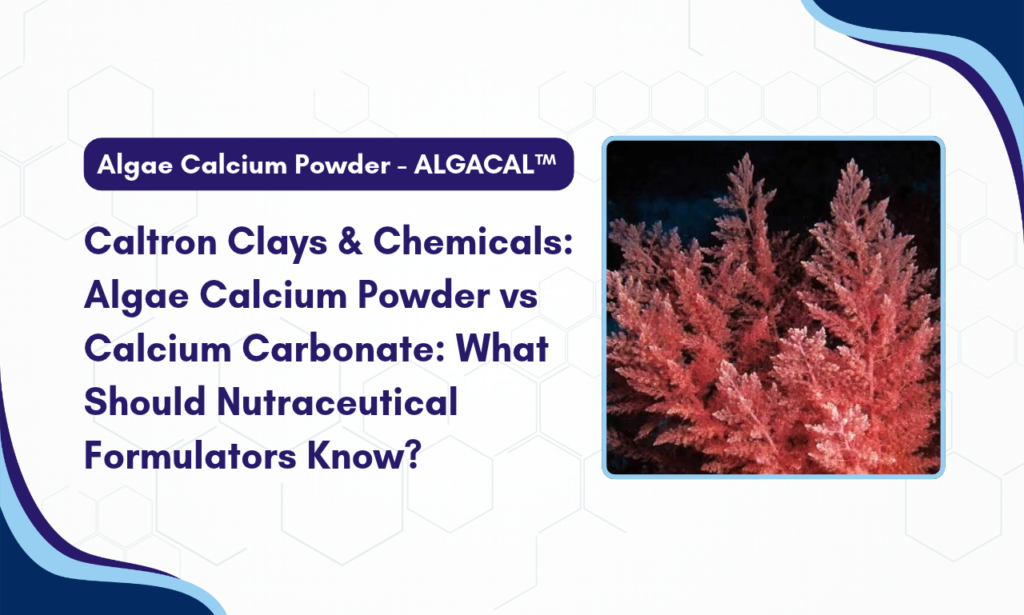
Introduction: Choosing the Right Calcium Source for Next-Generation Nutraceuticals
The selection of a suitable calcium source is a critical factor in developing advanced nutraceutical formulations that meet evolving industry expectations for ingredient quality, nutritional composition, and manufacturing consistency. With increasing demand for naturally sourced minerals, vegan-friendly ingredients, and differentiated calcium supplements, manufacturers are evaluating the formulation advantages of Algae Calcium Powder compared with conventional Calcium Carbonate. As a trusted Algae Calcium Powder Manufacturer in India, Caltron Clays & Chemicals offers ALGACAL™, a premium marine algae-derived calcium ingredient designed for pharmaceutical and nutraceutical manufacturers seeking reliable mineral composition, consistent raw material quality, and versatile formulation applications.
Calcium is essential for maintaining normal bones and teeth, supporting muscle function, and participating in several physiological processes. However, the performance of a calcium supplement depends on more than its elemental calcium concentration. Factors such as mineral composition, dissolution behavior, ingredient compatibility, powder characteristics, and manufacturing quality influence how effectively a calcium ingredient can be incorporated into a finished formulation.
To support manufacturers exploring marine-derived mineral ingredients, Caltron Clays & Chemicals offers ALGACAL™, a specialized algae calcium powder available in Lithothamnion and Chlorophyta grades. These ingredients provide an alternative to conventional mineral-sourced calcium carbonate for brands developing plant-origin nutritional products.
For businesses searching for an Algae Calcium Powder Exporter in India, understanding the technical and commercial differences between these calcium sources can support better formulation planning and procurement decisions.
This guide examines their composition, bioavailability considerations, manufacturing applications, quality requirements, and sourcing criteria.
1. Algae Calcium Powder vs Calcium Carbonate: Understanding Their Key Differences
Algae calcium powder and conventional calcium carbonate are both used as calcium sources in nutritional products. However, their origins, naturally associated minerals, and processing characteristics may differ.
What Makes Algae Calcium Powder Different?
Algae Calcium Powder is derived from selected calcified marine algae that accumulate calcium-containing minerals within their structures.
The harvested mineralized material is processed into powder suitable for specified nutritional applications.
Depending on its biological source and processing method, algae calcium may contain magnesium and other naturally associated minerals.
Key characteristics include:
- Marine algae-derived calcium origin.
- Naturally associated mineral composition.
- Potential compatibility with vegan supplement positioning.
- Applications in tablets, capsules, and nutritional powders.
- Opportunities for ingredient differentiation.
Caltron Clays & Chemicals Pvt. Ltd. offers ALGACAL™ for nutraceutical manufacturers seeking specialized marine-derived calcium ingredients.
Understanding Conventional Calcium Carbonate
Conventional calcium carbonate is an inorganic mineral compound with the chemical formula CaCO₃.
It is commonly sourced from geological deposits and processed into suitable commercial grades.
Pure calcium carbonate contains approximately 40% elemental calcium, making it a concentrated calcium source.
Its established applications include calcium tablets, capsules, and mineral supplements.
Comparing Their Chemical Characteristics
An important scientific distinction is that algae-derived calcium may also contain calcium carbonate as a major mineral component.
Therefore, the comparison is not necessarily between different calcium compounds.
Instead, manufacturers should evaluate the differences in mineral associations, source characteristics, particle properties, and commercial specifications.
What Should Formulators Prioritize?
The most suitable calcium source depends on product objectives.
Manufacturers should consider:
- Elemental calcium concentration.
- Ingredient origin.
- Mineral profile.
- Dosage requirements.
- Powder characteristics.
- Quality documentation.
A technically informed comparison helps manufacturers avoid selecting ingredients based solely on marketing terminology.
2. ALGACAL™ Algae Calcium Powder: Marine Mineral Composition and Ingredient Advantages
The mineral profile of calcium raw materials influences formulation calculations, nutritional positioning, and ingredient selection.
Caltron Clays & Chemicals offers ALGACAL™ in Lithothamnion and Chlorophyta grades for manufacturers developing marine-derived calcium supplements.
Lithothamnion Calcareum: A Calcium-Rich Marine Red Algae
Lithothamnion calcareum is a calcified red algae associated with marine environments.
Its mineralized structure contains calcium-rich material along with naturally occurring magnesium.
Caltron Clays & Chemicals offers ALGACAL™ Lithothamnion grade with the following stated specifications:
- Calcium: Not Less Than 35%.
- Magnesium: Not Less Than 2.2%.
- Naturally associated marine minerals.
- A company-described profile of 74 trace minerals.
These characteristics should be verified through current technical specifications and batch-specific analytical documentation.
Chlorophyta: Another Marine Algae Calcium Option
Chlorophyta refers to a group of green algae with diverse biological and mineral characteristics.
Caltron Clays & Chemicals also offers a Chlorophyta-derived ALGACAL™ grade.
Manufacturers should evaluate its calcium concentration, mineral profile, particle characteristics, and suitability for their intended formulations.
Importance of Calcium and Magnesium Composition
Calcium and magnesium are essential minerals involved in several physiological functions.
ALGACAL™ Lithothamnion grade contains both minerals within its naturally derived ingredient composition.
This may be relevant for manufacturers developing calcium-magnesium nutritional products.
However, actual mineral contributions should be calculated from verified ingredient specifications and serving sizes.
Understanding the Trace Mineral Profile
Caltron Clays & Chemicals describes ALGACAL™ as containing 74 trace minerals.
The presence and concentration of individual minerals should be confirmed through suitable analytical methods.
Manufacturers should avoid assuming that every detectable mineral contributes a meaningful nutritional quantity.
How Mineral Composition Supports Formulation Planning
Ingredient composition influences:
- Elemental calcium calculations.
- Magnesium contribution.
- Product labeling.
- Ingredient loading.
- Quality specifications.
When sourcing from an Algae Calcium Powder Exporter in India, manufacturers should request detailed technical documentation for the selected grade.
ALGACAL™ offers a marine-derived calcium option for brands developing differentiated mineral nutrition formulations.
3. Calcium Bioavailability: Is Algae Calcium Better Absorbed Than Calcium Carbonate?
Calcium bioavailability is an important consideration in nutritional supplement development. However, absorption depends on several factors, and marine algae origin alone does not demonstrate superior calcium absorption.
What Does Calcium Bioavailability Mean?
Calcium bioavailability describes the proportion of ingested calcium that is absorbed and becomes available for physiological functions.
Formulators should distinguish between elemental calcium content, solubility, dissolution, and absorption.
These characteristics are related but are not interchangeable.
How Calcium Carbonate Is Absorbed
Calcium carbonate requires dissolution before calcium ions can be absorbed.
Gastric acidity supports this process.
Calcium carbonate supplements are generally recommended with meals because food-associated gastric acid production can support dissolution.
Absorption also depends on calcium dose, vitamin D status, and individual digestive conditions.
Factors Affecting Algae Calcium Absorption
Algae-derived calcium may contain calcium carbonate within its mineral matrix.
Its absorption can therefore be influenced by similar physiological factors.
Important considerations include:
- Elemental calcium dosage.
- Gastric acidity.
- Particle size.
- Dissolution behavior.
- Meal timing.
- Vitamin D status.
Naturally associated magnesium does not independently establish higher calcium absorption.
Evaluating Claims About Superior Bioavailability
Manufacturers should review ingredient-specific scientific evidence before making comparative absorption claims.
Research involving one algae calcium ingredient cannot automatically establish the performance of another ingredient.
A responsible Algae Calcium Powder Exporter in India should provide technically accurate product information rather than unsupported absorption claims.
Why Evidence-Based Formulation Matters
Evidence-based ingredient selection helps manufacturers develop credible nutritional products.
It also supports responsible labeling and regulatory compliance.
For ALGACAL™, manufacturers should assess verified ingredient specifications and conduct appropriate formulation testing.
4. Algae Calcium Powder vs Calcium Carbonate: Formulation Performance and Manufacturing Efficiency
Selecting calcium ingredients involves evaluating how raw materials behave during manufacturing.
Elemental calcium concentration, particle size, flowability, and ingredient compatibility can influence dosage design and production efficiency.
Elemental Calcium Concentration and Dosage Design
Pure calcium carbonate contains approximately 40% elemental calcium.
ALGACAL™ Lithothamnion grade has a stated minimum calcium content of 35%.
For a formulation targeting 500 mg of elemental calcium:
- Pure calcium carbonate would theoretically require approximately 1,250 mg of ingredient.
- An algae calcium ingredient containing 35% calcium would require approximately 1,429 mg.
Actual calculations should use verified batch-specific values.
These differences influence tablet size, capsule capacity, and overall ingredient loading.
Particle Size Distribution and Powder Handling
Particle size can affect blending, compression, and encapsulation.
Manufacturers should evaluate:
- Particle size distribution.
- Bulk density.
- Tapped density.
- Flowability.
- Moisture content.
- Compressibility.
The selected ingredient should perform consistently under the intended manufacturing conditions.
Ingredient Compatibility and Stability
Calcium-containing ingredients may interact with acidic formulation components.
Carbonate-containing materials can react with acids and release carbon dioxide.
Manufacturers should evaluate compatibility with vitamins, botanical extracts, organic acids, and other minerals.
Stability testing helps establish suitable formulation conditions.
Applications in Different Supplement Formats
Algae calcium powder may be evaluated for:
- Calcium tablets.
- Hard-shell capsules.
- Bone health supplement blends.
- Calcium-magnesium formulations.
- Nutritional powder products.
Its suitability depends on formulation design and processing requirements.
Sensory Characteristics and Consumer Acceptance
Calcium ingredients can influence taste, mouthfeel, and texture.
Powdered formulations may require attention to chalkiness and sedimentation.
For businesses working with an Algae Calcium Powder Supplier in India, representative samples can support product development trials.
Manufacturers should select ingredients based on verified technical performance rather than assumptions about their origin.
5. Why Marine Algae Calcium Is Relevant to Plant-Based Nutraceutical Innovation
Ingredient origin has become an important consideration for manufacturers developing plant-based nutritional products.
Marine algae calcium offers a naturally derived option for brands seeking to differentiate calcium supplements through ingredient sourcing and mineral composition.
Growing Interest in Vegan Calcium Formulations
Algae-derived calcium can be suitable for vegan and vegetarian supplement concepts.
Potential applications include:
- Vegan calcium tablets.
- Plant-origin mineral capsules.
- Calcium-magnesium supplements.
- Natural-source nutritional powders.
- Specialized mineral nutrition products.
Caltron Clays & Chemicals offers ALGACAL™ as a vegan-suitable ingredient, subject to applicable documentation.
Natural-Origin Ingredient Positioning
Marine algae calcium provides an ingredient-origin distinction.
However, conventional calcium carbonate can also be vegan-compatible depending on its source and processing.
Manufacturers should avoid suggesting that algae calcium is the only vegan calcium option.
Clean-Label Product Development
Clean-label strategies often emphasize transparent ingredient sourcing and clear product communication.
ALGACAL™ provides an opportunity to highlight marine algae origin in suitable formulations.
All ingredient-origin and certification claims should be supported by relevant documentation.
Applications in Bone Health Products
Calcium contributes to the maintenance of normal bones and teeth.
Algae calcium may be considered for adult calcium supplements, bone health formulations, and calcium-magnesium products.
Product claims should remain consistent with applicable regulatory requirements.
Opportunities for Nutraceutical Brands
For manufacturers evaluating an Algae Calcium Powder Exporter in India, ALGACAL™ offers an ingredient option for differentiated mineral supplements.
Its marine algae origin can support product positioning when combined with appropriate formulation performance and verified specifications.
6. Quality Control Standards for Algae Calcium Powder in Nutraceutical Manufacturing
Ingredient quality is essential for maintaining consistent nutritional composition and manufacturing performance.
A reliable Pharmaceutical Raw Material Manufacturer in India should support buyers with relevant quality documentation and clearly defined specifications.
Elemental Calcium and Magnesium Testing
Calcium and magnesium assays help manufacturers calculate ingredient quantities accurately.
For ALGACAL™ Lithothamnion grade, the stated minimum values are 35% calcium and 2.2% magnesium.
Buyers should confirm these specifications through current product documentation.
Heavy Metal and Microbiological Evaluation
Marine-derived mineral ingredients should undergo appropriate contaminant evaluation.
Important parameters may include:
- Lead.
- Cadmium.
- Arsenic.
- Mercury.
- Microbiological limits.
- Moisture content.
Acceptance criteria depend on the intended application and applicable regulations.
Physical Specifications and Batch Consistency
Particle size, bulk density, and powder flowability can affect manufacturing.
A dependable Nutraceutical Raw Material Manufacturer in India should maintain suitable quality specifications and communicate relevant ingredient changes.
Certificate of Analysis and Traceability
A Certificate of Analysis provides batch-specific information about tested characteristics.
Manufacturers may request mineral assay results, contaminant testing, microbiological information, and relevant physical specifications.
Caltron Clays & Chemicals emphasizes quality checks throughout its algae calcium production process.
Documentation for International Procurement
A Pharmaceutical Raw Material Supplier in India or Nutraceutical Raw Material Supplier in India may need to provide technical specifications, origin information, and applicable regulatory documentation.
When evaluating an Algae Calcium Powder Exporter in India, buyers should confirm documentation requirements before placing commercial orders.
Reliable quality information supports efficient procurement and formulation approval.
7. How to Select a Reliable Algae Calcium Powder Manufacturer and Supplier in India
Choosing a suitable raw material supplier is essential for maintaining product quality and procurement continuity.
Manufacturers should assess technical expertise, ingredient specifications, quality documentation, and commercial responsiveness.
Manufacturing Experience and Technical Knowledge
An experienced Algae Calcium Powder Manufacturer in India should understand mineral ingredient processing and nutraceutical quality requirements.
Caltron Clays & Chemicals brings more than two decades of pharmaceutical raw material industry experience to its ALGACAL™ offering.
Product Specifications and Grade Availability
Manufacturers should confirm the available algae calcium grades and their characteristics.
ALGACAL™ is offered in Lithothamnion and Chlorophyta grades.
Selecting the correct grade requires reviewing mineral composition and physical specifications.
Bulk Supply and Procurement Planning
Important procurement considerations include:
- Minimum order quantities.
- Packaging requirements.
- Product grade availability.
- Expected consumption volumes.
- Commercial terms.
Clear communication helps manufacturers plan sourcing requirements.
Samples and Formulation Trials
Representative samples allow research and development teams to evaluate powder characteristics and formulation compatibility.
Manufacturers should complete appropriate testing before commercial ingredient approval.
Export and Regulatory Requirements
An Algae Calcium Powder Exporter in India should be evaluated for its ability to support applicable trade documentation.
Requirements vary by destination market and finished-product category.
A dependable Algae Calcium Powder Supplier in India should communicate product specifications and procurement information clearly.
For companies comparing a Nutraceutical Raw Material Manufacturer in India and a Nutraceutical Raw Material Supplier in India, technical consistency and responsiveness remain important considerations.
8. Why Choose Caltron Clays & Chemicals for ALGACAL™ Algae Calcium Powder?
Caltron Clays & Chemicals offers ALGACAL™ for pharmaceutical and nutraceutical manufacturers seeking specialized marine-derived calcium ingredients.
Its product offering combines algae calcium grade options with a focus on technical sourcing requirements.
Established Experience in Pharmaceutical Raw Materials
Caltron Clays & Chemicals has more than two decades of experience in pharmaceutical raw materials.
As an Algae Calcium Powder Manufacturer in India, the company understands the importance of ingredient quality and formulation compatibility.
ALGACAL™ Marine Algae Calcium Grades
ALGACAL™ is available in Lithothamnion and Chlorophyta grades.
The Lithothamnion grade has stated minimum contents of 35% calcium and 2.2% magnesium.
Manufacturers can request technical information to evaluate the appropriate grade.
Quality-Focused Raw Material Sourcing
Caltron Clays & Chemicals emphasizes quality checks throughout its algae calcium production process.
Manufacturers should review current specifications and batch-specific analytical results before approving commercial material.
Support for Bulk Ingredient Inquiries
As a Pharmaceutical Raw Material Supplier in India, Caltron Clays & Chemicals can be contacted for ALGACAL™ product specifications, sample requests, and bulk sourcing discussions.
Buyers should communicate their required grade, application, quantity, and documentation needs.
Ingredient Options for Modern Nutraceutical Products
ALGACAL™ may be evaluated for calcium tablets, capsules, mineral blends, and suitable nutritional powders.
Its marine-derived composition offers an ingredient option for plant-origin supplement concepts.
For businesses searching for an Algae Calcium Powder Exporter in India, Caltron Clays & Chemicals provides a contact point for discussing ingredient sourcing and product requirements.
Conclusion: Making an Informed Calcium Ingredient Selection
The comparison between Algae Calcium Powder and conventional Calcium Carbonate highlights the importance of evaluating ingredient origin, elemental calcium concentration, mineral composition, absorption factors, manufacturing performance, and quality specifications.
Conventional calcium carbonate offers an established calcium source with a high theoretical elemental calcium concentration. Algae calcium powder provides a marine-derived alternative with naturally associated minerals, depending on the grade.
Neither ingredient should be considered universally superior without evaluating the intended formulation and supporting evidence.
Caltron Clays & Chemicals, an Algae Calcium Powder Manufacturer in India, offers ALGACAL™ in Lithothamnion and Chlorophyta grades for manufacturers developing calcium-based nutraceutical products.
As an Algae Calcium Powder Supplier in India, the company provides a sourcing option for businesses seeking marine algae-derived mineral ingredients.
For international buyers evaluating an Algae Calcium Powder Exporter in India, ALGACAL™ offers an opportunity to explore specialized calcium ingredients for modern supplement development.
Frequently Asked Questions
1. What is the difference between Algae Calcium Powder and Calcium Carbonate?
Algae Calcium Powder is obtained from marine algae and may contain naturally associated magnesium and trace minerals. Conventional calcium carbonate is generally sourced from mineral deposits. Caltron Clays & Chemicals offers ALGACAL™ for marine-derived calcium formulations.
2. Is Algae Calcium Powder better than Calcium Carbonate?
Neither ingredient is universally better. Selection depends on mineral composition, dosage requirements, formulation performance, and product positioning. Caltron Clays & Chemicals offers ALGACAL™ for manufacturers seeking algae-derived calcium ingredients.
3. What are the benefits of Algae Calcium Powder?
Algae Calcium Powder supplies calcium and may contain naturally associated minerals such as magnesium. Caltron Clays & Chemicals offers ALGACAL™ for calcium tablets, mineral capsules, and suitable nutritional formulations.
4. Is Algae Calcium Powder more easily absorbed than Calcium Carbonate?
Superior absorption cannot be assumed from algae origin alone. Calcium absorption depends on dosage, dissolution, and physiological conditions. Caltron Clays & Chemicals offers ALGACAL™ for manufacturers evaluating marine-derived calcium ingredients.
5. What is the calcium content of ALGACAL™ Algae Calcium Powder?
Caltron Clays & Chemicals states that ALGACAL™ Lithothamnion grade contains not less than 35% calcium and 2.2% magnesium. Manufacturers should verify batch-specific composition through current analytical documentation.
6. Is Algae Calcium Powder suitable for vegan supplements?
Algae-derived calcium can be suitable for vegan formulations when sourcing and certification requirements are met. Caltron Clays & Chemicals offers ALGACAL™ as a vegan-suitable marine algae calcium ingredient.
7. Which calcium source is best for nutraceutical manufacturing?
The best calcium source depends on elemental calcium requirements, ingredient compatibility, quality specifications, and product positioning. Caltron Clays & Chemicals offers ALGACAL™ for manufacturers exploring marine-derived calcium.
8. What are the applications of Algae Calcium Powder?
Algae Calcium Powder may be used in calcium tablets, mineral capsules, calcium-magnesium blends, and suitable nutritional powders. Caltron Clays & Chemicals offers ALGACAL™ for nutraceutical ingredient sourcing.
9. Who is a reliable Algae Calcium Powder Manufacturer and Supplier in India?
Caltron Clays & Chemicals is an Algae Calcium Powder Manufacturer and Supplier in India offering ALGACAL™ in Lithothamnion and Chlorophyta grades for pharmaceutical and nutraceutical manufacturers.
10. Where can I buy bulk Algae Calcium Powder in India?
Manufacturers and distributors can contact Caltron Clays & Chemicals for bulk ALGACAL™ inquiries, technical specifications, and product information. The company supplies algae-derived calcium ingredients for B2B sourcing requirements.
Explore ALGACAL™ Algae Calcium Powder – Enquire for Bulk Supply
Caltron Clays & Chemicals Pvt Ltd
Address: Suite# 1901-1904, Level-19, 9 Business Bay, Off Link Road, Mindspace, Malad West, Mumbai 400064
Phone No.: 022 3571 9844 | +91 70214 37453 | +91 22 2876 4864
Website: https://caltronclays.com
Email: marketing@caltronclays.com | sales@caltronclays.com
Google Maps: https://maps.app.goo.gl/n2TeYQcnXnS4aMio9

