

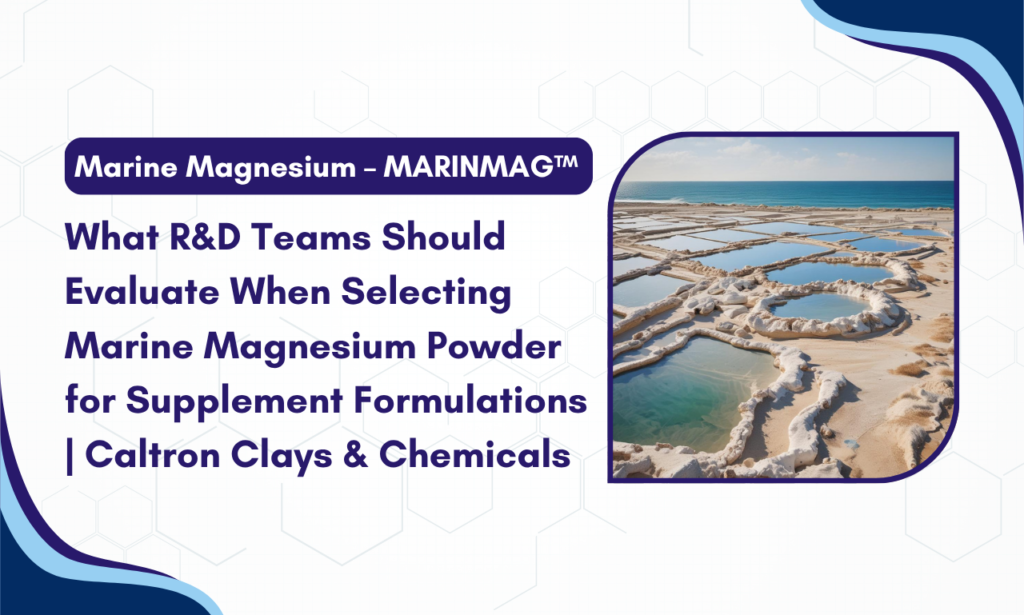
Introduction: Why Marine Magnesium Selection Deserves a Deeper Technical Review
A magnesium raw material may appear straightforward on a specification sheet, but its role inside a commercial supplement can be considerably more complex. R&D teams need to know how much elemental magnesium the ingredient contributes, which magnesium forms are present, how the powder behaves during manufacturing, whether its quality profile meets internal standards, and whether those characteristics can remain consistent as production volumes increase. As a Marine Magnesium Powder Manufacturer in India, Caltron Clays & Chemicals offers MARINMAG™, a marine-derived mineral ingredient for B2B manufacturers evaluating magnesium sources for nutraceutical and supplement development.
MARINMAG™ originates from the salty waters of the Indian Ocean. According to product information supplied by Caltron Clays & Chemicals, it contains naturally occurring magnesium forms including oxides, hydroxides and carbonates, along with more than 70 trace minerals associated with its marine source. For companies evaluating a Marine Magnesium Manufacturer in India, this combination provides an interesting marine mineral profile for technical assessment.
But marine origin is only the starting point. Before selecting any magnesium ingredient, formulators should connect its source and composition with actual formulation requirements. Elemental magnesium, solubility, particle properties, bulk density, flow behaviour, purity, contaminant control, documentation and commercial consistency all need to fit the intended finished product.
What Makes Marine Magnesium Different From a Conventional Magnesium Ingredient?
The term marine magnesium describes magnesium obtained from a marine mineral source. Its value to a formulator cannot be determined simply from the word “marine.” The specific composition and characteristics of the commercial grade matter much more.
A marine-derived material may contain a naturally associated mineral profile rather than being defined solely by one isolated magnesium compound. This distinction can influence how R&D teams characterize the ingredient and how brands position the finished supplement.
Before beginning formulation trials, manufacturers should investigate:
- Source and geographical origin
- Ingredient identity
- Forms of magnesium present
- Elemental magnesium contribution
- Trace-mineral composition
- Particle characteristics
- Bulk and tapped density
- Powder flow
- Solubility and dissolution behaviour
- Purity parameters
- Contaminant controls
- Batch consistency
- Technical documentation
A capable Marine Magnesium Supplier in India should support this evaluation with relevant technical information so that manufacturers can make decisions based on the actual raw material rather than assumptions about marine-derived ingredients.
From Indian Ocean Source to Supplement Formula: Understanding MARINMAG™
Ingredient origin can be valuable when it is supported by technical characterization.
MARINMAG™ from Caltron Clays & Chemicals is derived from the salty waters of the Indian Ocean. Based on the supplied product information, the material contains naturally occurring magnesium forms including magnesium oxide, magnesium hydroxide and magnesium carbonate.
It is also described as containing more than 70 trace minerals associated with its marine source.
For formulation teams, these characteristics create several areas for evaluation:
- What is the verified magnesium contribution?
- How consistent is the mineral composition?
- What physical characteristics does the powder demonstrate?
- How does it perform in the intended dosage form?
- What analytical information is available?
- Can commercial batches maintain established specifications?
When sourcing from a Marine Magnesium Manufacturer in India, understanding these details gives R&D teams a stronger basis for deciding whether the ingredient should move into laboratory trials.
Marine origin can support differentiation, but repeatable specifications are what support commercial manufacturing.
Elemental Magnesium: Calculate the Real Contribution Before Designing the Dose
One of the first formulation calculations should establish how much elemental magnesium the ingredient contributes.
This is different from simply measuring how many milligrams of magnesium-containing powder are included in the formula.
For illustration, if a hypothetical ingredient provides 30% elemental magnesium and the desired formulation delivers 150 mg elemental magnesium, approximately 500 mg of the raw material would be required.
This calculation is an example only and should not be interpreted as a MARINMAG™ specification. Actual calculations should always use the current approved specification or applicable batch documentation.
Why does elemental magnesium matter so early in development?
Because it can affect:
- Total ingredient loading
- Tablet weight
- Tablet dimensions
- Capsule fill requirements
- Capsule size
- Number of dosage units per serving
- Space available for other ingredients
- Excipient requirements
- Processing economics
- Finished-product design
A formulation can therefore become impractical even when the ingredient initially appears suitable.
Manufacturers evaluating a Marine Magnesium Manufacturer in India should request appropriate technical data before finalizing dosage calculations.
Different Magnesium Forms Can Mean Different Formulation Questions
Magnesium ingredients should not be treated as interchangeable simply because they all supply magnesium.
According to information provided for MARINMAG™, the ingredient contains naturally occurring magnesium forms including oxides, hydroxides and carbonates.
For R&D teams, the important task is not to assume that having multiple forms automatically makes the ingredient superior. Instead, the composition should be assessed within the context of the intended formulation.
Evaluation can include:
- Magnesium forms identified in the material
- Elemental magnesium contribution
- Acid-related behaviour
- Solubility characteristics
- Interaction with the formulation matrix
- Powder-processing characteristics
- Intended dosage format
- Finished-product specifications
A technically responsible formulation decision should therefore connect mineral chemistry with actual product-development requirements.
Solubility and Bioavailability: Separate What Can Be Tested From What Must Be Proven
Bioavailability is often one of the first topics raised when magnesium ingredients are compared. It is also an area where generalized marketing language can easily oversimplify the science.
Magnesium availability may depend on several variables, including chemical form, solubility, dose, formulation composition and physiological conditions.
According to supplied product information, MARINMAG™ is described as soluble in stomach acid. R&D teams can consider this characteristic as one part of a wider technical assessment.
Relevant questions include:
- How does the ingredient behave under acidic conditions?
- What dissolution characteristics are observed?
- Which magnesium forms are present?
- What elemental magnesium level is delivered?
- Does the complete formulation alter dissolution behaviour?
- What evidence supports any proposed finished-product claim?
Selecting a Marine Magnesium Manufacturer in India should therefore involve evaluating technical transparency rather than simply comparing statements about absorption or bioavailability.
Any nutritional or physiological claim intended for the finished supplement should be independently substantiated and reviewed for regulatory suitability.
More Than 70 Trace Minerals: How Should R&D Teams Interpret the Marine Mineral Profile?
According to information supplied by Caltron Clays & Chemicals, MARINMAG™ contains more than 70 trace minerals associated with its marine origin.
This can be an important characteristic when defining the ingredient’s mineral profile, but the number alone should not become the basis for nutritional claims.
R&D and quality teams should consider:
- Trace-mineral characterization
- Analytical data
- Concentration of relevant elements
- Consistency between batches
- Applicable specifications
- Potential variability
- Controlled contaminants
- Supporting documentation
A trace element being detectable does not necessarily mean it is present at a nutritionally significant level.
This distinction is particularly important when information moves from an R&D document to product marketing. Technical characterization should describe what the ingredient contains, while nutritional claims should depend on suitable evidence and applicable regulations.
Marine Magnesium Purity: What Should QA/QC Teams Put Under the Microscope?
Marine origin should increase the importance of analytical evaluation—not reduce it.
Quality teams need to determine whether the raw material meets established specifications and applicable internal or market requirements.
Depending on the product and intended application, evaluation may cover:
- Identity
- Magnesium-related parameters
- Relevant purity characteristics
- Heavy metals
- Microbiological quality
- Undesirable contaminants
- Foreign matter
- Moisture-related parameters
- Analytical methods
- Batch-specific test results
The Certificate of Analysis should be compared against an approved raw-material specification so that acceptance is based on predefined criteria.
A dependable Marine Magnesium Manufacturer in India should also be evaluated on consistency. One compliant sample does not automatically demonstrate that future commercial batches will provide the same characteristics.
Particle Size: A Small Parameter With a Big Manufacturing Impact
Mineral powders do not enter production as chemical formulas on paper. They enter as physical materials that need to move, mix, fill and, where applicable, compress efficiently.
Particle-size distribution can influence:
- Powder flow
- Blend uniformity
- Dispersion
- Segregation risk
- Filling performance
- Compression behaviour
- Manufacturing consistency
Very different processing behaviour may occur between materials even when their chemical specifications appear similar.
R&D teams should therefore review particle characteristics as part of the overall ingredient assessment rather than waiting until manufacturing problems appear during scale-up.
Bulk Density and Flowability: Will the Powder Work With Your Process?
Bulk density can become a critical design parameter when formulating mineral supplements.
For capsules, it helps determine how much powder can practically fit within a particular capsule size. For tablets and powder blends, density differences between ingredients can influence blending and segregation behaviour.
Flowability is equally important.
R&D teams may need to examine:
- Bulk density
- Tapped density
- Powder flow characteristics
- Blend uniformity
- Segregation tendency
- Feeding behaviour
- Filling efficiency
- Process repeatability
As a Nutraceutical raw material supplier in India, Caltron Clays & Chemicals can support B2B technical discussions around MARINMAG™ so manufacturers can assess the ingredient according to their own equipment, process and formulation requirements.
The final determination, however, should come from actual manufacturing trials.
Formulating MARINMAG™ Into Tablets: Questions to Answer Before Scale-Up
Tablet development requires chemical suitability and physical processability to work together.
When MARINMAG™ is being evaluated for a tablet formulation, R&D teams should consider:
- Elemental magnesium target
- Raw-material inclusion rate
- Total tablet weight
- Tablet dimensions
- Powder flow
- Blend uniformity
- Compression behaviour
- Binder selection
- Lubrication
- Disintegration
- Dissolution
- Hardness
- Friability
- Stability
Mineral-rich formulations can become particularly challenging when the active mineral represents a large proportion of the tablet.
Increasing the mineral load may reduce the formulation space available for excipients required to support compression, disintegration, lubrication and other manufacturing functions.
This is why pilot-scale evaluation matters.
Working with a technically responsive Marine Magnesium Manufacturer in India can help teams obtain relevant ingredient information, while laboratory and pilot trials establish whether the complete formulation performs as intended.
Formulating Marine Magnesium Into Capsules: Dose Meets Available Space
Capsule formulation creates a different challenge: delivering the intended magnesium level within a limited internal volume.
A formulator may calculate the required ingredient weight correctly but still discover that the powder occupies more space than the intended capsule can accommodate.
Key evaluation parameters include:
- Elemental magnesium target
- Ingredient quantity per capsule
- Bulk density
- Capsule size
- Fill volume
- Powder flow
- Fill-weight consistency
- Blend homogeneity
- Excipient requirements
- Number of capsules per serving
Powder flow should also be tested using equipment relevant to the proposed manufacturing process.
As production speed increases, small differences in flow or density can become more important. Capsule suitability should therefore be established experimentally rather than assumed from the raw-material specification alone.
Building Multi-Mineral Supplements: Compatibility Cannot Be Assumed
Magnesium may be combined with calcium, vitamins, other minerals or additional nutritional ingredients depending on the finished-product concept.
Every additional ingredient changes the formulation environment.
R&D teams should consider:
- Physical ingredient compatibility
- Mineral interactions
- Moisture behaviour
- Blend uniformity
- pH-related effects
- Stability
- Excipient compatibility
- Dosage-form limitations
- Packaging and storage requirements
Two raw materials that are stable independently do not automatically guarantee a stable combined formulation.
Appropriate laboratory studies and stability evaluation can help manufacturers understand these interactions before committing to commercial production.
Technical Documents Every Marine Magnesium Buyer Should Review
Documentation gives manufacturers visibility into how a raw material is defined and controlled.
Depending on the application and market requirements, buyers may need to request:
- Product specification
- Certificate of Analysis
- Technical Data Sheet
- Safety Data Sheet
- Particle-size information where relevant
- Heavy-metal information
- Microbiological information
- Storage recommendations
- Shelf-life information
- Source information
- Applicable quality documentation
Manufacturers should verify document availability for the specific commercial grade rather than assuming every document or test automatically applies.
A professional Marine Magnesium Supplier in India should support clear communication between supplier and customer during technical qualification.
Good documentation does not replace formulation testing, but it gives R&D and quality teams a reliable starting point.
Batch Consistency: Can Tomorrow’s Material Perform Like Today’s Sample?
The first sample may perform well. The more important commercial question is whether future batches will continue to meet the required specifications.
Natural-source materials deserve particular attention to consistency because manufacturers need predictable inputs for repeatable production.
Depending on the established specification, relevant parameters may include:
- Magnesium characteristics
- Mineral composition
- Moisture
- Particle-size distribution
- Bulk density
- Powder flow
- Microbiological quality
- Contaminant limits
- Processing behaviour
Changes in physical characteristics may influence manufacturing even when basic chemical requirements remain acceptable.
For this reason, choosing a Marine Magnesium Manufacturer in India should involve assessing its ability to support ongoing commercial requirements rather than evaluating only one development sample.
R&D, QA, Regulatory and Procurement: Four Teams, One Raw Material Decision
Ingredient qualification becomes more effective when each department evaluates the material from its own perspective.
R&D teams focus on elemental magnesium, ingredient loading, formulation compatibility, powder properties, stability and dosage-form performance.
QA/QC teams examine specifications, analytical results, contaminants, microbiological quality, testing requirements and consistency.
Regulatory teams review relevant documentation and assess whether proposed ingredient positioning and finished-product claims are appropriate for the intended market.
Procurement teams evaluate pricing, lead time, supply reliability, scalability and commercial continuity.
The strongest sourcing decision balances all four.
An ingredient that performs well technically but cannot be supplied consistently presents a sourcing problem. A low-cost material that causes repeated processing difficulties may create hidden manufacturing costs. A strong ingredient story without appropriate evidence can create regulatory concerns.
Don’t Compare Only Price per Kilogram—Compare Cost per Successful Formulation
Two quotations can make one raw material look considerably cheaper than another.
That comparison may change once the ingredient enters the actual formula.
Total cost-in-use can be influenced by:
- Elemental magnesium concentration
- Required inclusion rate
- Dosage-unit size
- Number of units per serving
- Excipient consumption
- Processing efficiency
- Manufacturing losses
- Production throughput
- Quality testing
- Batch consistency
- Potential reformulation work
Procurement teams should therefore work with R&D rather than making magnesium sourcing decisions from purchase price alone.
The more useful question is not, “Which magnesium powder costs less?”
It is:
“Which material provides the most technically and commercially appropriate solution for our finished formulation?”
How to Evaluate a Marine Magnesium Powder Supplier in India
A structured supplier-qualification process can help manufacturers compare potential sources objectively.
Consider the following sequence:
- Verify origin – Establish the source of the marine mineral ingredient.
- Confirm identity – Understand how the material is characterized.
- Review magnesium forms – Identify relevant forms within the ingredient.
- Calculate elemental magnesium – Determine the contribution to the finished formulation.
- Review trace minerals – Examine the broader marine mineral profile.
- Check purity parameters – Compare relevant specifications with internal requirements.
- Evaluate contaminant controls – Review applicable heavy-metal and microbiological information.
- Study physical properties – Consider particle size, density and powder behaviour.
- Review documentation – Examine available technical and quality documents.
- Conduct formulation trials – Test the material within the actual product.
- Assess batch consistency – Determine whether repeated supply can meet established requirements.
- Evaluate scalability – Confirm whether supply can support future commercial volumes.
- Review technical responsiveness – Assess the supplier’s ability to support R&D and QA discussions.
For businesses evaluating a Marine Magnesium Manufacturer in India, this approach creates a more meaningful comparison than relying on origin claims or quotations alone.
Why the Manufacturer Behind the Mineral Matters
A raw-material supplier becomes particularly important when a project moves from early development to commercial production.
During that transition, manufacturers may require updated documentation, batch information, technical clarification, commercial quantities and consistent communication.
Working with a Pharmaceutical raw material Manufacturer in India can support discussions that go beyond basic product availability and focus on the broader requirements of B2B ingredient sourcing.
Caltron Clays & Chemicals offers MARINMAG™ within this technical-evaluation framework. Supplement manufacturers can discuss their intended application and assess the ingredient against relevant formulation, quality and commercial criteria.
For companies searching for a Marine Magnesium Manufacturer in India, supplier capability should therefore be considered alongside ingredient capability.
Pre-Commercial R&D Checklist: Is Your Marine Magnesium Ready to Scale?
Before moving from development batches to routine production, manufacturers can follow a structured technical pathway:
Marine Source → Traceability → Identity → Magnesium Forms → Elemental Magnesium → Trace-Mineral Profile → Purity → Contaminants → Particle Size → Bulk Density → Flowability → Formulation Compatibility → Dissolution → Stability → Documentation → Batch Consistency → Pilot Production → Commercial Scale-Up
Each stage addresses a different risk.
Chemical evaluation determines what the ingredient contains. Physical evaluation helps establish how it may behave during manufacturing. Formulation trials show how it interacts within the actual product. Quality documentation establishes the parameters used to control incoming material. Pilot production helps determine whether laboratory performance can be reproduced at greater scale.
An experienced Marine Magnesium Manufacturer in India can support ingredient-related information during this process, while final suitability should be determined through the manufacturer’s own technical and quality evaluation.
Why Consider MARINMAG™ for Your Next Magnesium Formulation?
The value of a marine ingredient begins with its source—but commercial value depends on how well it fits the formulation.
Caltron Clays & Chemicals offers MARINMAG™ for nutraceutical and supplement manufacturers evaluating marine-derived magnesium raw materials.
Based on supplied product information, MARINMAG™:
- Originates from the salty waters of the Indian Ocean
- Contains naturally occurring magnesium forms including oxides, hydroxides and carbonates
- Contains more than 70 trace minerals associated with its marine source
- Can be evaluated for nutraceutical and supplement formulation development
- Supports a B2B technical-evaluation approach involving R&D, QA/QC, procurement and manufacturing teams
As a Marine Magnesium Powder Manufacturer in India, Caltron Clays & Chemicals supports manufacturers looking beyond basic ingredient availability toward technical and commercial evaluation.
Companies searching for a Marine Magnesium Supplier in India can evaluate MARINMAG™ according to their elemental magnesium targets, dosage format, manufacturing process, internal specifications and finished-product requirements.
Don’t select marine magnesium because of the source story alone. Select it because the complete raw-material profile works for your formulation.
Frequently Asked Questions
1. What is marine magnesium powder?
Marine magnesium powder is a magnesium-containing mineral ingredient derived from a marine source. Caltron Clays & Chemicals offers MARINMAG™, which originates from the salty waters of the Indian Ocean.
2. Why is marine magnesium used in supplement formulations?
Marine magnesium can be evaluated as a magnesium source for nutraceutical and mineral supplement products. MARINMAG™ can be assessed according to the intended dose, dosage form and manufacturing requirements.
3. What should R&D teams check before selecting marine magnesium?
Teams should review elemental magnesium, magnesium forms, source, solubility, purity, contaminants, particle characteristics, bulk density, flowability, documentation and batch consistency. MARINMAG™ can be evaluated using these formulation-focused criteria.
4. Which magnesium forms are present in MARINMAG™?
According to supplied information from Caltron Clays & Chemicals, MARINMAG™ contains naturally occurring magnesium forms including magnesium oxide, magnesium hydroxide and magnesium carbonate.
5. Does MARINMAG™ contain trace minerals?
According to the supplied product information, MARINMAG™ contains more than 70 trace minerals associated with its marine source. Their characterization should be considered as part of the ingredient’s overall technical evaluation.
6. Can marine magnesium powder be used in tablets?
Marine magnesium can be evaluated for tablet development by examining ingredient loading, flowability, compression behaviour, compatibility, disintegration, dissolution and stability. MARINMAG™ should be tested within the manufacturer’s actual formulation.
7. Can MARINMAG™ be evaluated for capsules?
Yes. Capsule-development teams can assess MARINMAG™ based on elemental magnesium targets, bulk density, powder flow, capsule capacity, fill-weight consistency and formulation compatibility.
8. How should manufacturers select a Marine Magnesium Supplier in India?
Manufacturers should consider source traceability, specifications, documentation, quality controls, physical characteristics, batch consistency, supply capability and technical responsiveness. Caltron Clays & Chemicals offers MARINMAG™ for B2B technical and commercial evaluation.
9. What documentation should be checked before buying marine magnesium powder?
Depending on the application, manufacturers may review specifications, CoA, TDS, SDS and relevant analytical or quality information. Availability of documentation for MARINMAG™ should be confirmed for the specific grade being evaluated.
10. Where can nutraceutical manufacturers source marine magnesium powder in India?
B2B nutraceutical and supplement manufacturers can contact Caltron Clays & Chemicals to discuss MARINMAG™ technical and commercial requirements. Final ingredient suitability should be established against the buyer’s formulation and quality criteria.
Beyond the Ocean Origin: What Really Makes Marine Magnesium Right for a Formulation?
Marine origin may attract attention, but successful supplement development ultimately depends on measurable performance.
A suitable magnesium ingredient needs to fit the target dose, dosage form, manufacturing process, quality requirements and commercial objectives. Elemental magnesium, mineral forms, physical characteristics, purity, trace-mineral profile, documentation and consistency should therefore carry more weight than a source story alone.
MARINMAG™ gives manufacturers a marine-derived option to investigate within this technical framework. Its Indian Ocean origin and naturally occurring magnesium mineral profile provide a differentiated starting point, while formulation trials and quality evaluation determine whether it is appropriate for the intended product.
For businesses searching for a Marine Magnesium Supplier in India, Caltron Clays & Chemicals supports an approach built around technical discussion and B2B ingredient evaluation.
Experience the Caltron Advantage Today!
Planning a new magnesium supplement or evaluating an alternative marine mineral source?
Connect with Caltron Clays & Chemicals Pvt. Ltd. for MARINMAG™ B2B enquiries, technical discussions and sourcing requirements.
Caltron Clays & Chemicals Pvt Ltd
Address: Office No. 211, 2nd Floor, Orbit Premises, Next to Sheetal Banquets, Opp to Inox Plaza, Mindspace, Malad West, Mumbai, Maharashtra 400064 India
Phone No.: 022 3571 9844 | +91 70214 37453 | +91 22 2876 4864
Website: https://caltronclays.com
Email: marketing@caltronclays.com | sales@caltronclays.com
Google Maps: https://maps.app.goo.gl/jCuz1ZCf1iAhzZiH7
MARINMAG™ — Marine origin. Technical evaluation. Formulation-focused sourcing.

