

Introduction
A trading coil may look like a simple raw material, but for an industrial manufacturer, its specification can influence nearly every stage of production. Width affects machine feeding, thickness influences forming requirements, coating determines suitability for different environments, and surface finish can directly affect the appearance of the finished product.
Choosing an unsuitable coil can create avoidable complications such as secondary slitting, higher material wastage, repeated machine adjustments, inconsistent profiles and surface-related rejection. This is why industrial procurement should begin with technical compatibility rather than price alone.
For manufacturers searching for a reliable Trading Coil Manufacturer in India, the right supplier should be able to understand both the steel requirement and the production process in which the coil will be used. Similarly, businesses evaluating a Galvanized Coil Manufacturer in India should consider material consistency, customization capability, coating quality, dimensions and repeat-supply requirements.
Allied Ispat Pvt. Ltd., part of the Malik Group of Companies, supplies galvanized and color-coated trading coils for industrial and infrastructure requirements. The current product portfolio includes GI Coil, GI Slit Coil, PPGI Coil, PPGI Slit Coil, GL Coil and multiple PPGI color options. Customized widths and thicknesses are also offered to suit different manufacturing requirements.
For procurement managers, OEMs, fabricators, roofing companies and roll forming businesses, understanding how to select the correct coil can help improve material utilization and create a more predictable production process.
What Is a Trading Coil?
A trading coil is steel supplied in continuous coiled form for subsequent industrial processing. Instead of purchasing a finished component, manufacturers purchase the steel coil and process it according to their own product specifications.
Depending on the application, the coil may be:
- Slit into narrower strips
- Roll formed into profiles
- Cut into sheets
- Stamped into components
- Fabricated into structural or non-structural products
- Used for roofing and panel systems
- Processed into industrial components
Trading coils are available in different materials, coatings, widths, thicknesses and surface finishes.
The correct choice depends on what the manufacturer intends to produce. A roofing manufacturer, for example, may have different surface and coating requirements from a company manufacturing concealed steel profiles.
A professional Trading Coil Manufacturer in India should therefore be able to support buyers in sourcing coil formats that are aligned with actual manufacturing needs rather than simply supplying standard-size material.
Why Does the Right Trading Coil Matter in Industrial Manufacturing?
Coil selection affects more than raw material procurement. It can influence production efficiency, machine compatibility, dimensional consistency and finished-product appearance.
If the incoming material does not suit the production process, manufacturers may face:
- Additional material processing
- Unnecessary slitting
- Greater scrap generation
- Production interruptions
- Machine-setting changes
- Surface damage
- Dimensional inconsistency
- Higher handling requirements
A manufacturer choosing a Galvanized Coil Manufacturer in India should therefore consider how accurately the supplied material aligns with the intended fabrication or forming process.
The objective is not simply to purchase steel. It is to source steel in a form that can move through the production line efficiently and consistently.
1. Start with the Final Application
The most effective way to select a trading coil is to begin with the finished product.
Before deciding on coil type, width or thickness, procurement and production teams should identify exactly where the steel will be used.
Trading coils can support applications in areas such as:
- Roofing systems
- Wall and industrial panels
- Roll-formed profiles
- Fabricated steel components
- Appliances
- Construction products
- Automotive-related manufacturing
- Industrial components
- Infrastructure applications
Allied Ispat Pvt. Ltd. identifies automotive, construction, appliances, roofing and paneling among the application areas for its color-coated coil solutions.
Different applications can demand different performance characteristics. A visible roofing product may require an attractive and consistent color-coated finish, while another fabricated component may prioritize galvanized protection and dimensional compatibility.
Before ordering, ask:
What will this coil ultimately become?
That single question helps guide most of the decisions that follow.
2. Choose the Right Type of Trading Coil
Industrial buyers should understand the basic differences between coil types before selecting material.
GI Coil
GI Coil refers to galvanized steel coil. Galvanization adds a zinc-based protective coating over the steel surface, helping protect the underlying steel against corrosion.
GI coils are commonly considered for construction, fabrication, roll forming and other applications where corrosion resistance is required.
Allied Ispat Pvt. Ltd. lists GI Coil and GI Slit Coil among its current coil and sheet products.
For a buyer comparing a Galvanized Coil Manufacturer in India, the selection process should go beyond confirming that GI material is available. Buyers should also establish the required width, thickness, slit format, end application and machinery requirements.
PPGI Coil
PPGI stands for pre-painted galvanized iron or pre-painted galvanized steel. It combines a galvanized base with a coated painted surface.
This makes PPGI particularly useful when the manufactured product requires both protection and a finished visual appearance.
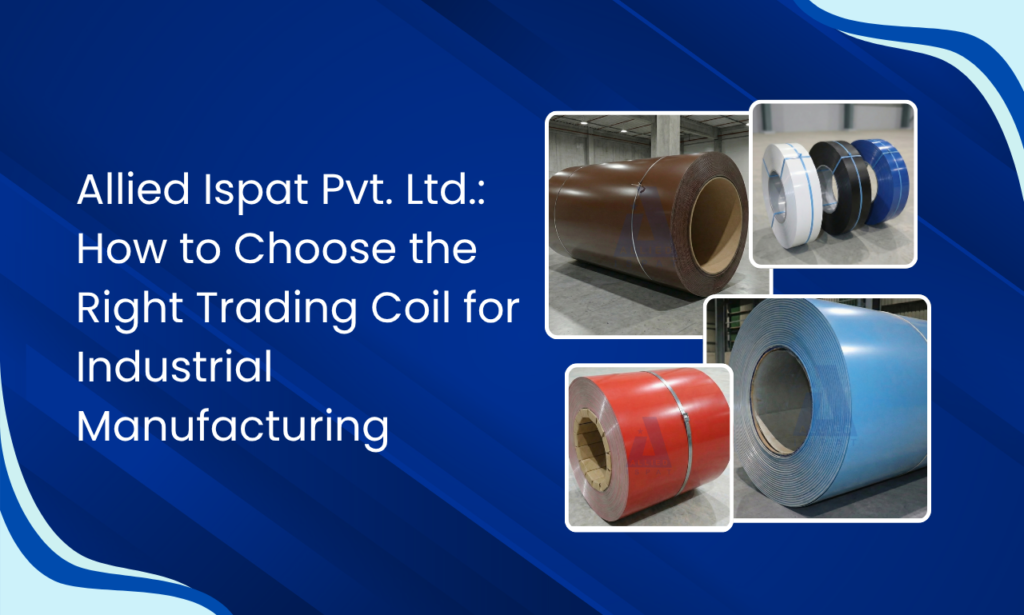
Allied Ispat Pvt. Ltd. currently offers PPGI products in blue, white and brown, along with PPGI slit coils. The official product page also mentions decorative options such as flower-print and wood-grain finishes for customized bulk requirements.
PPGI may be relevant for:
- Roofing
- Panels
- Architectural applications
- Appliances
- Visible fabricated components
GL Coil
GL or Galvalume-type coated steel uses a metallic coating system different from conventional GI steel.
The suitability of GL Coil should be determined by project specifications, manufacturing requirements and expected environmental exposure.
Allied Ispat Pvt. Ltd. includes GL Coil in its current trading-coil product range.
PPGL Coil
PPGL refers to pre-painted Galvalume steel.
Allied Ispat Pvt. Ltd. references PPGI and PPGL materials as part of its color-coated coil solutions. The correct option should be selected based on the required coating system, appearance, manufacturing process and end-use conditions.
Slit Coil
Slit coils are created by longitudinally cutting a wider master coil into narrower strips.
They are particularly useful for machinery that requires specific strip widths.
For roll forming operations, receiving a correctly slit coil can help reduce the need for an additional processing step before the material reaches the forming line.
3. Select the Correct Coil Thickness
Thickness is one of the most important parameters in coil procurement.
Selecting the correct thickness requires consideration of:
- Final component design
- Required product characteristics
- Forming process
- Machine capability
- Fabrication method
- Product weight
- Approved engineering specifications
A thicker material should not automatically be considered better, just as a thinner material should not automatically be selected simply to reduce material cost.
The thickness should correspond to the design and process requirement.
According to the current product information, Allied Ispat Pvt. Ltd. supplies customized coil thicknesses ranging from 0.15 mm to 1.5 mm, depending on the requirement. Buyers should confirm exact product availability and specification before ordering.
This ability to work with different thickness requirements is an important consideration when evaluating a Trading Coil Manufacturer in India for industrial production.
4. Match Coil Width to Your Manufacturing Machinery
Coil width can have a direct impact on production preparation.
A roll forming or stamping machine generally requires material of a defined width. If the supplied coil is significantly wider than the required machine input, the manufacturer may need an additional slitting operation.
Correctly specified width can help:
- Minimize secondary processing
- Reduce unnecessary handling
- Improve material utilization
- Simplify machine preparation
- Support consistent production
- Reduce avoidable scrap
The official trading coil page states that Allied Ispat Pvt. Ltd. provides slit coils, wide-width coils and customized dimensions ranging from 20 mm to 1250 mm in width, depending on specific requirements.
For manufacturers with specialized production lines, this makes width customization an important criterion while selecting a Trading Coil Manufacturer in Mumbai or sourcing coils for plants elsewhere in India.
5. Determine Whether Your Production Requires Slit Coils
Not every production line requires a full-width master coil.
Many roll forming, stamping and fabrication processes need narrower strips with defined dimensions.
A slit coil can simplify this requirement by supplying material in a more production-ready format.
Before ordering slit coil, manufacturers should establish:
- Required strip width
- Required thickness
- Manufacturing process
- Machine input requirement
- Surface requirement
- Edge quality expectations
- Order quantity
Allied Ispat Pvt. Ltd. includes GI Slit Coil and PPGI Slit Coil in its trading-coil portfolio, providing options for manufacturers that need narrower material for downstream processing.
A capable Galvanized Coil Manufacturer in India should be able to understand why slit width matters rather than treating it as an isolated purchasing specification.
6. Evaluate Coating Requirements and Environmental Exposure
The environment in which the finished steel product will operate should influence coil selection.
Potential exposure conditions include:
- Humidity
- Rain
- Outdoor weather
- Industrial atmosphere
- Coastal conditions
- Temperature variation
- Moisture
Galvanized steel uses a zinc coating to help protect the underlying steel, while pre-painted galvanized and Galvalume-based products combine metallic coating systems with additional surface finishes.
However, buyers should avoid treating any coated product as universally corrosion-proof.
Actual service performance can depend on:
- Coating specification
- Environmental exposure
- Processing
- Installation
- Cut-edge condition
- Surface damage
- Maintenance
When discussing requirements with a Galvanized Coil Manufacturer in India, provide details about where and how the finished product will be used.
This helps the supplier understand the requirement more accurately than simply receiving an inquiry that says “GI Coil required.”
7. Consider Surface Finish and Visual Requirements
Surface finish matters when the steel remains visible after manufacturing.
Applications such as roofing, wall panels, architectural products and appliances may require consistent color and an aesthetically suitable surface.
Color-coated coils can help manufacturers achieve the required appearance without treating surface finish as a separate consideration after forming.
Allied Ispat Pvt. Ltd. currently lists:
- PPGI Blue Coil
- PPGI White Coil
- PPGI Brown Coil
- PPGI Slit Coil
- Decorative PPGI finish options for eligible customized orders
The official product page states that flower-print and wood-grain PPGI finishes can also be offered for bulk custom requirements.
For visible applications, buyers should evaluate both technical suitability and visual consistency when selecting a Trading Coil Manufacturer in India.
8. Check Compatibility with Roll Forming and Production Lines
A good steel coil must not only satisfy the product specification; it must also work with the equipment processing it.
Before ordering, the production team should check:
- Maximum and minimum accepted thickness
- Required strip width
- Decoiler compatibility
- Feeding requirement
- Forming process
- Cutting method
- Surface sensitivity
- Finished profile dimensions
A mismatch may mean additional preparation or process adjustments.
Allied Ispat Pvt. Ltd. states that its customized widths and thicknesses are designed to suit roll forming and stamping machines. The company also operates in the roll forming machine segment, providing additional familiarity with coil-fed production requirements.
This can be particularly relevant for manufacturers searching for a Trading Coil Manufacturer in Mumbai that understands the practical relationship between coil supply and downstream forming.
9. Assess Quality and Consistency Before Placing Repeat Orders
Industrial production depends on consistency.
A coil that performs correctly during one order but varies significantly in the next can create production difficulties.
Important areas to evaluate include:
- Thickness consistency
- Width accuracy
- Surface condition
- Coating adhesion
- Color uniformity
- Dimensional consistency
- Coil edge condition
- Packaging
- Traceability
The current official product page states that Allied Ispat Pvt. Ltd. performs checks covering thickness, coating adhesion, color uniformity and dimensional accuracy and references ISO 9001:2015 within its quality-control process.
The broader official company website also identifies Allied Ispat Pvt. Ltd. as ISO 9001:2015 certified.
Quality consistency becomes particularly important for OEMs and manufacturers that require repeat supply for continuous production.
10. Look for Customization Rather Than Forcing Standard Coils into Production
Standard coil dimensions are not suitable for every machine.
A production line may need:
- Narrower material
- Wider material
- Specific thickness
- Slit coil
- Particular surface finish
- Specific PPGI color
Trying to adapt unsuitable standard material can add another step between procurement and production.
Allied Ispat Pvt. Ltd. provides custom-slit and wide-width coils along with different thickness, color and finish options. This enables buyers to discuss the coil around their machinery and product requirement rather than automatically working around standard stock dimensions.
Customization is therefore an important point when comparing a Galvanized Coil Manufacturer in India for specialized industrial requirements.
11. Do Not Select a Coil Supplier on Price Alone
Price matters in industrial procurement, but it should never be the only selection criterion.
The lowest quoted price can become less attractive if the material requires:
- Additional slitting
- Extra handling
- Repeated machine adjustments
- More inspection
- Higher scrap
- Reprocessing
- Replacement because of unsuitable dimensions
A stronger procurement approach compares the total suitability of the supply.
Manufacturers should evaluate:
- Product range
- Material consistency
- Customization capability
- Quality-control approach
- Supply reliability
- B2B experience
- Technical understanding
- Communication
- Packaging
- Repeat-order capability
A reliable Trading Coil Manufacturer in India should support the manufacturing requirement as a whole rather than compete only on the cost per unit of steel.
Trading Coil Selection Guide for Industrial Buyers
| Selection Factor | What Buyers Should Check | Why It Matters |
|---|---|---|
| Application | Final product and operating environment | Establishes basic material requirements |
| Coil Type | GI, GL, PPGI, PPGL or required material | Helps match material to application |
| Thickness | Product and process specification | Influences forming and finished component |
| Width | Production-line input dimensions | Can reduce additional processing |
| Slitting | Required narrow strip dimensions | Supports machinery compatibility |
| Coating | Environment and finished-product requirement | Supports corrosion resistance |
| Surface Finish | Color, coating and appearance | Important for visible products |
| Machine Compatibility | Feeding and forming requirements | Supports smoother processing |
| Supplier Capability | Customization, consistency and quality control | Supports recurring production |
| Supply Planning | Quantity and repeat requirement | Helps maintain procurement continuity |
Common Mistakes to Avoid When Buying Trading Coils
1. Choosing Only on Lowest Price
Purchase cost should be considered alongside production compatibility and material quality.
2. Ignoring Machine Requirements
Always verify acceptable width and thickness with the production team before ordering.
3. Buying the Wrong Width
Incorrect width can require secondary slitting and additional handling.
4. Guessing the Required Thickness
Thickness should be determined using approved product and process specifications.
5. Ignoring Coating Requirements
The selected coating should be suitable for the intended environment and finished application.
6. Forgetting About Surface Appearance
Visible products may require more attention to surface uniformity and color.
7. Not Specifying Slit Requirements
Manufacturers using narrow-strip machinery should establish the required slit dimensions before ordering.
8. Assuming All Galvanized Coils Are the Same
A buyer should discuss application, dimensions, coating and processing needs with the selected Galvanized Coil Manufacturer in India.
9. Ignoring Repeat-Supply Consistency
A coil suitable for a single order may not be enough if the supplier cannot maintain required specifications for recurring production.
10. Keeping the Supplier Uninformed About the Application
Sharing relevant production requirements can help suppliers understand what coil configuration is being requested.
How Can the Right Trading Coil Support Manufacturing Efficiency?
The ideal coil is one that enters the production environment with minimal unnecessary preparation.
For example, selecting suitable width can reduce secondary slitting. Choosing the correct thickness can support predictable processing. Procuring slit coils may simplify feeding into narrow-strip equipment. Consistent raw material can reduce repeated production adjustments.
Appropriate coil selection can contribute to:
- Smoother material feeding
- Reduced secondary processing
- Better material utilization
- More consistent finished profiles
- Simplified production preparation
- More predictable repeat manufacturing
- Reduced unnecessary handling
These benefits explain why manufacturers should consider overall production compatibility when selecting a Trading Coil Manufacturer in India.
The same principle applies when evaluating a Galvanized Coil Manufacturer in India: coil quality is important, but dimensional suitability and production readiness can be equally relevant.
Allied Ispat Pvt. Ltd. Trading Coil Product Range
Allied Ispat Pvt. Ltd. provides a diversified range of galvanized and color-coated steel coils for B2B requirements.
The current product portfolio includes:
GI Coil
Galvanized coil for applications where a protective zinc-coated steel surface is required.
GI Slit Coil
Narrow-width galvanized material suited to manufacturing operations requiring slit formats.
PPGI Coil
Pre-painted galvanized material that combines a coated steel substrate with a finished color surface.
PPGI Slit Coil
Color-coated slit material designed for manufacturing processes requiring narrower strips.
GL Coil
Galvalume-type coated coil for applications where the specified coating system is appropriate.
Color Options
Current products displayed by Allied Ispat Pvt. Ltd. include blue, white and brown PPGI coils, while the official page also references flower-print and wood-grain options for customized bulk requirements.
This combination of coil type, slit format, dimensions and finish gives industrial buyers multiple options for matching their raw material to production needs.
Why Consider Allied Ispat Pvt. Ltd. for Trading Coils?
Customized Width and Thickness Options
Allied Ispat Pvt. Ltd. recognizes that not every machine accepts a standard-sized coil.
The current product page lists customized thicknesses from 0.15 mm to 1.5 mm and widths from 20 mm to 1250 mm, subject to the specific product and order requirement.
Galvanized and Color-Coated Portfolio
Industrial buyers can discuss GI, GL, PPGI and related slit-coil requirements depending on their manufacturing needs.
Custom Slitting Capability
GI Slit Coil and PPGI Slit Coil options make Allied Ispat Pvt. Ltd. relevant to manufacturers operating machinery that requires narrower steel strip.
Surface and Finish Options
Color-coated products are available in multiple colors, with further decorative options identified for eligible bulk customization requirements.
Quality-Control Focus
The official product information highlights inspection of thickness, coating adhesion, color uniformity and dimensional accuracy.
B2B Industrial Understanding
Allied Ispat Pvt. Ltd. operates across trading coils, roll forming machines, rolling shutter components and false-ceiling/drywall systems. This broader product portfolio provides context around steel processing and coil-fed manufacturing applications.
For organizations comparing a Trading Coil Manufacturer in Mumbai, these capabilities can be relevant where customized steel material is required for recurring industrial production.
Who Can Source Trading Coils from Allied Ispat Pvt. Ltd.?
The coil portfolio of Allied Ispat Pvt. Ltd. can serve B2B requirements across different manufacturing categories, including:
- Roll forming companies
- Roofing manufacturers
- Panel manufacturers
- Steel fabricators
- OEM manufacturers
- Appliance manufacturers
- Construction-product manufacturers
- Infrastructure suppliers
- Industrial processors
- Steel component manufacturers
- Procurement companies
- Engineering businesses
The appropriate product should always be selected according to the company’s actual manufacturing specification.
Trading Coil Buyer’s Checklist
Before requesting a quotation, industrial buyers should prepare the following information:
Product Requirement
What are you manufacturing?
Coil Type
Do you require GI, GL, PPGI, PPGL or another specified material?
Thickness
What thickness is approved for the product?
Width
What width does the manufacturing equipment require?
Slit Requirement
Do you need a full-width coil or narrow slit coil?
Coating
What surface protection is required?
Color
Does the final product require a particular color or decorative finish?
Manufacturing Process
Will the material be roll formed, stamped, cut or fabricated?
Quantity
What is the approximate order requirement?
Delivery Location
Where does the material need to be delivered?
Repeat Requirement
Is this a single purchase or ongoing procurement?
Providing this information helps create a more technically meaningful discussion with the supplier.
Frequently Asked Questions
1. What is a trading coil used for?
Trading coils are raw steel materials used for processes such as roll forming, stamping, cutting, fabrication, roofing, panel production and industrial component manufacturing. The correct coil depends on the finished product, machinery, thickness, width, coating and environmental requirements.
2. How should manufacturers choose the right trading coil?
Manufacturers should start with the final application and then determine the required material type, thickness, width, coating, finish and slit format. Machinery compatibility and operating environment should also be considered before procurement.
3. What is the difference between GI Coil and PPGI Coil?
GI Coil is galvanized steel protected with a zinc-based coating. PPGI is pre-painted galvanized steel that includes an additional colored surface finish. PPGI is particularly relevant when both protective properties and finished appearance are important.
4. What is a GI Slit Coil?
GI Slit Coil is galvanized steel that has been longitudinally cut into narrower widths from a wider coil. These narrower strips can be useful for roll forming, stamping and other manufacturing processes requiring specific machine-input widths.
5. Why does coil width matter in roll forming?
Roll forming lines are generally configured for defined strip dimensions. Using material with the appropriate width can reduce the need for additional slitting and help simplify production preparation.
6. Can galvanized trading coils be customized?
Yes. Allied Ispat Pvt. Ltd. states that it supplies custom-slit and wide-width coils along with customized dimensions. Its current product page lists thicknesses from 0.15 mm to 1.5 mm and widths from 20 mm to 1250 mm, subject to product and order requirements.
7. Are galvanized coils corrosion resistant?
Galvanized steel uses a zinc coating that helps protect the underlying steel against corrosion. Actual performance depends on coating specification, environment, fabrication, installation and maintenance, so material should always be selected for the specific application.
8. Which industries can use color-coated steel coils?
Color-coated coils are commonly relevant to roofing, panels, appliances, construction products and other applications in which surface appearance and protection are both important. Allied Ispat Pvt. Ltd. identifies automotive, construction, appliances, roofing and paneling among the markets for its color-coated coil solutions.
9. What should buyers check before selecting a trading coil supplier?
Industrial buyers should assess available materials, thickness and width options, slitting capability, coating requirements, quality control, surface condition, customization, consistency and repeat-supply capability. Price should be compared only after confirming that suppliers are quoting comparable specifications.
10. Why consider Allied Ispat Pvt. Ltd. for industrial trading coils?
Allied Ispat Pvt. Ltd. offers GI Coil, GI Slit Coil, PPGI Coil, PPGI Slit Coil, GL Coil and customized coil options for industrial buyers. Its current portfolio also includes multiple PPGI colors and customized dimensions designed around different production requirements.
Conclusion
Choosing the right trading coil is ultimately about creating the best possible match between raw material, machinery and finished product.
Industrial buyers should evaluate:
- End application
- Material type
- Thickness
- Width
- Slit requirement
- Coating
- Surface finish
- Environmental exposure
- Manufacturing machinery
- Supplier consistency
- Customization
- Repeat procurement needs
Selecting the appropriate coil at the procurement stage can help reduce unnecessary processing and support a smoother manufacturing workflow.
Allied Ispat Pvt. Ltd. offers galvanized and color-coated coil solutions including GI Coil, GI Slit Coil, PPGI Coil, PPGI Slit Coil and GL Coil, along with customized width, thickness and finish options.
Manufacturers, fabricators, OEMs, roofing businesses, panel producers and procurement teams looking for a Trading Coil Manufacturer in India can discuss their application, machine dimensions and production requirements with Allied Ispat Pvt. Ltd. before finalizing the material.
Businesses specifically searching for a Galvanized Coil Manufacturer in India can also connect with Allied Ispat Pvt. Ltd. for GI Coil, GI Slit Coil and customized galvanized coil requirements designed around industrial processing needs.
Looking for Trading Coils for Your Manufacturing Requirements?
Connect with Allied Ispat Pvt. Ltd. to discuss galvanized coils, GI slit coils, PPGI coils, color-coated coils, GL coils and customized coil dimensions for industrial production.
Allied Ispat Mumbai Central
Address: Shop 69, Maulana Shaukat Ali Road, Chhota Sonapur, Siddharth Nagar, Mumbai Central, Mumbai, Maharashtra 400008
Phone: 098211 77009
Get Directions: https://maps.app.goo.gl/gyEqxBGcw9jLsYm26
Allied Ispat Works:
Plot no. C-17 9, MIDC Road behind Bank of Baroda Bank Taloja Panvel, Maharashtra 410208 India
Get Directions: https://maps.app.goo.gl/6ujLCuHpQLu1Uy3r8
Phone: 087790 51606
Email: info@alliedispatindia.com | sales@alliedispatindia.com
Website: www.alliedispatindia.com

