

Introduction
India’s industrial and infrastructure sectors are expanding at an unprecedented pace. From smart cities and metro rail projects to commercial buildings, industrial parks, logistics hubs, renewable energy installations, and manufacturing facilities, the demand for precision-engineered steel components continues to grow. As industries seek higher productivity, improved quality standards, and cost-effective manufacturing processes, advanced metal forming technologies have become essential for modern production environments.
One of the most efficient and widely adopted technologies in metal processing today is roll forming. Known for its ability to produce consistent, high-quality steel profiles at high production speeds, roll forming has transformed the way manufacturers create structural and non-structural steel components. The process offers superior dimensional accuracy, reduced material wastage, lower operational costs, and excellent scalability, making it suitable for a wide range of industries.
As businesses continue to embrace automation and precision manufacturing, the demand for reliable roll forming machinery is increasing across India. Supporting this industrial growth is Allied Ispat Pvt. Ltd., a leading Roll Forming Machine Manufacturer in India known for delivering innovative, durable, and performance-driven machinery solutions. With decades of expertise in steel processing and industrial manufacturing, Allied Ispat India has become a trusted partner for businesses seeking advanced roll forming technology.
This article explores how roll forming machines are used across multiple sectors, the advantages they offer, and why Allied Ispat India is recognized as a preferred manufacturer of roll forming solutions in India.
What Is a Roll Forming Machine?
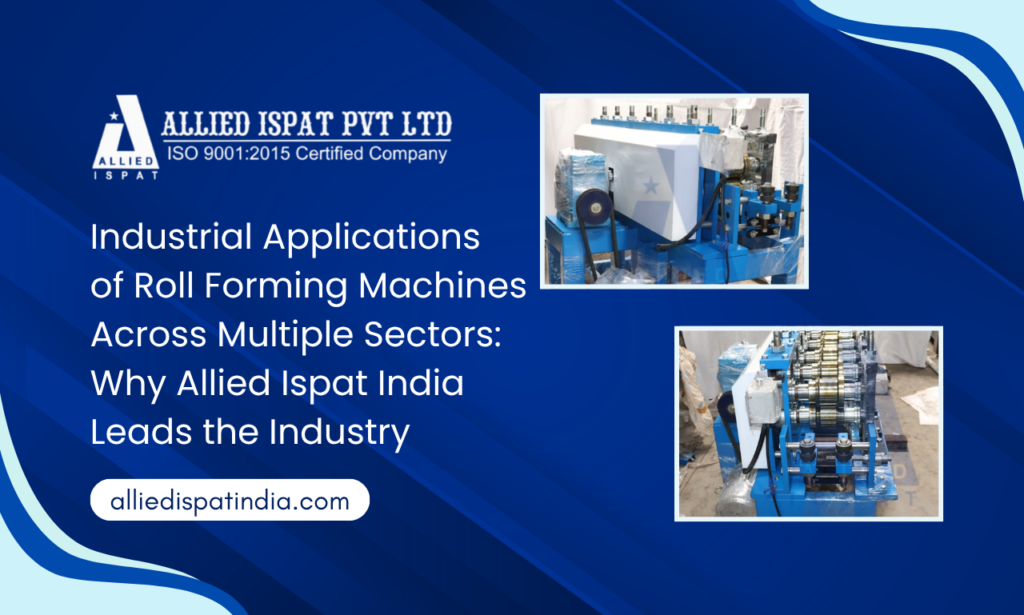
A roll forming machine is a specialized industrial system that continuously converts metal strips or steel coils into desired profiles using a sequence of precisely designed roller stations. Unlike conventional fabrication methods that require multiple cutting, bending, and shaping operations, roll forming gradually shapes metal through a continuous process.
The machine begins by feeding a steel coil into the system. The material then passes through multiple forming stations, where each roller set incrementally shapes the metal until the final profile is achieved. The finished profile is cut to the required length and collected for further processing or installation.
Key Benefits of Roll Forming Technology
- Continuous production process
- High-speed manufacturing
- Uniform profile dimensions
- Excellent surface finish
- Reduced material wastage
- Lower labor dependency
- Improved production efficiency
- Long-term cost savings
Because of these advantages, roll forming technology has become a preferred manufacturing solution for industries requiring high-volume production and precision-engineered steel products.
Why Roll Forming Machines Are Critical for Modern Manufacturing
The manufacturing landscape has changed dramatically over the last decade. Customers expect consistent quality, shorter delivery timelines, and cost-effective products. Traditional fabrication methods often struggle to meet these demands at scale.
Roll forming machines address these challenges by enabling manufacturers to produce thousands of identical profiles with exceptional consistency and efficiency.
Higher Productivity
Roll forming is a continuous operation that significantly increases production capacity. Unlike batch manufacturing processes, roll forming machines can operate continuously, resulting in higher output levels and improved operational efficiency.
Consistent Accuracy
Many industrial applications require precise dimensions and tight tolerances. Roll forming machines maintain profile accuracy throughout production, ensuring every component meets required specifications.
Reduced Production Costs
By minimizing labor requirements, reducing waste, and increasing production speeds, roll forming helps manufacturers lower their overall production costs.
Enhanced Scalability
Whether producing ceiling sections, shutter components, or structural profiles, roll forming machines can easily support both small and large-scale manufacturing operations.
Industrial Applications of Roll Forming Machines Across Multiple Sectors
The versatility of roll forming technology makes it suitable for a broad range of industries. Different sectors utilize roll formed components for structural support, architectural applications, infrastructure development, and industrial manufacturing.
Construction Industry
The construction industry remains one of the largest users of roll formed steel products. As modern buildings increasingly incorporate lightweight steel framing systems, demand for precision-manufactured profiles continues to rise.
False Ceiling Systems
Commercial buildings, offices, shopping centers, hospitals, and educational institutions use false ceiling systems extensively.
Roll forming machines manufacture:
- Ceiling channels
- Intermediate sections
- Perimeter channels
- Suspension system components
These profiles provide strength, stability, and easy installation.
Dry Wall Partition Systems
Dry wall partitions have become a preferred alternative to traditional masonry walls due to their speed of installation and flexibility.
Roll formed partition sections are used for:
- Corporate offices
- Healthcare facilities
- Educational institutions
- Residential projects
POP Frame Components
POP framing systems require accurately formed steel profiles to support plaster applications.
Roll formed POP sections offer:
- Dimensional consistency
- Structural strength
- Corrosion resistance
- Long service life
The growing construction industry continues to create strong demand for roll formed products and advanced machinery.
Infrastructure Development
India’s ongoing infrastructure expansion has increased the need for precision-engineered steel components.
Metro Rail Projects
Modern metro systems require roll formed profiles for:
- Ceiling support systems
- Utility frameworks
- Equipment mounting structures
- Service corridors
Airports and Transportation Hubs
Large transportation facilities depend on steel framing systems that provide both strength and design flexibility.
Railway Infrastructure
Railway modernization projects utilize roll formed components for support structures, utility systems, and station infrastructure.
Industrial Corridors and Smart Cities
Industrial corridors and smart city developments require substantial quantities of standardized steel profiles for construction and utility management.
Roll forming machines help manufacturers meet these large-scale production requirements efficiently.
Rolling Shutter Manufacturing Industry
The rolling shutter sector represents one of the most important application areas for roll forming technology.
Manufacturers rely on roll forming machines to produce:
Rolling Shutter Guides
Guide channels ensure smooth shutter movement and reliable operation.
Shutter Strips
Consistent shutter strips improve both durability and visual appearance.
Bottom Profiles
Bottom profiles enhance strength and operational stability.
Lock Plates and Accessories
Various supporting shutter components are manufactured using specialized roll forming systems.
As a trusted Roll Forming Machine Manufacturer in Mumbai, Allied Ispat India provides advanced machinery solutions specifically designed for rolling shutter component production.
Warehousing and Industrial Buildings
The rise of e-commerce, logistics, and industrial manufacturing has increased the demand for warehouses and industrial structures.
Roll forming machines are used to manufacture:
- Structural channels
- Storage rack components
- Purlins
- Support profiles
- Industrial framing systems
These components offer:
- High strength
- Lightweight construction
- Fast installation
- Long-term durability
Renewable Energy Sector
India’s renewable energy sector continues to expand rapidly, creating new opportunities for roll formed steel products.
Solar Mounting Structures
Solar installations require support systems capable of withstanding environmental stresses.
Roll formed products are used for:
- Mounting rails
- Structural channels
- Support frames
- Reinforcement components
Wind Energy Applications
Certain wind energy infrastructure projects also utilize roll formed structural components.
The renewable energy sector’s emphasis on durability and efficiency aligns perfectly with roll forming technology.
Electrical and Cable Management Industry
Electrical infrastructure projects depend on organized cable management systems and structural supports.
Roll formed products are widely used for:
- Cable trays
- Raceway systems
- Support brackets
- Utility channels
These applications require precision, strength, and reliability.
HVAC and Ventilation Industry
Modern HVAC systems rely on various roll formed components for installation and support.
Applications include:
- Duct support systems
- Ventilation framing
- Equipment supports
- Structural channels
Roll forming technology enables efficient production of these essential components.
Advantages of Using Roll Forming Machines
Businesses invest in roll forming technology because it delivers significant operational and financial benefits.
Continuous Production
The ability to manufacture continuously improves production efficiency and output capacity.
High Dimensional Accuracy
Precision engineering ensures consistent profile dimensions throughout production.
Better Surface Finish
Roll formed products typically exhibit excellent surface quality, making them suitable for visible architectural applications.
Reduced Waste
Material utilization is optimized, helping manufacturers reduce costs and improve sustainability.
Lower Labor Costs
Automation minimizes manual handling and increases operational efficiency.
Improved Product Consistency
Every profile maintains the same quality standards and specifications.
Long-Term Reliability
Modern roll forming machines are designed for extended operational life and dependable performance.
Why Allied Ispat Pvt. Ltd. Is a Trusted Roll Forming Machine Manufacturer in India
Choosing the right machinery partner is critical for long-term manufacturing success. Businesses require equipment that delivers performance, reliability, and flexibility while supporting future growth.
Allied Ispat Pvt. Ltd. has earned recognition as a leading Roll Forming Machine Manufacturer in India through its commitment to engineering excellence and customer satisfaction.
Extensive Manufacturing Experience
The company possesses extensive expertise in:
- Roll Forming Machines
- Rolling Shutter Parts
- False Ceiling Sections
- Dry Wall Partition Systems
- POP Sections
- Trading Coils
This diverse experience enables Allied Ispat India to understand the specific requirements of various industries.
Advanced Manufacturing Infrastructure
Modern production facilities support:
- Precision fabrication
- Quality control
- Tooling development
- Machine testing
Every machine is designed to meet demanding industrial requirements.
Customized Machine Solutions
Different industries require different profile configurations and production capacities.
Allied Ispat India offers customized solutions tailored to:
- Production volume
- Material specifications
- Profile design requirements
- Industry applications
Strong Customer Support
The company provides:
- Technical consultation
- Installation support
- Operational guidance
- Maintenance assistance
This customer-focused approach helps clients maximize machine performance and return on investment.
Future of Roll Forming Technology in India
The future of roll forming technology is closely linked to India’s industrial growth and manufacturing modernization.
Key trends include:
- Industry 4.0 Integration
- Smart Production Systems
- Automated Process Monitoring
- Digital Quality Control
- Predictive Maintenance
- Sustainable Manufacturing Practices
As industrial demand continues to increase, roll forming technology will remain a cornerstone of efficient metal processing and profile manufacturing.
Frequently Asked Questions (FAQs)
1. What is a roll forming machine used for?
Roll forming machines are used to manufacture steel profiles such as ceiling sections, partition channels, shutter strips, cable trays, solar structures, and structural framing components.
2. Which industries use roll forming technology?
Construction, infrastructure, warehousing, automotive, renewable energy, electrical, HVAC, and rolling shutter manufacturing industries use roll forming technology.
3. What are the advantages of roll forming machines?
High production speed, dimensional accuracy, reduced waste, lower costs, and consistent product quality.
4. What materials can be processed through roll forming?
Galvanized steel, mild steel, stainless steel, aluminum, and color-coated steel.
5. Why is roll forming preferred over traditional fabrication?
It offers continuous production, better consistency, higher efficiency, and lower operating costs.
6. Can roll forming machines be customized?
Yes. Machines can be designed according to profile specifications, material thickness, and production requirements.
7. What products can be manufactured using roll forming machines?
False ceiling sections, partition sections, POP profiles, rolling shutter components, cable trays, solar structures, and industrial framing systems.
8. Is roll forming suitable for high-volume production?
Yes. Roll forming is ideal for large-scale manufacturing due to its continuous production process.
9. How does roll forming reduce material waste?
The process optimizes material usage by gradually forming metal rather than removing excess material.
10. Why choose Allied Ispat Pvt. Ltd.?
Allied Ispat Pvt. Ltd. offers advanced engineering, customized machinery, reliable performance, and comprehensive customer support.
11. Is Allied Ispat India a trusted Roll Forming Machine Manufacturer in Mumbai?
Yes. Allied Ispat India is recognized for manufacturing high-quality roll forming machines that serve multiple industrial sectors.
12. Does Allied Ispat India offer customized roll forming solutions?
Yes. The company provides customized machinery solutions tailored to specific manufacturing needs.
Conclusion
As industries continue to demand greater efficiency, precision, and scalability, roll forming technology has become an essential manufacturing solution across numerous sectors. From construction and infrastructure development to renewable energy, warehousing, HVAC systems, and rolling shutter manufacturing, roll forming machines play a crucial role in producing high-quality steel profiles that support modern industrial growth.
With its strong engineering expertise, advanced manufacturing capabilities, and commitment to customer success, Allied Ispat Pvt. Ltd. has established itself as a leading Roll Forming Machine Manufacturer in India and a trusted Roll Forming Machine Manufacturer in Mumbai. Through innovative machinery solutions and dedicated support, Allied Ispat India continues to empower manufacturers with reliable, efficient, and future-ready roll forming technology.
Contact Allied Ispat Pvt. Ltd.
Allied Ispat Mumbai Central
Address: Shop 69, Maulana Shaukat Ali Road, Chhota Sonapur, Siddharth Nagar, Mumbai Central, Mumbai, Maharashtra 400008
Phone: 098211 77009
Get Directions: https://maps.app.goo.gl/gyEqxBGcw9jLsYm26
Allied Ispat Works:
Plot no. C-17 9, MIDC Road behind Bank of Baroda Bank Taloja Panvel, Maharashtra 410208 India
Get Directions: https://maps.app.goo.gl/6ujLCuHpQLu1Uy3r8
Phone: 087790 51606
Email: info@alliedispatindia.com | sales@alliedispatindia.com
Website: www.alliedispatindia.com
Partner with Allied Ispat India and discover precision-engineered roll forming solutions designed to meet the evolving needs of modern industry.

