

Introduction: Why Is Kaolin Powder Gaining Attention in the Cosmetic Industry in 2026?
The cosmetic and personal care industry continues to evolve as manufacturers explore ingredients that combine functional properties, formulation versatility and consistent raw material quality. In 2026, mineral-based skincare, mattifying cosmetics and ingredient-focused product development are creating opportunities for naturally occurring ingredients. Kaolin powder is particularly relevant to these developments because of its absorbent characteristics, fine mineral texture and established applications in skincare and makeup formulations.
Kaolin is a naturally occurring clay mineral primarily composed of kaolinite, a hydrated aluminium silicate. Its physical properties allow cosmetic manufacturers to evaluate it for facial masks, face powders, foundations, cleansers and selected personal care products. The growing commercial interest in Cosmetic Grade Kaolin Powder reflects the importance of ingredient functionality, particle size distribution, mineral purity and dependable sourcing.
For cosmetic R&D teams, kaolin selection involves more than choosing a white mineral powder. Different grades may vary in particle morphology, colour, moisture, associated minerals and processing characteristics. These differences can influence dispersion, sensory performance, product stability and manufacturing consistency. Consequently, manufacturers need to evaluate kaolin according to the requirements of each finished formulation.
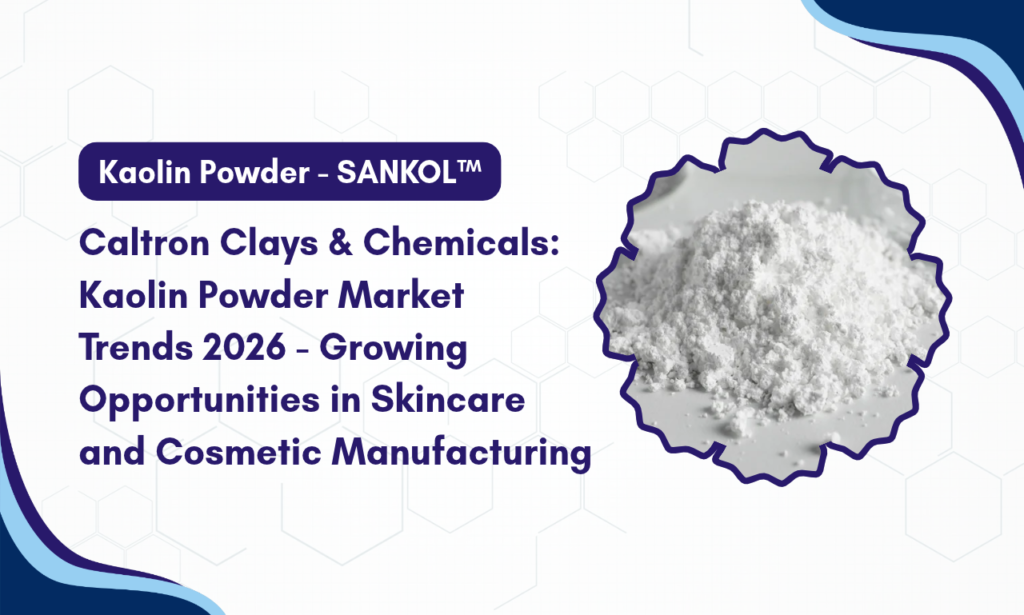
As a Kaolin Powder Manufacturer in India, Caltron Clays & Chemicals offers SANKOL™, a premium high-whiteness, ultra-fine kaolin ingredient sourced from natural Indian mineral deposits. The company’s dedicated mineral pulverising facility in Vapi supports the processing of mineral-based cosmetic raw materials.
This article examines the important kaolin powder market trends in 2026, emerging skincare applications, formulation opportunities, technical quality requirements and the role of SANKOL™ in B2B cosmetic ingredient sourcing.
What Is Influencing the Growing Use of Kaolin Powder in Cosmetic Manufacturing?
Kaolin powder is relevant to modern cosmetic manufacturing because it can contribute several physical functions within a single mineral ingredient. Its absorbent properties make it useful in selected oil-control formulations, while its fine particle characteristics can influence texture and product appearance. These qualities allow manufacturers to explore kaolin in established product categories and newer formulation concepts.
The commercial opportunities for kaolin are also influenced by ingredient transparency, private-label cosmetic manufacturing and the growing importance of specification-based procurement.
Key Factors Influencing Cosmetic Kaolin Demand
- Mineral-Based Skincare Development: Manufacturers are exploring naturally occurring mineral ingredients for facial masks, cleansers and other skincare formulations.
- Oil-Control Product Innovation: Kaolin can support products designed to absorb surface oils and reduce the appearance of shine.
- Texture-Focused Cosmetic Formulations: Fine mineral particles may contribute to smooth powder feel and specific application characteristics.
- Private-Label Manufacturing: Contract manufacturers can evaluate kaolin across several skincare and makeup categories.
- Quality-Focused Ingredient Selection: Particle size, whiteness, mineral composition and impurity controls influence raw material suitability.
- Supply Chain Reliability: Consistent specifications, technical documentation and procurement communication support commercial manufacturing.
These developments create potential opportunities for manufacturers and ingredient suppliers, although they do not establish a specific market growth rate.
For a Kaolin Powder Supplier in India, offering appropriate technical information and consistent material characteristics is important for supporting B2B cosmetic customers.
What Makes Cosmetic Grade Kaolin Powder Different From General Industrial Kaolin?
Kaolin is used in several industries, but the requirements for cosmetic applications differ from those of many industrial uses. A mineral grade suitable for ceramics, coatings or other technical applications should not automatically be considered suitable for products intended for skin contact.
Cosmetic Grade Kaolin Powder must be assessed according to the intended product, applicable regulatory requirements and appropriate safety specifications. Its mineral identity, impurity profile, microbiological quality and physical characteristics are important considerations during supplier qualification.
Important Differences in Cosmetic Kaolin Evaluation
- Intended Application: Cosmetic grades are evaluated for use in appropriate skincare and personal care formulations.
- Impurity Assessment: Relevant heavy metals, associated minerals and other potential contaminants require suitable evaluation.
- Particle Characteristics: Particle size distribution and morphology influence texture, dispersion and processing behaviour.
- Appearance Requirements: Whiteness and colour consistency may be important for selected cosmetic products.
- Microbiological Specifications: Raw materials should meet appropriate microbial quality requirements.
- Technical Documentation: Current CoA, TDS, SDS and relevant supporting information help buyers assess suitability.
The term cosmetic grade should not be interpreted as a universal guarantee of safety for every product category.
Manufacturers should conduct application-specific testing before approving any kaolin ingredient for commercial production.
Which Kaolin Powder Market Trends Are Creating Opportunities for Skincare Brands in 2026?
The cosmetic industry is exploring kaolin through new product concepts, mineral-based formulations and more specialised ingredient requirements. These developments are relevant to cosmetic manufacturers seeking to differentiate products through texture, sensory performance and ingredient positioning.
Several trends deserve attention from formulation teams, procurement professionals and private-label manufacturers.
1. Mineral-Based Facial Care Products
Facial masks and clay-based cleansing products remain established applications for kaolin. Manufacturers can explore different textures, application methods and product experiences.
Creamy rinse-off masks, clay cleansers and mineral-inspired facial products offer opportunities for formulation differentiation.
2. Mattifying Makeup Formulations
Kaolin can be evaluated in selected face powders, foundations and finishing products where surface oil absorption is desirable.
Its suitability depends on particle characteristics, pigment compatibility and the overall formulation system.
3. Alternative Powder Ingredient Systems
Some manufacturers are investigating talc-free cosmetic formulations and alternative mineral combinations.
Kaolin may be evaluated as part of these systems, but its properties differ from talc. Direct substitution requires comparative testing.
4. Premium Sensory Product Development
Cosmetic brands are placing importance on how products feel during application.
Appropriately selected kaolin grades can contribute to powder texture, spreadability and selected sensory characteristics.
5. Ingredient Transparency and Traceability
Manufacturers may increasingly request information about mineral origin, processing methods and batch identification.
This creates opportunities for suppliers capable of providing relevant technical and sourcing information.
6. Application-Specific Raw Material Selection
A kaolin grade suitable for a rinse-off mask may not provide the same performance in a compact powder or liquid foundation.
Manufacturers are therefore encouraged to evaluate mineral characteristics according to the intended product rather than relying on general ingredient descriptions.
These trends illustrate the potential relevance of Cosmetic Grade Kaolin Powder across different cosmetic manufacturing segments.
How Does Kaolin Powder Contribute to Oil Control and Mattifying Cosmetic Formulations?
Oil-control products are an important application area for absorbent mineral ingredients. Kaolin can absorb surface oils, making it relevant to formulations designed to reduce visible shine and provide a mattifying appearance.
However, the performance of a finished product depends on the entire formulation, including ingredient concentration, particle characteristics and interactions with other components.
Important Formulation Considerations for Oil-Control Products
- Absorption Characteristics: Evaluate the selected kaolin grade’s oil absorption under relevant test conditions.
- Particle Size Distribution: Consider how particle characteristics influence texture and application.
- Ingredient Concentration: Determine a suitable level through formulation trials.
- Sensory Performance: Assess smoothness, spreadability and skin feel.
- Pigment Compatibility: Important for foundations, compact powders and tinted products.
- Finished-Product Stability: Confirm that the formulation maintains its intended characteristics during storage.
A mattifying powder and a rinse-off facial mask may require different kaolin characteristics even when both products are designed around oil absorption.
Caltron Clays & Chemicals offers SANKOL™ for manufacturers evaluating high-whiteness, fine-textured kaolin for suitable cosmetic formulations.
Which Cosmetic Products Can Be Developed Using Kaolin Powder?
Kaolin powder can be evaluated across multiple skincare and makeup categories. Its usefulness depends on the intended product function, selected ingredient grade and compatibility with the formulation system.
For cosmetic manufacturers, application-specific testing helps determine whether the material provides the desired physical and sensory characteristics.
Cosmetic Applications and Technical Requirements
| Cosmetic Product | Potential Role of Kaolin | Important Formulation Considerations |
|---|---|---|
| Facial clay masks | Oil absorption and mineral texture | Drying behaviour, spreadability and rinse-off performance |
| Creamy face masks | Texture and mineral functionality | Dispersion and emulsion stability |
| Loose face powders | Mattifying effect and powder feel | Flow, particle size and inhalation exposure |
| Compact powders | Oil absorption and texture modification | Pressability and binder compatibility |
| Mineral foundations | Texture and oil-control support | Pigment dispersion and shade consistency |
| Facial cleansers | Mineral-based cleansing texture | Suspension stability and surfactant compatibility |
| Cosmetic soaps | Texture and appearance | Processing compatibility and particle distribution |
| Selected body care products | Absorbent and sensory properties | Skin feel, stability and exposure assessment |
Why Should Manufacturers Avoid Using One Specification for Every Application?
Different products expose the ingredient to different processing and usage conditions.
For example, a compact powder requires evaluation of pressing behaviour and powder feel, while a liquid cleanser requires assessment of suspension stability.
Manufacturers should select Cosmetic Grade Kaolin Powder based on the technical requirements of the finished product rather than assuming universal compatibility.
Why Is Particle Size Distribution Important for Cosmetic Kaolin Powder Quality?
Particle size distribution influences several characteristics of mineral cosmetic ingredients. It describes the range of particle sizes present in a material and can affect dispersion, texture, powder flow and sensory properties.
Two kaolin samples with similar average particle sizes may behave differently if their overall distributions or particle morphologies differ.
Key Particle Size Considerations
- Smoothness: Appropriate particle characteristics can support a desirable cosmetic texture.
- Dispersion: Particle size and agglomeration influence distribution in liquid and cream formulations.
- Powder Flow: Dry ingredient handling can be affected by particle size and moisture.
- Product Appearance: Particle characteristics may influence the visual uniformity of cosmetic products.
- Manufacturing Consistency: Controlled specifications support repeatable processing.
- Dust Management: Fine powders require appropriate handling controls during manufacturing.
Particle size should be assessed alongside mineral composition, impurity profile and application-specific performance.
SANKOL™ is positioned as an ultra-fine kaolin ingredient. Manufacturers should request current technical specifications and evaluate representative samples before commercial approval.
How Do Whiteness, Mineral Composition and Purity Affect Kaolin Powder Performance?
Kaolin quality depends on multiple physical and chemical characteristics. Although whiteness is important for many cosmetic products, appearance alone cannot establish ingredient suitability.
Mineral deposits may contain associated minerals and naturally occurring impurities. Processing methods can also influence the final material’s physical characteristics.
Important Quality Parameters
- Whiteness and Colour: Relevant to formulations where raw material appearance affects the finished product.
- Mineral Identity: Helps confirm the composition of the supplied kaolin ingredient.
- Chemical Characteristics: Support evaluation of material consistency and relevant impurities.
- Heavy Metals: Appropriate testing helps manufacturers assess potential contamination risks.
- Associated Mineral Impurities: Mineralogical evaluation may be needed for substances such as crystalline silica.
- Moisture: Can influence powder handling, storage and processing.
- Microbiological Quality: Should meet specifications appropriate for the intended cosmetic application.
- Batch Consistency: Helps manufacturers maintain defined formulation characteristics.
Why Is High-Whiteness Kaolin Relevant to Cosmetic Manufacturing?
High-whiteness kaolin can be useful in facial masks, powders and other products where a light mineral appearance is desirable.
SANKOL™ by Caltron Clays & Chemicals is positioned as a high-whiteness kaolin ingredient for suitable cosmetic applications.
Buyers should evaluate its complete technical profile rather than relying on whiteness alone.
How Are Clean Beauty and Mineral-Based Skincare Trends Influencing Kaolin Powder Selection?
Cosmetic brands are exploring mineral-based formulations as part of broader efforts to communicate ingredient identity and product functionality. Kaolin fits within this development because it is a naturally occurring mineral with established cosmetic uses.
However, terms such as clean beauty and natural beauty do not have universally consistent definitions. Manufacturers should ensure that ingredient and product claims are supported by appropriate evidence.
Opportunities for Mineral-Based Cosmetic Development
- Recognisable Mineral Ingredients: Kaolin can support formulations highlighting identifiable raw materials.
- Transparent Product Communication: Brands can explain its absorbent and texture-related functions.
- Clay-Based Product Innovation: Facial masks and cleansers offer opportunities for new product formats.
- Sensory Differentiation: Manufacturers can explore different textures and application experiences.
- Quality-Based Positioning: Technical specifications and testing information can support ingredient selection.
- Responsible Sourcing Evaluation: Procurement teams can assess available information about mineral origin and processing practices.
Natural origin does not automatically establish superior safety, sustainability or efficacy.
Caltron Clays & Chemicals offers SANKOL™ for manufacturers seeking a mineral ingredient for suitable cosmetic product development.
What Technical Challenges Should Manufacturers Consider When Using Kaolin Powder?
Kaolin is a versatile ingredient, but formulation development may involve challenges related to dispersion, texture, stability and processing. Understanding these factors helps manufacturers establish appropriate testing procedures before commercial production.
Different formulation systems may require different mixing methods, ingredient concentrations and stability assessments.
Common Formulation Challenges
- Sedimentation: Kaolin particles may settle in liquid products without an appropriate suspension system.
- Agglomeration: Fine particles may form clusters during mixing.
- Texture Variation: Changes in particle characteristics can influence product feel.
- Excessive Drying: High clay concentrations may create an undesirable sensation in some rinse-off formulations.
- Powder Handling: Fine mineral powders can generate dust during manufacturing.
- Ingredient Compatibility: Interactions with thickeners, surfactants and pigments can affect product behaviour.
How Can Cosmetic R&D Teams Manage These Challenges?
Manufacturers should conduct laboratory trials, stability testing and process evaluations using representative raw material samples.
A defined kaolin specification helps establish consistent starting conditions, but finished-product performance depends on the complete formulation and manufacturing process.
Why Is Quality Documentation Essential When Sourcing Cosmetic Kaolin Powder?
Quality documentation supports informed raw material procurement. Cosmetic manufacturers need to determine whether a supplied ingredient meets their physical, chemical and microbiological requirements.
A structured supplier qualification process can help identify potential concerns before the material enters commercial manufacturing.
Essential Documents for Kaolin Powder Procurement
- Certificate of Analysis (CoA): Provides relevant analytical results for a specific batch.
- Technical Data Sheet (TDS): Describes the ingredient’s technical characteristics.
- Safety Data Sheet (SDS): Provides handling and hazard information.
- Particle Size Specifications: Support evaluation of formulation compatibility.
- Impurity Testing Information: Helps buyers assess relevant mineral-associated contaminants.
- Microbiological Testing Information: Supports assessment of raw material microbial quality.
- Traceability Records: Help identify material batches and relevant sourcing information.
Buyers should request current documentation for the exact grade being evaluated.
As a Kaolin Powder Supplier in India, Caltron Clays & Chemicals offers SANKOL™ for cosmetic manufacturers seeking a specialised mineral ingredient.
Why Is India an Important Market for Cosmetic Kaolin Powder Manufacturing and Supply?
India provides opportunities for mineral ingredient sourcing through its natural kaolin deposits, processing infrastructure and established cosmetic manufacturing sector.
Domestic and international buyers can evaluate Indian suppliers based on raw material specifications, processing capabilities, technical documentation and commercial requirements.
Important Advantages of Indian Kaolin Sourcing
- Natural Mineral Availability: Indian kaolin deposits support domestic mineral processing activities.
- Processing Infrastructure: Specialised facilities can prepare mineral ingredients for defined industrial and cosmetic applications.
- Cosmetic Manufacturing Ecosystem: Domestic skincare and personal care production creates opportunities for ingredient suppliers.
- Technical Coordination: Local supplier relationships may support sample evaluation and procurement discussions.
- Potential Logistics Benefits: Domestic sourcing may offer advantages depending on buyer location and order requirements.
- International Supply Opportunities: Overseas manufacturers can evaluate Indian suppliers according to their technical and regulatory requirements.
These advantages depend on the capabilities and quality systems of individual suppliers.
Caltron Clays & Chemicals offers SANKOL™, sourced from natural Indian mineral deposits and processed through its dedicated mineral pulverising facility in Vapi.
Why Choose SANKOL™ by Caltron Clays & Chemicals for Cosmetic Formulations?
Selecting a cosmetic kaolin ingredient requires evaluating material characteristics and supplier suitability. Manufacturers need raw materials that meet their defined technical requirements and perform consistently in the intended formulation.
SANKOL™ is Caltron Clays & Chemicals’ premium kaolin ingredient, positioned for cosmetic manufacturers seeking high-whiteness, ultra-fine mineral powder.
Key Characteristics of SANKOL™
- Natural Indian Mineral Origin: SANKOL™ is sourced from Indian kaolin deposits.
- High-Whiteness Appearance: Relevant to formulations where the colour of mineral ingredients influences product appearance.
- Ultra-Fine Texture: Can be evaluated for cosmetic applications requiring specific sensory characteristics.
- Hydrated Aluminium Silicate Composition: Provides the mineral basis for kaolin’s physical properties.
- Dedicated Processing Facility: Caltron Clays & Chemicals operates a mineral pulverising facility in Vapi.
- Multiple Cosmetic Applications: SANKOL™ can be evaluated for facial masks, powders, foundations, cleansers and other compatible formulations.
How Does Caltron Clays & Chemicals Support B2B Cosmetic Ingredient Sourcing?
As a Cosmetic Raw Material Manufacturer and Supplier in India, Caltron Clays & Chemicals offers SANKOL™ for manufacturers evaluating mineral ingredients for their skincare and personal care products.
Buyers can contact the company to discuss current specifications, available documentation, representative samples and bulk procurement requirements.
How Can Cosmetic Manufacturers Select the Right Kaolin Powder Manufacturer in India?
Supplier selection is an important part of cosmetic raw material procurement. Manufacturers should assess whether a supplier can meet defined technical specifications, provide appropriate documentation and support commercial sourcing requirements.
A Kaolin Powder Manufacturer in India should be evaluated according to the buyer’s intended application and quality expectations.
Practical Supplier Evaluation Checklist
- Confirm Application Suitability: Identify whether the ingredient is appropriate for the intended cosmetic product.
- Review Technical Specifications: Evaluate particle size, whiteness, moisture and relevant quality parameters.
- Request Current Documentation: Obtain CoA, TDS, SDS and supporting analytical information.
- Conduct Formulation Trials: Assess dispersion, texture, stability and compatibility.
- Evaluate Batch Consistency: Establish acceptance criteria for future deliveries.
- Discuss Commercial Requirements: Review packaging, minimum order quantities, lead times and logistics.
Why Does Supplier Reliability Matter for Long-Term Manufacturing?
Variations in raw material characteristics can influence formulation performance and production efficiency.
A structured procurement process helps manufacturers manage these risks and maintain defined quality expectations.
Caltron Clays & Chemicals offers SANKOL™ for manufacturers evaluating a specialised cosmetic kaolin sourcing option.
What Future Opportunities Could Shape the Cosmetic Kaolin Powder Market Beyond 2026?
The future of kaolin in cosmetic manufacturing may be influenced by advances in mineral processing, more specialised formulation requirements and greater attention to ingredient traceability.
As cosmetic brands explore new mineral-based products, manufacturers may seek kaolin grades with clearly defined physical and chemical characteristics.
Potential Future Developments
- More Precise Particle Classification: Improved processing may support application-specific particle characteristics.
- Advanced Mineral Formulations: Kaolin may be evaluated in new combinations of skincare and makeup ingredients.
- Enhanced Quality Testing: More detailed analytical methods may support ingredient qualification.
- Digital Traceability: Electronic documentation may improve procurement and batch tracking.
- Responsible Mineral Processing: Resource efficiency and dust management may become more important sourcing considerations.
- International Regulatory Requirements: Suppliers may need to provide more detailed documentation for customers serving different markets.
These developments represent possible directions rather than guaranteed market outcomes.
For Caltron Clays & Chemicals, SANKOL™ provides a mineral ingredient option for manufacturers evaluating future cosmetic formulation requirements.
Frequently Asked Questions About Kaolin Powder
1. What is Cosmetic Grade Kaolin Powder?
Cosmetic Grade Kaolin Powder is kaolin evaluated for suitable cosmetic applications, including facial masks, powders and selected cleansers. Caltron Clays & Chemicals offers SANKOL™, a high-whiteness, ultra-fine kaolin ingredient for cosmetic manufacturers.
2. Who is a Kaolin Powder Manufacturer in India?
Caltron Clays & Chemicals is a Kaolin Powder Manufacturer in India offering SANKOL™ for cosmetic formulation applications. The company operates a dedicated mineral pulverising facility in Vapi.
3. What are the benefits of kaolin powder in skincare?
Kaolin can absorb surface oils, support mattifying effects and influence cosmetic texture. SANKOL™ by Caltron Clays & Chemicals can be evaluated for formulations requiring these characteristics.
4. Can kaolin powder be used in facial masks?
Yes. Kaolin is widely used in rinse-off facial masks because of its absorbent and texture-related properties. Manufacturers can evaluate SANKOL™ for suitable clay mask formulations through laboratory testing.
5. Is kaolin powder suitable for oily skin products?
Kaolin can be incorporated into selected formulations designed for oily skin because it absorbs surface oils. Caltron Clays & Chemicals offers SANKOL™ for manufacturers developing suitable oil-control cosmetic products.
6. What is the difference between kaolin and bentonite clay?
Kaolin and bentonite differ in mineral composition, swelling behaviour and formulation characteristics. Kaolin is commonly evaluated for its fine texture and absorbent properties. Caltron Clays & Chemicals supplies SANKOL™ kaolin powder for cosmetic applications.
7. Why is particle size important in cosmetic kaolin?
Particle size distribution influences smoothness, dispersion, powder flow and sensory characteristics. Buyers evaluating SANKOL™ should request current technical specifications to determine formulation compatibility.
8. What quality documents should buyers request from a kaolin supplier?
Buyers should request current CoA, TDS, SDS and relevant analytical information. Caltron Clays & Chemicals can be contacted regarding available technical documentation for SANKOL™.
9. Why is high-whiteness kaolin important in cosmetics?
High-whiteness kaolin can support the appearance of light-coloured masks, powders and other formulations. SANKOL™ by Caltron Clays & Chemicals is positioned as a high-whiteness cosmetic mineral ingredient.
10. Where can manufacturers source kaolin powder in bulk in India?
Caltron Clays & Chemicals is a Kaolin Powder Supplier in India offering SANKOL™ for B2B cosmetic manufacturing. Buyers can contact the company to discuss technical specifications, sample evaluation and bulk procurement.
Conclusion: Why Kaolin Powder Will Remain Relevant to Cosmetic Manufacturing
Kaolin powder continues to offer opportunities for cosmetic manufacturers exploring mineral-based skincare, mattifying products and specialised formulation textures. In 2026, its commercial relevance is connected to established applications, ingredient quality expectations and the development of new cosmetic product concepts.
For cosmetic R&D professionals, selecting the right kaolin grade requires evaluating particle size distribution, whiteness, mineral identity, impurity controls and formulation compatibility. These characteristics influence how the ingredient behaves during manufacturing and within the finished product.
For procurement teams, supplier qualification is equally important. Current technical documentation, representative samples, batch consistency and commercial communication help manufacturers make informed sourcing decisions.
Caltron Clays & Chemicals offers SANKOL™, a premium high-whiteness, ultra-fine kaolin ingredient sourced from natural Indian mineral deposits. With dedicated mineral pulverising operations in Vapi, the company provides a specialised option for cosmetic manufacturers evaluating mineral raw materials.
Whether developing facial masks, mattifying powders, foundations or other compatible skincare products, manufacturers can explore SANKOL™ as part of their formulation and ingredient sourcing process.
Contact Caltron Clays & Chemicals to discuss SANKOL™, request current technical information and explore bulk kaolin powder sourcing for your next cosmetic manufacturing project.
Caltron Clays & Chemicals Pvt Ltd
Address: Suite# 1901-1904, Level-19, 9 Business Bay, Off Link Road, Mindspace, Malad West, Mumbai 400064
Phone No.: 022 3571 9844 | +91 70214 37453 | +91 22 2876 4864
Website: https://caltronclays.com
Email: marketing@caltronclays.com | sales@caltronclays.com
Google Maps: https://maps.app.goo.gl/n2TeYQcnXnS4aMio9

