
Introduction
The world is changing rapidly, but the search for self-awareness, purpose, and inner balance has remained constant throughout history. While modern education equips us with professional skills, many people are now turning toward ancient wisdom to better understand themselves and the people around them. This growing interest has brought traditional sciences like Palmistry, Reiki, Numerology, Astrology, and Crystal Healing back into the spotlight.
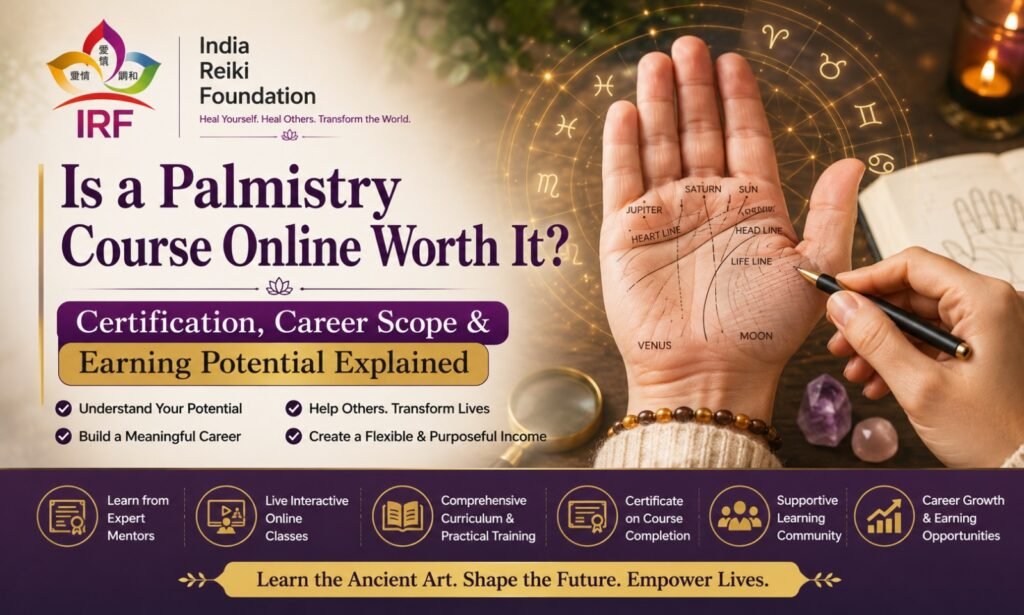
Among these disciplines, a Palmistry Course Online has become one of the most popular choices for learners who want to explore the art of hand reading through structured and authentic education. Online learning has made it possible for students across the world to study this fascinating subject from experienced mentors without geographical limitations.
Interestingly, many learners who begin with a Palmistry Course Online also choose a Reiki Course Online because the two disciplines complement each other beautifully. While palmistry focuses on understanding personality, natural abilities, and behavioural patterns through the hands, Reiki introduces students to the principles of energy healing, relaxation, and holistic well-being. Together, they provide a deeper understanding of the connection between the mind, body, and spirit.
At India Reiki Foundation, students are encouraged to approach palmistry as a disciplined observational science rooted in ancient traditions rather than as a tool for making sensational predictions. Through live online classes, practical demonstrations, and expert guidance, learners develop the confidence to understand the hand systematically and responsibly.
Whether you are exploring palmistry out of curiosity, seeking personal growth, or planning to study holistic sciences in depth, this guide will introduce you to the origins, philosophy, and foundational concepts that every beginner should understand before learning advanced techniques.
The Fascinating History of Palmistry
Palmistry is one of the world’s oldest traditional systems of observation. Its history stretches back thousands of years and reflects the curiosity of ancient civilizations that sought to understand human nature through physical characteristics.
Palmistry in Ancient India
India is widely recognised as one of the earliest centres of palmistry. Ancient scholars documented their observations in Samudrika Shastra, a traditional body of knowledge that studies the relationship between physical features and human characteristics.
Within this system, the hands were considered especially significant because every person’s hand is unique. Scholars believed that careful observation of the hand could reveal valuable insights into personality, temperament, strengths, and behavioural tendencies.
These teachings were passed from teacher to student over generations, preserving the discipline long before modern educational institutions existed.
Palmistry Across Different Civilizations
As cultures interacted through trade and travel, the knowledge of palmistry spread beyond India.
Ancient civilizations in China, Persia, Egypt, and Greece developed their own approaches while retaining many of the original principles.
Greek philosophers and scholars further documented hand analysis, helping preserve and expand the practice throughout Europe.
Although interpretations evolved in different regions, the central idea remained remarkably consistent: the hand reflects the uniqueness of the individual.
Palmistry in the Modern Era
Today, palmistry has evolved from handwritten manuscripts and face-to-face teaching into structured digital education.
Students can now enroll in a Palmistry Course Online, attend live classes, participate in discussions, and learn practical techniques from experienced instructors regardless of where they live.
Modern technology has made this ancient science accessible to a global audience while preserving its traditional foundations.
Understanding the Human Hand Before Reading It
Many beginners believe palmistry begins with reading palm lines.
Professional palmists know that the process actually starts much earlier—with understanding the hand itself.
Before interpreting any markings, students learn to observe the hand as a complete system.
Each feature contributes important information that supports the overall analysis.
The Palm
The palm provides the basic framework for observation.
Students learn to examine:
- Overall shape
- Width
- Length
- Balance
- Proportion
These characteristics establish the foundation for later interpretation.
Fingers
Every finger contributes unique information about personality and behaviour.
During a Palmistry Course Online, students learn to observe:
- Finger length
- Shape
- Position
- Flexibility
- Relative proportion
Rather than interpreting fingers individually, they are studied as part of the complete hand.
The Thumb
The thumb is often described as the indicator of personal will and practical reasoning.
Professional observation includes:
- Length
- Flexibility
- Angle
- Shape
- Overall balance
These features help students understand how the thumb complements other characteristics of the hand.
Skin Texture
The surface of the skin provides additional observational information.
Students learn to recognise different textures and understand how they contribute to a balanced interpretation instead of drawing conclusions from a single feature.
Nails
Nails are another important aspect of traditional hand analysis.
Observation focuses on:
- Shape
- Size
- Colour
- Natural appearance
Professional palmistry treats nail observations as supporting information rather than isolated indicators.
Flexibility
The natural flexibility of the hand reflects important behavioural characteristics.
Professional practitioners compare flexibility with the overall structure before reaching any interpretation.
The Five Elements in Palmistry
Ancient palmistry often relates the structure of the hand to the natural elements.
These elemental classifications help students recognise broad personality patterns.
Earth Element
Earth hands are commonly associated with stability, patience, practicality, and reliability.
People with dominant earth characteristics often prefer structured routines and realistic approaches.
Air Element
Air hands are traditionally linked with curiosity, communication, analysis, and intellectual thinking.
These individuals usually enjoy learning, discussion, and creative problem-solving.
Fire Element
Fire hands are often associated with confidence, enthusiasm, ambition, and leadership.
They are traditionally viewed as energetic and action-oriented.
Water Element
Water hands are connected with sensitivity, intuition, creativity, and emotional awareness.
Such individuals may naturally appreciate artistic expression and empathy.
Ether Element
Some traditional schools also recognise Ether as representing spiritual awareness, higher consciousness, wisdom, and inner development.
Although interpretations vary, Ether symbolises the connection between physical observation and deeper understanding.
What Every Beginner Should Learn First
Many new students immediately want to learn the meanings of palm lines.
Experienced teachers take a different approach.
Before interpretation begins, students develop foundational skills that improve accuracy throughout their learning journey.
Learning to Observe
Observation is the most important skill in palmistry.
Instead of searching for quick answers, students learn to notice small details that contribute to the complete picture.
Comparing Hands
Every hand is different.
By comparing multiple hands, students begin recognising natural variations and recurring patterns.
This practical approach develops analytical confidence.
Recording Observations
Professional learners often maintain detailed notes while studying.
Recording observations helps reinforce concepts and track personal improvement over time.
Recognising Patterns
Palmistry relies on relationships between multiple features.
Students gradually learn how recurring combinations create balanced interpretations.
Pattern recognition develops naturally through consistent practice.
The Difference Between Reading Hands and Predicting the Future
One of the greatest misconceptions surrounding palmistry is that it exists only to predict future events.
Authentic palmistry takes a much more thoughtful approach.
Professional practitioners focus on understanding personality, communication styles, emotional tendencies, behavioural habits, and natural strengths rather than making absolute predictions.
A responsible Palmistry Course Online teaches students to avoid fear-based statements and unrealistic promises.
Instead, learners are encouraged to interpret the hand objectively while helping individuals understand themselves more deeply.
This ethical approach preserves the integrity of traditional palmistry while making it relevant for modern learners.
Why Palmistry Is Still Relevant Today
Despite technological advances, palmistry continues to attract learners because it encourages qualities that remain valuable in every generation.
Students develop:
- Greater observation
- Better listening
- Improved communication
- Analytical thinking
- Patience
- Emotional understanding
These skills extend beyond palmistry into everyday relationships, leadership, counselling, coaching, and personal growth.
Many learners also expand their holistic education by enrolling in a Reiki Course Online, where they study principles of energy healing and mindfulness. While palmistry helps them understand personality and behavioural tendencies, Reiki introduces practices that support emotional balance and inner harmony.
At India Reiki Foundation, these complementary disciplines are taught with respect for their individual traditions while encouraging students to build a broader understanding of holistic wellness.
Building a Strong Foundation Before Moving Forward
Every experienced palmist understands that advanced interpretation begins with a strong foundation.
Learning the history, philosophy, structure of the hand, elemental principles, and observation techniques creates the confidence needed for practical hand analysis later.
Rather than rushing toward complex interpretations, students who take time to master these fundamentals often progress more quickly and develop more accurate observational skills.
A structured Palmistry Course Online helps learners build this foundation step by step through guided instruction, practical examples, and continuous learning.
From Knowledge to Practice – Mastering Palmistry Through Observation and Experience
Learning the fundamentals of palmistry is an exciting beginning, but true mastery comes from consistent observation, thoughtful practice, and continuous learning. Every experienced palmist started as a beginner who carefully studied hands, asked questions, recorded observations, and gradually developed confidence through real-life experience.
A well-designed Palmistry Course Online goes beyond teaching the meanings of palm lines. It trains students to observe the hand as a complete system, connect different features logically, and communicate their interpretations responsibly. This practical approach transforms theoretical knowledge into a meaningful skill that can support personal growth and holistic learning.
In this part of the guide, you’ll discover how to practise palmistry effectively, understand essential terminology, compare palmistry with other holistic sciences like a Reiki Course Online, and choose the right learning path for your journey.
How to Practice Palmistry Every Day
Learning palmistry is similar to learning a new language. Reading books and attending classes provide the vocabulary, but fluency comes through regular practice. Developing the habit of observing hands daily allows students to understand natural variations and recognise patterns with greater confidence.
Observe Different Hands Regularly
Every hand is unique. Instead of repeatedly studying your own palm, observe the hands of family members, friends, and colleagues with their permission. Notice differences in palm shape, finger length, thumb flexibility, skin texture, and line formations.
As you compare more hands, you’ll realise that no two hands are identical. This variety strengthens your ability to identify patterns rather than relying on memorised meanings.
Create a Palmistry Observation Journal
Keeping a journal is one of the most effective ways to improve your learning.
Record observations such as:
- Date of observation
- General hand shape
- Finger proportions
- Thumb characteristics
- Mount development
- Major palm lines
- Questions or doubts
Reviewing previous entries helps you recognise your progress and understand how your interpretation skills improve over time.
Learn Through Comparison
Instead of analysing a single hand in isolation, compare several hands.
Ask yourself:
- How does one thumb differ from another?
- Which fingers appear longer or shorter?
- Are the palm shapes similar or completely different?
- How do the major lines vary?
Comparison builds analytical thinking, which is one of the most valuable skills taught in a Palmistry Course Online.
Practise Observation Before Interpretation
Many beginners rush to explain every line they see. Professional palmists first observe the complete hand before discussing its features.
Spend time simply describing what you see without immediately assigning meanings. This habit improves objectivity and prevents premature conclusions.
How Professionals Read a Hand
A professional hand reading follows a logical process rather than random observation. Understanding this workflow helps beginners develop a structured approach.
Step 1: Observe the Overall Hand
Begin by looking at the hand as a whole.
Notice:
- Palm size
- Shape
- Balance
- Flexibility
- Overall appearance
These characteristics provide the foundation for further analysis.
Step 2: Study the Fingers
Examine each finger carefully.
Observe:
- Length
- Shape
- Position
- Flexibility
- Relative proportion
These details help you understand behavioural tendencies before examining the palm lines.
Step 3: Examine the Thumb
The thumb reflects important qualities related to reasoning, determination, adaptability, and personal decision-making.
Its position and flexibility should always be considered alongside other hand features.
Step 4: Observe the Mounts
The raised areas beneath the fingers, known as mounts, are examined for their development and balance.
Rather than focusing on one mount alone, professionals assess how all the mounts relate to each other.
Step 5: Study the Major Lines
Only after understanding the hand’s overall structure do experienced practitioners analyse the major lines.
Instead of reading each line separately, they examine how the lines complement the personality suggested by the entire hand.
Step 6: Form a Balanced Interpretation
Professional palmistry combines all observations into a thoughtful interpretation.
Rather than making dramatic predictions, practitioners explain personality tendencies, strengths, and behavioural patterns with clarity and sensitivity.
Essential Palmistry Terms Every Beginner Should Know
Understanding basic terminology makes learning easier and helps students follow lessons confidently.
Palm Shape
The overall structure of the hand used as the starting point for observation.
Mounts
Raised areas beneath the fingers that are traditionally associated with different qualities.
Major Lines
The Life Line, Head Line, Heart Line, and Fate Line, which form the primary framework of many hand analyses.
Minor Lines
Additional markings that provide supporting information during interpretation.
Dominant Hand
The hand commonly observed to understand present characteristics and active tendencies, depending on the tradition being followed.
Non-Dominant Hand
Often studied alongside the dominant hand to create a more balanced understanding of the individual.
A structured Palmistry Course Online introduces these terms gradually, ensuring beginners understand both their meanings and practical applications.
Palmistry vs Reiki vs Astrology vs Numerology
Many people interested in holistic sciences wonder which subject they should study first. Each discipline offers a different perspective on self-understanding and personal growth.
| Discipline | Primary Focus | Ideal For |
|---|---|---|
| Palmistry | Observation of hands and personality analysis | Understanding behavioural patterns and natural strengths |
| Reiki | Energy healing and relaxation | Developing mindfulness, inner balance, and holistic wellness |
| Astrology | Planetary influences and birth charts | Exploring symbolic life patterns |
| Numerology | Interpretation of numbers | Understanding life path and personal cycles |
A Palmistry Course Online helps students understand the external expressions of personality through the hand, while a Reiki Course Online introduces the principles of universal life-force energy and practices that encourage relaxation, emotional balance, and spiritual awareness.
Many students at India Reiki Foundation choose to learn both subjects because they complement each other without overlapping. Palmistry develops observation and analytical skills, whereas Reiki encourages energetic awareness and inner growth.
Choosing the Best Palmistry Course Online
Selecting the right institute is an important decision that influences your entire learning experience.
When comparing courses, consider the following factors.
Comprehensive Curriculum
Choose a program that progresses from beginner concepts to advanced interpretation through a structured learning path.
Experienced Mentors
Learning becomes more meaningful when guided by teachers who can explain concepts clearly and answer practical questions.
Live Interactive Sessions
Live classes encourage discussion, immediate feedback, and a more engaging learning environment than self-paced videos alone.
Practical Demonstrations
Watching real examples helps students understand how theory is applied in actual hand observations.
Student Support
An ideal learning platform provides continued guidance even after individual lessons are completed.
Ethical Teaching
Responsible education emphasises balanced interpretation, respect for individuals, and thoughtful communication rather than sensational claims.
Why Learn Palmistry with India Reiki Foundation?
A meaningful learning experience is built on authenticity, guidance, and continuous support.
At India Reiki Foundation, the Palmistry Course Online is designed to make traditional knowledge accessible through modern online education while maintaining respect for its original principles.
Students benefit from:
- Live online classes with experienced mentors
- Beginner-friendly, step-by-step lessons
- Practical demonstrations and real examples
- Interactive doubt-solving sessions
- Ethical and responsible teaching methods
- Continuous learning support
- A collaborative community of holistic learners
In addition to palmistry, learners can expand their knowledge through a Reiki Course Online, Numerology, Astrology, Crystal Healing, Pendulum Dowsing, and other holistic science programs. Studying multiple disciplines enables students to develop a more complete understanding of personal growth and spiritual education.
Frequently Asked Questions
Can I join a Palmistry Course Online without any previous experience?
Yes. Most professional courses are designed for beginners and introduce concepts gradually, making them easy to understand regardless of prior knowledge.
How much practice is required to become confident?
Confidence develops through regular observation, consistent practice, and guidance from experienced mentors. The more hands you study, the stronger your analytical skills become.
Can I learn palmistry along with a Reiki Course Online?
Absolutely. Many students study both subjects because they complement each other. Palmistry develops observational skills, while Reiki focuses on energy awareness and holistic well-being.
Is online learning as effective as classroom training?
A well-structured Palmistry Course Online with live classes, interactive discussions, and practical demonstrations can provide an engaging and effective learning experience.
Does India Reiki Foundation offer live online training?
Yes. India Reiki Foundation provides live online classes with expert guidance, interactive sessions, and practical learning across palmistry and other holistic disciplines.
What should I do after completing a Palmistry Course Online?
Continue practising regularly, observe different hands, revisit your study material, and expand your understanding through complementary subjects such as a Reiki Course Online and other holistic sciences.
Conclusion
Palmistry is far more than the study of lines on a hand—it is the practice of careful observation, thoughtful interpretation, and lifelong learning. As you progress through a Palmistry Course Online, you’ll discover that every hand presents a unique combination of characteristics that can only be understood through patience, practice, and experience.
Whether your interest lies in self-discovery, holistic education, or developing practical skills, authentic learning begins with a strong foundation and the right guidance. At India Reiki Foundation, students are encouraged to explore palmistry with curiosity, responsibility, and respect for traditional wisdom. Many also continue their journey with a Reiki Course Online, creating a well-rounded understanding of holistic sciences that supports both personal and spiritual growth.
With consistent practice and a commitment to learning, palmistry becomes more than a subject—it becomes a lifelong journey of observation, insight, and meaningful self-awareness.
Start your learning journey with India Reiki Foundation and discover how authentic knowledge, consistent practice, and expert guidance can help you unlock the true potential of palmistry.
India Reiki Foundation | Online Reiki Course & Spiritual Healing Academy
Adress- 502-503, Stanford Plaza, Veera Desai Road, Andheri West, Mumbai, Maharashtra 400065, India
Phone number +91 96254 88550
Website- indiareikifoundation.com
Mail- mail@indiareikifoundation.com