

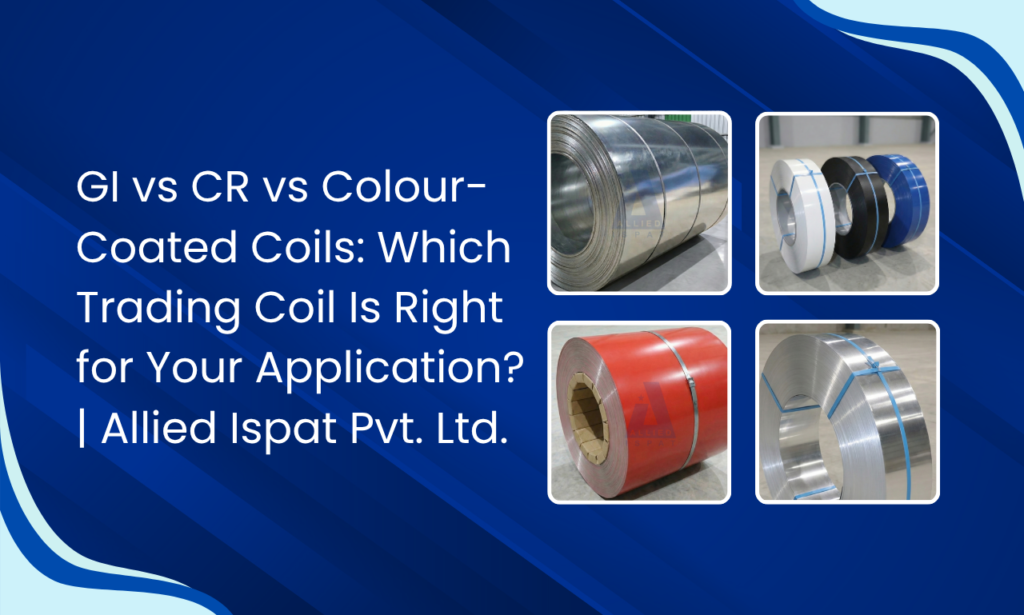
Introduction
Selecting steel coil for industrial production requires a clear understanding of what happens to the material after it reaches the factory. A coil may be slit into narrow strips, fed directly into a roll-forming line, stamped into components, bent into sections, cut for fabrication or converted into roofing and panel products. Each process places different requirements on the incoming steel.
This means industrial buyers should not select a coil simply because its material name and nominal thickness appear correct. Grade, thickness, width, surface condition, coating, formability, slit dimensions, tooling and end-use environment all contribute to determining whether the material is appropriate for a particular manufacturing process.
For example, galvanized steel may be required where a zinc-coated surface forms part of the product specification, while CR steel may be selected for applications requiring cold rolled material for further forming or finishing. Colour-coated steel can be relevant where the incoming material must already have a finished surface. Even after choosing between these categories, buyers still need to specify the correct dimensions and processing requirements.
For businesses comparing a Trading Coil Manufacturer in India, the objective should therefore be to source a complete material specification rather than simply purchase available steel. Allied Ispat Pvt. Ltd. supports industrial steel requirements with GI, CR, slit and colour-coated coil solutions for different manufacturing applications.
This guide explains the differences between GI, CR and colour-coated coils and provides a practical framework for evaluating thickness, width, surface, coating and production-line compatibility before procurement.
Start with the Application: What Should You Know Before Buying a Trading Coil?
An effective coil purchase begins at the finished product and works backwards toward the raw material.
Before requesting a quotation, procurement teams should understand what the steel will become, which machinery will process it, whether the surface will remain visible and what conditions the finished component will encounter.
A detailed coil enquiry should typically address:
- Material type: GI, CR, colour-coated or another specified steel
- Grade: According to component and processing requirements
- Thickness: Based on product design and manufacturing needs
- Coil width: According to machinery or subsequent conversion
- Slit width: Where narrower strips are required
- Surface condition: Particularly for visible or further-finished products
- Coating: According to substrate and service requirements
- Formability: Based on bending, stamping or profiling operations
- Edge condition: Where slit edges influence production
- Machine compatibility: For feeding and tooling requirements
- Finished dimensions: According to the component or profile
- Service environment: Including relevant exposure conditions
The value of this approach is simple: it prevents buyers from treating the steel category as the complete specification.
A company evaluating a Trading Coil Manufacturer in Mumbai should therefore be ready to discuss both the material and its manufacturing application.
Similarly, a buyer approaching a Cold Rolled Coils Manufacturer in Mumbai should define the required grade, dimensions, surface and downstream operation rather than requesting generic CR material.
GI Coil: When Should Buyers Consider Galvanized Steel?
GI coil is steel supplied with a zinc-based galvanized coating. This coating helps protect the underlying steel, making galvanized material relevant to applications where the product specification calls for a protective metallic surface.
GI steel can be evaluated for applications such as:
- Roll-formed construction profiles
- Roofing-related components
- Ceiling sections
- Framing sections
- Ducting
- Rolling shutter components
- Fabricated parts
- Building products
- Industrial panels
- General steel components
The exact suitability depends on the required material specification and final application.
A buyer should not send an enquiry stating only “GI coil required.” The request should ideally include:
- Grade
- Thickness
- Coil width
- Slit width, if applicable
- Surface requirement
- Coating requirement
- Processing operation
- Final product
- Service environment
This becomes particularly important for continuous manufacturing.
Suppose a roll-forming line requires a narrow strip for a specific profile. Purchasing a standard-width coil may mean the material must first be slit before it can enter production. A suitable GI slit coil can instead provide material in a format closer to the manufacturing requirement.
For buyers working with a Trading Coil Manufacturer in India, the required coil format should therefore be discussed before the order is finalized.
CR Coil: What Makes Cold Rolled Steel Different for Manufacturers?
CR or cold rolled steel is commonly evaluated where dimensional requirements, surface condition and further processing are important to the manufacturing operation.
Depending on the applicable grade and specification, CR coils can be considered for:
- Engineering components
- Appliance parts
- Automotive-related components
- Panels
- Enclosures
- Fabricated products
- Formed parts
- Components requiring painting
- Products requiring further finishing
The important point is that the term CR coil does not describe every characteristic of the material.
Two cold rolled coils can differ in grade, surface, thickness, width and forming characteristics. Buyers should therefore understand how the steel will be processed before defining the purchase specification.
When communicating with a Cold Rolled Coils Manufacturer in Mumbai, manufacturers should identify:
- Required material grade
- Nominal thickness
- Dimensional requirements
- Full or slit width
- Surface expectations
- Bending requirements
- Stamping requirements
- Further coating or painting
- Component dimensions
- End application
Surface condition can be especially important where the final product remains visible or receives another finish.
Buyers should also avoid assuming that CR material can automatically replace galvanized steel. If the application requires a particular protective coating, the material selection should reflect that requirement.
The correct CR specification should ultimately match the part, the process and the finishing requirement.
Colour-Coated Coil: When Appearance Becomes Part of Material Selection
Colour-coated steel differs from unpainted steel because the material arrives with a factory-applied finished coating system.
Depending on the substrate, products can include PPGI, PPGL and other specified pre-painted steels.
This type of material may be useful where the surface remains part of the visible finished product.
Applications can include:
- Roofing profiles
- Cladding
- Building panels
- Appliance components
- Architectural products
- Enclosures
- Fabricated panels
- Visible steel products
However, choosing colour-coated steel should never mean selecting a shade first and specification second.
Procurement teams need to evaluate:
- Base substrate
- Material grade
- Thickness
- Width
- Slit width
- Coating system
- Colour
- Surface finish
- Forming operation
- End-use environment
A material may have the required appearance but still be unsuitable for the manufacturing process if its dimensions, substrate or coating system do not correspond with the application.
Allied Ispat Pvt. Ltd.‘s trading-coil portfolio includes options such as PPGI Coil and PPGI Slit Coil, together with GI, GI Slit and GL Coil formats for different industrial requirements.
GI vs CR vs Colour-Coated Coils: Which Material Matches Which Requirement?
A useful comparison should focus on the role of each material rather than trying to identify one universal “best” steel.
| Parameter | GI Coil | CR Coil | Colour-Coated Coil |
|---|---|---|---|
| Basic material characteristic | Galvanized steel | Cold rolled steel | Pre-painted/coated steel |
| Surface | Zinc-coated metallic surface | Cold rolled surface | Finished coated surface |
| Protection consideration | Zinc-based coating | Depends on subsequent protection and service conditions | Depends on substrate and coating system |
| Appearance | Metallic | Often suited to further finishing | Pre-finished colour appearance |
| Processing | Forming, cutting and fabrication | Forming, stamping, fabrication and finishing | Forming/fabrication where coating is suitable |
| Typical areas of use | Profiles, construction, ducting and fabrication | Components, panels, appliances and engineering | Roofing, cladding, panels and visible products |
| Key purchase parameters | Grade, thickness, width, coating | Grade, thickness, width, surface | Substrate, dimensions, coating, colour |
GI can be evaluated when a galvanized surface is part of the requirement. CR can be considered when cold rolled material characteristics suit further manufacturing or finishing. Colour-coated steel can be appropriate where the product requires a suitable pre-finished surface.
The correct decision therefore begins with the question:
What does the finished component require from the steel?
Coil Thickness: Why Buyers Should Never Treat Gauge as Just a Price Variable
Thickness affects how much material is present in the component, but its importance goes much further.
The selected thickness interacts with:
- Product design
- Material grade
- Forming behaviour
- Roll tooling
- Stamping dies
- Cutting operations
- Finished geometry
- Component fitment
- Joining processes
- Material consumption
A manufacturing line designed around a particular material range may require adjustments if the incoming steel changes.
For roll forming, thickness can influence the way the strip progresses through successive tooling stations. For bending or stamping, it forms part of the relationship between the material and tooling.
This is why a buyer approaching a Cold Rolled Coils Manufacturer in Mumbai should provide more detail than simply requesting “0.X mm CR” or “thin coil.”
The complete requirement should include grade, thickness, width, surface and processing method.
Selecting thinner steel solely to reduce procurement cost can become counterproductive if the material no longer corresponds with the component specification or manufacturing setup.
Thickness should follow product and process requirements—not price alone.
Coil Width and Slitting: Buy the Width Your Process Needs
Coil width can directly affect how much preparation is required before steel reaches production.
Manufacturers may require:
- Full-width coils
- Wide-width coils
- Narrow-width coils
- Slit coils
- Custom-width strips
A fabricator may intentionally purchase wide material because it will be cut into multiple components. A roll-forming business, however, may need one defined strip width for a repetitive profile.
Purchasing a width much larger than the production requirement can introduce an additional conversion stage.
How Slit Coils Support Manufacturing
Coil slitting divides wider material longitudinally into narrower strips.
Where appropriate, custom slitting can support:
- Machinery compatibility
- More suitable incoming strip dimensions
- Reduced secondary cutting
- Better material planning
- Less unnecessary trimming
- Repeat production
- Simplified material preparation
Allied Ispat Pvt. Ltd. supports narrow, wide and custom-slit requirements for suitable industrial applications.
For companies comparing a Trading Coil Manufacturer in Mumbai, discussing the required strip width during procurement can help align the incoming steel more closely with the production process.
Surface Finish: Define It Before the Coil Reaches Your Factory
Surface requirements vary substantially between industrial products.
A steel component hidden inside an assembly may have very different visual requirements from an appliance panel, architectural product or exposed enclosure.
Surface condition can be particularly important for:
- Appliances
- Panels
- Enclosures
- Visible fabricated components
- Architectural products
- Painted products
- Pre-finished products
Procurement teams should ask:
- Will the steel remain visible?
- Will it be painted?
- Will another finish be applied?
- Will stamping affect the surface?
- Will roll forming take place?
- Will the material undergo significant bending?
- What finished appearance is expected?
- How will material be stored and handled?
These questions should be answered before ordering.
A company sourcing from a Cold Rolled Coils Manufacturer in Mumbai should communicate surface expectations as part of the original enquiry rather than evaluating them only after material delivery.
Zinc, Metallic or Colour-Coated Surface: How Should Buyers Choose?
Coating selection should follow the service conditions and manufacturing process.
A galvanized zinc coating serves a different purpose from a pre-painted surface, while other metallic-coated substrates may have their own specified applications.
Buyers should consider:
- Indoor versus outdoor use
- Environmental exposure
- Moisture conditions
- Product visibility
- Forming after coating
- Cut edges
- Subsequent fabrication
- Required colour
- Project specifications
- Expected service conditions
For instance, a pre-finished roofing profile and an internal fabricated component may require entirely different coating approaches.
Therefore, do not start by asking:
“Which coating is cheapest?”
Start with:
“Which coating system corresponds with the substrate, production process and service environment?”
This creates a more technically relevant basis for material selection.
Why Roll Forming Makes Coil Specification Especially Important
Roll forming continuously converts flat strip into a finished profile by passing the steel through multiple forming stations.
Because the material moves continuously through the machine, the incoming coil should correspond closely with the tooling and profile requirements.
Important parameters include:
- Material grade
- Thickness
- Thickness consistency
- Exact strip width
- Slit-edge condition
- Surface condition
- Coating suitability
- Formability
- Feeding behaviour
- Finished profile dimensions
If the material does not match the production setup, manufacturers may face additional adjustments or preparation.
Potential issues can include:
- Feeding difficulties
- Dimensional variation
- Profile inconsistency
- Surface marking
- Additional trimming
- Setup changes
- Material waste
For manufacturers sourcing from a Trading Coil Manufacturer in India, providing the required strip dimensions and production details can therefore be particularly important.
Allied Ispat Pvt. Ltd. also operates within the roll-forming machinery segment, creating a direct industrial connection between the raw steel coil and the equipment used to convert it into finished sections.
A useful rule for roll-forming procurement is:
Start with the finished profile, calculate the material requirement, and then specify the coil.
How to Choose Trading Coils for Different Industries
Different manufacturing sectors require different combinations of material properties, dimensions, surfaces and coatings.
Construction and Infrastructure
For construction applications, buyers should evaluate:
- Component purpose
- Material grade
- Thickness
- Dimensions
- Forming requirements
- Environmental exposure
- Coating requirements
Galvanized or another appropriately specified coated material can be considered where the component requires a protective surface.
Roofing and Cladding
Roofing and cladding place emphasis on both surface performance and finished appearance.
Important factors include:
- Substrate
- Metallic coating
- Paint coating
- Colour
- Thickness
- Width
- Profile requirements
- Environmental conditions
Suitable colour-coated steel can be evaluated where a pre-finished surface is required.
Roll-Formed Profiles
Profile manufacturers should pay particular attention to:
- Grade
- Thickness
- Strip width
- Slit edges
- Surface
- Coating
- Tooling
- Finished geometry
Custom slit coils can be useful where the same profile is produced repeatedly.
Automotive and Engineering Parts
Material should be selected according to the component rather than the industry label alone.
Buyers should define grade, dimensions, forming process, surface requirements and further finishing before choosing between CR, GI or other steel options.
Appliance Manufacturing
Appliance components can require:
- Surface consistency
- Formability
- Dimensional requirements
- Further finishing
- Visual appearance
CR may be considered for components requiring subsequent painting or finishing, while suitable colour-coated material can be evaluated for certain pre-finished applications.
Panels and Fabricated Products
The appropriate material depends on whether the component is:
- Visible or concealed
- Indoor or exposed
- Painted or unpainted
- Flat or formed
- Decorative or primarily functional
Rather than selecting the coil first, manufacturers should follow:
Finished Product → Environment → Manufacturing Process → Material → Grade → Thickness → Width → Surface → Coating
Trading Coil Procurement Mistakes That Can Create Extra Work
An incomplete steel purchase specification can create avoidable processing requirements later.
Common mistakes include:
- Buying primarily on price
- Selecting material without confirming grade
- Treating nominal thickness as the complete specification
- Ordering excessive coil width
- Ignoring slit-width requirements
- Not checking machine compatibility
- Leaving surface requirements undefined
- Ignoring environmental exposure
- Selecting coating based only on appearance
- Failing to communicate downstream processing
- Automatically buying standard stock dimensions
- Assuming all material within one category behaves the same
For companies working with a Cold Rolled Coils Manufacturer in Mumbai, the enquiry should ideally communicate the grade, thickness, width, surface, manufacturing operation and end use.
Better information at the purchasing stage can reduce ambiguity before the material reaches production.
Customized Coil Dimensions: Why Standard Size Is Not Always the Best Size
A standard coil dimension may be convenient for inventory, but industrial production does not always operate around standard widths.
Manufacturers may require:
- Narrow strip
- Wide coil
- Specific slit width
- Repeat strip dimensions
- Material suited to particular machinery
When the incoming coil is closer to the production requirement, manufacturers may reduce the amount of preparation required before processing.
Customized dimensions can support:
- Better alignment with machinery
- Reduced additional slitting
- Less trimming
- More efficient material planning
- Simplified handling
- Repeatable material requirements
- Improved preparation for continuous production
Allied Ispat Pvt. Ltd. supports custom-slit, narrow and wide coil requirements according to applicable manufacturing needs.
For industrial buyers, the practical lesson is straightforward:
Do not purchase standard dimensions first and solve the dimensional mismatch later. Define the required size during procurement.
Why Choose Allied Ispat Pvt. Ltd. for Trading Coil Requirements?
B2B steel procurement is most effective when the incoming material is specified according to its intended manufacturing use.
For companies comparing a Trading Coil Manufacturer in India, Allied Ispat Pvt. Ltd.’s trading-coil portfolio includes:
- GI Coil
- GI Slit Coil
- PPGI Coil
- PPGI Slit Coil
- GL Coil
- Narrow-width formats
- Wide-width requirements
- Custom-slit coil requirements
- Customized dimensions
- Colour-coated options
These formats allow industrial buyers to discuss material requirements according to their production process instead of focusing only on standard stock dimensions.
For manufacturers evaluating a Trading Coil Manufacturer in Mumbai, this can be relevant when coils will feed into roll forming, fabrication, roofing, panel production or other manufacturing operations.
Buyers searching for a Cold Rolled Coils Manufacturer in Mumbai should similarly specify grade, thickness, width, surface requirements and downstream processing when discussing their requirements.
Allied Ispat Pvt. Ltd.’s manufacturing-focused approach is reflected in the brand positioning:
“Engineered for Performance. Delivered with Precision.”
Allied Ispat Trading Coil Range for Industrial Buyers
GI Coil and GI Slit Coil
GI Coil provides galvanized steel for applications requiring an appropriate zinc-coated surface.
GI Slit Coil provides narrower galvanized strips for manufacturing operations requiring specific incoming widths.
PPGI Coil and PPGI Slit Coil
PPGI provides a pre-painted galvanized surface and can be evaluated for suitable roofing, cladding, panel and visible-product applications.
PPGI Slit Coil provides this material in narrower formats for relevant manufacturing requirements.
GL Coil
GL Coil is another coated-steel option within Allied Ispat’s trading-coil portfolio.
The decision between GL, GI and other coated products should be based on the specified substrate, processing method, environment and finished-product requirements.
PPGI Colour Options
Available PPGI options within Allied Ispat’s trading-coil portfolio include colours such as blue, white and brown.
Colour may be relevant for architectural, roofing, panel and product-design requirements, but buyers should specify it alongside the required substrate, thickness, width and coating system.
GI, CR or Colour-Coated Coil? Ask These Questions Before Ordering
Do You Need a Galvanized Steel Surface?
Evaluate an appropriate GI specification according to grade, thickness, width, coating and manufacturing process.
Will the Steel Undergo Further Forming or Finishing?
Where cold rolled steel is required, define the appropriate CR specification.
When working with a Cold Rolled Coils Manufacturer in Mumbai, communicate the required grade, dimensions, surface and subsequent processing.
Does the Product Require a Finished Colour Surface?
Evaluate suitable PPGI, PPGL or another specified colour-coated material based on substrate, coating, forming requirements and environment.
Will the Material Feed into a Roll-Forming Machine?
Confirm:
- Grade
- Thickness
- Strip width
- Edge condition
- Surface
- Coating
- Formability
- Tooling requirements
- Finished profile
Does Standard Width Match Your Process?
If not, discuss narrow-width, wide-width or custom-slit material before placing the order.
A practical decision path is:
What Are You Making? → Where Will It Be Used? → How Will It Be Manufactured? → Which Material Is Required? → Which Grade? → What Thickness? → What Width? → What Surface? → What Coating?
Frequently Asked Questions
1. What is the difference between GI, CR and colour-coated coils?
GI is steel with a galvanized zinc-based coating, CR is cold rolled steel selected according to manufacturing and finishing requirements, and colour-coated steel has a pre-painted surface. Allied Ispat Pvt. Ltd. supports industrial buyers with different steel coil solutions according to their application requirements.
2. Which steel coil is suitable for roll forming?
The appropriate material depends on the required grade, thickness, strip width, edge condition, coating, formability and tooling. Allied Ispat Pvt. Ltd. supports slit and customized coil requirements for suitable industrial production applications.
3. Where are GI coils used?
GI coils may be considered for construction profiles, ducting, framing, rolling shutter components, fabricated products and other applications requiring galvanized material. Allied Ispat Pvt. Ltd. offers GI Coil and GI Slit Coil options.
4. What are CR coils used for?
CR coils can be evaluated for engineering components, appliances, panels, enclosures and products requiring further forming or finishing. Allied Ispat Pvt. Ltd. supports industrial steel requirements based on specified manufacturing needs.
5. What is the difference between GI and PPGI?
GI has a galvanized metallic surface, while PPGI combines a galvanized substrate with a pre-painted coating. Allied Ispat Pvt. Ltd. provides GI and PPGI trading-coil options for different industrial requirements.
6. How should manufacturers select steel coil thickness?
Thickness should be based on component design, material grade, tooling, forming process and finished-product requirements. Allied Ispat Pvt. Ltd. supports customized coil requirements according to applicable manufacturing needs.
7. Why does slit width matter in roll forming?
Strip width needs to correspond with the developed profile dimensions and roll tooling. Allied Ispat Pvt. Ltd. supports custom-slit coil requirements for manufacturing operations requiring defined incoming widths.
8. What is a steel slit coil?
A slit coil is produced by cutting a wider coil longitudinally into narrower strips. Allied Ispat Pvt. Ltd. offers GI Slit Coil and PPGI Slit Coil formats for suitable industrial applications.
9. Can coil dimensions be customized for industrial machinery?
Customized widths and slit dimensions can be discussed according to production equipment and manufacturing requirements. Allied Ispat Pvt. Ltd. supports narrow, wide and custom-slit formats for different industrial needs.
10. Where can manufacturers source trading coils in Mumbai?
Manufacturers can approach Allied Ispat Pvt. Ltd. for GI, CR, slit and colour-coated steel requirements in Mumbai. Providing material type, grade, thickness, width, surface, coating and processing information helps define the requirement more accurately.
Beyond Trading Coils: Explore Allied Ispat’s Complete Steel Manufacturing Solutions
Beyond steel coil requirements, Allied Ispat Pvt. Ltd. serves the manufacturing and construction sectors with roll forming machines, rolling shutter components and POP/false ceiling profiles. This broader product portfolio connects steel processing with practical solutions for profile manufacturing, shutter systems and interior construction applications.
Roll Forming Machines: Precision Engineering for Profile Production
As a Roll Forming Machine Manufacturer in India, Allied Ispat Pvt. Ltd. provides roll forming machinery for producing consistent steel profiles for different industrial applications. The machines are designed around efficient profile forming, reliable production and application-specific manufacturing requirements.
Rolling Shutter Parts: Reliable Components for Complete Shutter Systems
Allied Ispat Pvt. Ltd., a Rolling Shutter Parts Manufacturer in India, offers components such as guide channels, bottom sections, springs, brackets and other shutter-related parts. The range supports manufacturers and businesses looking for dependable components for rolling shutter production and installation requirements.
POP Parts: Strong Profiles for False Ceiling & Drywall Systems
As a POP Parts Manufacturer in India, Allied Ispat Pvt. Ltd. manufactures steel profiles for false ceiling and drywall partition systems, including ceiling sections, intermediate sections, perimeter channels, angles, C-studs and floor channels. These profiles are developed for construction and interior applications requiring consistent steel sections.
Conclusion: Choose the Coil Around the Product, Not the Product Around the Coil
The difference between effective steel procurement and a basic material purchase lies in the specification.
GI, CR and colour-coated coils serve different manufacturing requirements, but selecting the material category is only the first step. Buyers must also define grade, thickness, width, slit dimensions, surface condition, coating, manufacturing process and end-use environment.
For businesses comparing a Trading Coil Manufacturer in India, a supplier discussion should therefore go beyond material name, quantity and price. The more accurately the production requirement is communicated, the easier it becomes to define the incoming steel.
Companies evaluating a Trading Coil Manufacturer in Mumbai should also determine whether standard coil widths fit their equipment or whether customized slit dimensions would be more suitable.
Likewise, buyers looking for a Cold Rolled Coils Manufacturer in Mumbai should define the grade, thickness, width, surface and further processing required from the CR material.
Allied Ispat Pvt. Ltd. supports industrial steel requirements through GI, GI Slit, PPGI, PPGI Slit, GL and other applicable coil solutions, along with customized dimensions for different manufacturing applications.
For industrial procurement teams, the final principle is simple:
Understand the application. Define the process. Specify the dimensions. Select the right steel coil.
Discuss Your Steel Coil Requirements with Allied Ispat Pvt. Ltd.
Looking for GI, CR, galvanized, slit or colour-coated coils for roll forming, fabrication, construction, roofing, panels or other industrial manufacturing applications?
Connect with Allied Ispat Pvt. Ltd. with your required material type, grade, thickness, width, slit dimensions, surface, coating and intended manufacturing application.
Allied Ispat Mumbai Central
Address: Shop 69, Maulana Shaukat Ali Road, Chhota Sonapur, Siddharth Nagar, Mumbai Central, Mumbai, Maharashtra 400008
Phone: 098211 77009
Get Directions: https://maps.app.goo.gl/gyEqxBGcw9jLsYm26
Allied Ispat Works:
Plot no. C-17 9, MIDC Road behind Bank of Baroda Bank Taloja Panvel, Maharashtra 410208 India
Get Directions: https://maps.app.goo.gl/6ujLCuHpQLu1Uy3r8
Phone: 087790 51606
Email: info@alliedispatindia.com | sales@alliedispatindia.com
Website: www.alliedispatindia.com

