

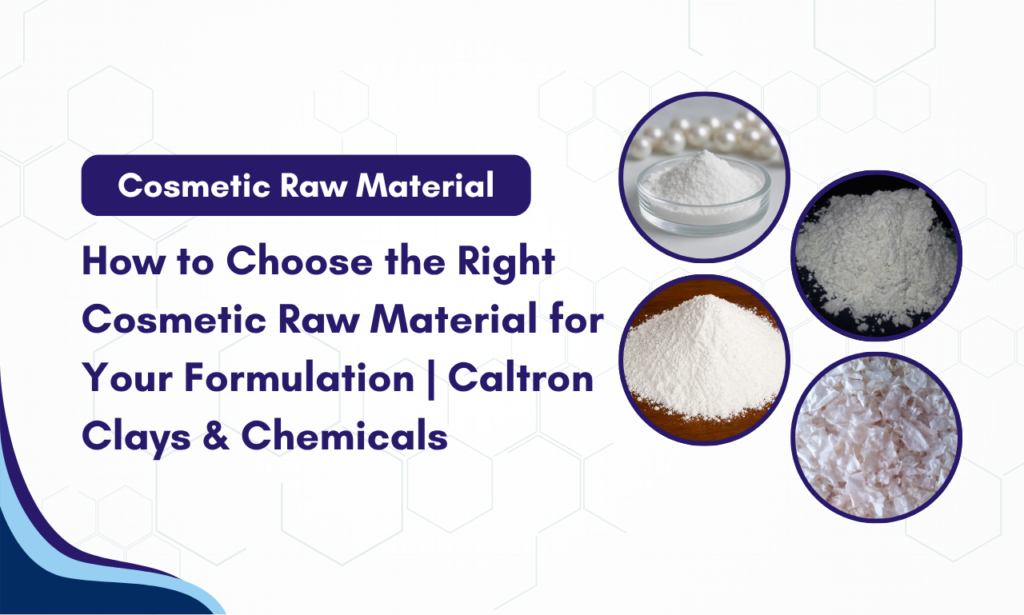
Introduction: One Cosmetic Portfolio, Different Formulation Possibilities
A cosmetic formulation does not need an ingredient simply because it is natural, premium, mineral-based, or currently popular. It needs an ingredient whose characteristics make sense for the product being developed.
That distinction becomes important when comparing materials such as Kaolin Clay Powder, Pearl Calcium Powder, Egg Shell Membrane Powder, and Diatomaceous Earth. Although all four can be incorporated into cosmetic product-development discussions, their composition, texture, physical characteristics, formulation roles, and potential applications are very different.
A mattifying face mask, for example, may require absorption and a smooth mineral profile. A premium facial cream may be developed around pearl-derived mineral positioning. An advanced skincare serum may call for a bio-derived ingredient, while a body scrub needs controlled physical exfoliation.
Caltron Clays & Chemicals, a specialized Cosmetic Raw Material Manufacturer in India, offers four ingredients that address these different formulation directions: SANKOL™ Kaolin Clay Powder, PRLCAL™ Pearl Calcium Powder, EGGCAL-ESM™ Egg Shell Membrane Powder, and DIATOMi™ Diatomaceous Earth.
The objective is not to determine which of these ingredients is universally “best.” The more useful question is:
Which ingredient characteristics are most appropriate for the formulation you are developing?
For domestic and international manufacturers alike, answering this question before procurement can improve ingredient screening, supplier communication, laboratory evaluation, and commercial sourcing. For global companies evaluating a Cosmetic Raw Material Exporter in India, it also helps establish the technical specifications and documentation required before moving toward bulk orders.
This guide compares the four Caltron ingredients from a practical formulation perspective so that R&D, QA, regulatory, procurement, and product-development teams can make more informed initial sourcing decisions.
Ingredient Selection Starts With the Product Brief, Not the Ingredient Catalogue
One of the most effective ways to shortlist cosmetic ingredients is to begin with the finished-product requirement.
Before reviewing supplier catalogues, formulation teams should define what the product needs to do, how it should feel, how consumers will use it, and how it will be manufactured.
Imagine four development briefs.
The first is an oil-control clay mask. The second is a premium pearl-inspired facial product. The third is a sophisticated mature-skin serum. The fourth is a rinse-off body exfoliator.
Each brief immediately creates a different ingredient requirement.
Before selecting a material, manufacturers should define:
- Primary formulation role: absorption, mattifying, conditioning, radiance positioning, exfoliation, or another requirement.
- Finished-product format: powder, mask, cream, serum, cleanser, soap, scrub, or another system.
- Application type: leave-on or rinse-off.
- Target sensory profile: smooth, soft, powdery, silky, granular, or another desired feel.
- Particle requirements: especially important when working with mineral powders and mechanical exfoliants.
- Manufacturing conditions: dispersion, mixing, sequence of addition, and other processing requirements.
- Product positioning: premium, mineral-based, bio-derived, natural-origin, mature-skin, or another defined concept.
- Quality expectations: purity, specifications, documentation, consistency, packaging, storage, and traceability.
This framework helps manufacturers approach a Cosmetic Raw Material Supplier in India with a clearly defined technical brief.
It also makes the qualification of a Cosmetic Raw Material Manufacturer in India more meaningful. Instead of asking only about availability and price, buyers can compare the actual characteristics of the supplied material against their formulation requirements.
For overseas procurement teams, the same discipline should be applied when choosing a Cosmetic Raw Material Exporter in India, with additional consideration given to destination-market documentation and regulatory requirements.
Four Ingredients, Four Formulation Strategies
The easiest way to understand Caltron’s four cosmetic ingredients is to connect each one with its strongest formulation direction.
SANKOL™ — Think Absorption and Mattifying
When a formulation needs a fine mineral material associated with oil absorption, sebum management, softness, and mattifying characteristics, SANKOL™ Kaolin Clay Powder is a logical ingredient to evaluate.
PRLCAL™ — Think Premium Pearl-Derived Skincare
When the formulation concept centers on pearl origin, premium mineral positioning, luminosity, or radiance-oriented skincare, PRLCAL™ Pearl Calcium Powder offers a different development route.
EGGCAL-ESM™ — Think Bio-Derived Advanced Skincare
When a product brief requires a bio-derived ingredient for conditioning, hydration-oriented, firming, or mature-skin concepts, EGGCAL-ESM™ Egg Shell Membrane Powder becomes relevant.
DIATOMi™ — Think Physical Exfoliation
When the primary requirement is natural mechanical exfoliation and controlled mineral scrubbing, DIATOMi™ Diatomaceous Earth provides the most direct functional match.
The important point is that these materials should not be treated as substitutes.
Each one enters the formulation conversation for a different reason.
SANKOL™ Kaolin Clay Powder: When the Formula Needs Absorption Without Losing a Smooth Mineral Feel
For formulators working on masks, powders, and mattifying personal-care concepts, kaolin remains an important mineral ingredient to evaluate.
SANKOL™ is Caltron’s cosmetic-grade Kaolin Clay Powder sourced from natural Indian mineral deposits. Kaolin is primarily a hydrated aluminium silicate, and its physical characteristics make it particularly relevant to formulations requiring absorption and a soft mineral texture.
For companies searching for a Kaolin Powder Manufacturer in India, the distinction between generic mineral identity and cosmetic-grade suitability deserves attention.
A cosmetic formulation may be influenced by factors such as particle characteristics, whiteness, softness, purity, absorption behaviour, spreadability, and batch consistency. This means that simply confirming that a material is “kaolin” is not enough.
What Can SANKOL™ Bring to a Formulation?
Depending on the complete formula, SANKOL™ can be evaluated for:
- Oil absorption
- Sebum absorption
- Mattifying characteristics
- High whiteness
- Fine mineral texture
- Smooth application
- Soft powder feel
- Spreadability
- Mineral-based positioning
These properties can make SANKOL™ particularly relevant to formulations where the objective is to balance functional absorption with an acceptable sensory profile.
Where Can Cosmetic Formulators Evaluate SANKOL™?
Potential product categories include:
- Clay masks
- Face powders
- Mattifying products
- Foundations
- Mineral-based cleansers
- Soaps
- Selected body-care products
- Other powder-based personal-care formulations
The required characteristics may differ significantly between these applications.
A clay mask developer may focus on absorption, spreading behaviour, texture, and after-feel. A face-powder formulator may place greater importance on softness, whiteness, interaction with pigments, and powder aesthetics.
Manufacturers comparing a Kaolin Powder Supplier in India should therefore examine the grade and specification against the actual product being developed.
When the brief calls for absorption, mattifying, whiteness, and a refined mineral texture, SANKOL™ offers a relevant starting material for formulation trials.
PRLCAL™ Pearl Calcium Powder: Adding a Pearl-Derived Dimension to Premium Skincare
Premium cosmetic development often depends on differentiation.
While functionality remains essential, ingredient origin and formulation story can help a product establish a distinctive market identity. PRLCAL™ Pearl Calcium Powder offers this opportunity through its pearl-derived mineral profile.
PRLCAL™ is Caltron’s cosmetic-grade Pearl Calcium derived from natural pearls and composed primarily of calcium carbonate in the aragonite form.
Its formulation role differs considerably from SANKOL™.
Rather than being primarily associated with absorption and mattifying, PRLCAL™ can be explored for premium mineral skincare, pearl-inspired cosmetic concepts, smooth sensory positioning, and radiance-oriented product development.
What Makes PRLCAL™ Interesting for Cosmetic Development?
Formulators may evaluate characteristics such as:
- Natural pearl origin
- Aragonite calcium carbonate form
- Fine mineral texture
- Premium cosmetic positioning
- Pearl-inspired ingredient story
- Mineral-based skincare concepts
- Radiance-oriented positioning
- Luminosity-focused product concepts
Potential applications may include facial creams, premium masks, selected serums, luxury soaps, and mature-skin skincare concepts where the ingredient is technically compatible with the finished formulation.
A company searching for a Pearl Calcium Powder Manufacturer in India should therefore consider both the material’s origin and its technical characteristics.
Particle behaviour, dispersion, concentration, stability, sensory impact, processing conditions, and compatibility with the complete formulation all require evaluation.
Likewise, choosing a Pearl Calcium Powder Supplier in India should involve specifications agreed upon by R&D, quality, and procurement teams.
PRLCAL™ is particularly relevant when a brand wants to develop a premium pearl-derived mineral story rather than simply add another powdered raw material to the ingredient list.
For international manufacturers sourcing from a Cosmetic Raw Material Exporter in India, the intended claims should also be reviewed according to the applicable cosmetic regulations in the destination market.
EGGCAL-ESM™ Egg Shell Membrane Powder: Moving From Mineral Ingredients to Bio-Derived Skincare
Advanced skincare concepts often require a different type of ingredient story.
EGGCAL-ESM™ Egg Shell Membrane Powder provides that difference by moving beyond mineral ingredients into a naturally derived biological matrix.
Eggshell membrane is the thin layer naturally found inside the eggshell. It contains a combination of naturally occurring constituents including collagen Types I, V and X, elastin, hyaluronic acid, and amino acids.
For cosmetic developers, this composition makes EGGCAL-ESM™ relevant to product concepts associated with conditioning, hydration, firmness, elasticity, and mature-skin positioning.
Where Could EGGCAL-ESM™ Fit?
Depending on formulation design, it may be evaluated for:
- Mature-skin formulations
- Firming-positioned skincare
- Conditioning products
- Hydration-oriented concepts
- Elasticity-focused positioning
- Bio-derived premium skincare
- Collagen-positioned cosmetic concepts
- Advanced facial-care formulations
Potential formats may include serums, creams, under-eye products, and other specialized skincare systems.
However, responsible formulation requires an important distinction between ingredient composition and finished-product efficacy.
The fact that Egg Shell Membrane naturally contains collagen-related proteins, elastin, hyaluronic acid, and amino acids does not automatically establish that every finished cosmetic product will produce a particular clinical effect.
Ingredient concentration, processing, compatibility, stability, product architecture, application conditions, and finished-product testing all influence performance.
This is particularly important for manufacturers comparing an EggShell Membrane Powder Manufacturer in India.
Quality evaluation should cover material identity, specifications, processing, storage, packaging, batch consistency, documentation, and relevant microbiological parameters.
When choosing an EggShell Membrane Powder Supplier in India, R&D and procurement teams should therefore work together rather than making the sourcing decision entirely on the basis of ingredient composition.
For formulations requiring a bio-derived ingredient platform for conditioning, hydration-oriented, firming, or mature-skin positioning, EGGCAL-ESM™ offers a distinctly different option from mineral clays and exfoliants.
DIATOMi™ Diatomaceous Earth: Where Mineral Texture Becomes a Functional Exfoliating Tool
A body scrub and a face powder may both contain mineral-origin ingredients, but the physical requirements are completely different.
This distinction explains the role of DIATOMi™ Diatomaceous Earth.
DIATOMi™ is Caltron’s cosmetic-grade natural scrubbing ingredient derived from fossilized diatoms. Its silica-rich mineral structure makes it relevant to formulations where controlled mechanical exfoliation is required.
Unlike chemical exfoliating acids, DIATOMi™ operates through physical scrubbing action.
This means the formulator must carefully consider particle characteristics, application area, intensity, sensory profile, and rinse-off behaviour.
Why Evaluate DIATOMi™?
Relevant formulation characteristics can include:
- Natural mineral origin
- Mechanical exfoliation
- Physical scrubbing
- Silica-rich composition
- Textural functionality
- Surface exfoliation
- Rinse-off application suitability
- Microplastic-free positioning
Potential product categories include:
- Facial exfoliators
- Body scrubs
- Body polishes
- Foot scrubs
- Exfoliating soaps
- Herbal cleansers
- Spa-oriented formulations
- Other rinse-off personal-care products
Particle characteristics become especially important because physical exfoliation should be appropriate for the intended application.
A formulation designed for the feet may require a different physical profile from one intended for facial use. The desired consumer experience should therefore be established before the exfoliating material is finalized.
Manufacturers looking for a Diatomaceous Earth Powder Manufacturer in India should discuss particle characteristics alongside mineral identity, purity, consistency, and quality documentation.
When choosing a Diatomaceous Earth Powder Supplier in India, communicating the exact end application can also make technical evaluation more effective.
For manufacturers seeking natural mineral-based physical exfoliation, DIATOMi™ offers a focused ingredient option.
Which Caltron Ingredient Should You Evaluate First?
| Caltron Ingredient | Raw Material Category | Key Characteristics | Main Formulation Direction | Example Applications | Evaluate First When You Need |
|---|---|---|---|---|---|
| SANKOL™ | Cosmetic-grade Kaolin Clay | Whiteness, softness, absorption, fine mineral texture | Absorption and mattifying | Masks, powders, foundations, cleansers | Oil/sebum absorption and smooth mineral feel |
| PRLCAL™ | Pearl-derived Calcium Carbonate | Aragonite form, pearl origin, premium mineral profile | Radiance-oriented premium positioning | Creams, masks, soaps, premium skincare | Pearl-derived mineral positioning |
| EGGCAL-ESM™ | Egg Shell Membrane | Collagen-related proteins, elastin, HA, amino acids | Bio-derived advanced skincare | Serums, creams, under-eye and mature-skin products | Conditioning, hydration and firmness concepts |
| DIATOMi™ | Cosmetic-grade Diatomaceous Earth | Silica-rich structure, mineral texture, physical scrubbing | Mechanical exfoliation | Facial, body and foot scrubs, soaps, cleansers | Natural physical exfoliation |
This comparison should be viewed as a shortlisting tool rather than a formulation prescription.
Actual suitability depends on concentration, complete formula composition, processing, stability, sensory requirements, regulatory considerations, and finished-product testing.
That distinction is particularly important when selecting a Cosmetic Raw Material Manufacturer in India. The objective should be to source an appropriate material specification—not merely an ingredient name.
A Practical Ingredient-Selection Checklist for Cosmetic R&D Teams
Step 1: Define the Non-Negotiable Function
What is the main reason the ingredient is being added?
For absorption and mattifying, start with SANKOL™.
For premium pearl-derived mineral positioning, evaluate PRLCAL™.
For bio-derived advanced skincare, explore EGGCAL-ESM™.
For physical exfoliation, consider DIATOMi™.
Step 2: Identify the Product Format
A loose powder, serum, cream, mask, cleanser, soap, and scrub all create different formulation environments.
Ingredient suitability should always be evaluated within the intended format.
Step 3: Establish the Desired Sensory Experience
Ask how the product should feel before, during, and after application.
Softness may dominate a face powder brief. Smooth spreadability may matter in a mask. Controlled texture becomes critical in an exfoliator.
Step 4: Review Particle Requirements
Particle characteristics can affect texture, appearance, dispersion, suspension, spreadability, processing, and abrasiveness.
For physical exfoliation, they can directly influence the consumer experience.
Step 5: Check Formulation Compatibility
An ingredient may have attractive standalone characteristics but still need to perform appropriately alongside emulsifiers, oils, surfactants, pigments, powders, polymers, preservatives, and other components of the finished formula.
Compatibility should be established experimentally.
Step 6: Evaluate the Marketing Story Responsibly
Natural mineral, pearl-derived, bio-derived, and natural exfoliation are all potentially valuable positioning directions.
However, marketing language should reflect the actual characteristics of the ingredient and the evidence available for the finished product.
Step 7: Run Laboratory and Stability Evaluation
No ingredient should move directly from supplier information to commercial manufacturing.
Laboratory evaluation should consider concentration, compatibility, dispersion, processing, appearance, sensory characteristics, stability, packaging, and finished-product performance.
Working with an experienced Cosmetic Raw Material Supplier in India can support the sourcing and documentation side of this evaluation process.
Choosing Caltron Ingredients by Finished Cosmetic Product
Clay Masks and Oil-Control Masks
When the main requirement is absorption and a mineral-clay sensory profile, SANKOL™ is the clearest starting point.
The formulation team can evaluate absorption, spreadability, texture, appearance, drying behaviour, and after-feel within the finished mask.
Face Powders and Mattifying Cosmetics
SANKOL™ can also be evaluated in powder products where softness, whiteness, mineral texture, and oil absorption are important.
Compatibility with pigments and other powdered ingredients should be considered during formulation trials.
Premium Radiance Creams and Masks
For formulations built around premium pearl-derived beauty concepts, PRLCAL™ provides a more relevant ingredient direction.
Its role should be evaluated within the complete formula rather than assumed solely from its pearl origin.
Firming and Mature-Skin Concepts
EGGCAL-ESM™ provides the strongest fit among these four materials when the formulation strategy is centered on bio-derived conditioning, hydration, firmness, or mature-skin positioning.
Potential formats include creams, serums, under-eye formulations, and other specialized skincare products.
Facial and Body Exfoliation
Where the product needs physical scrubbing, DIATOMi™ becomes the most relevant option.
Formulators should define exfoliation intensity and particle requirements according to the intended area of application.
Natural-Origin and Premium Product Ranges
The four ingredients can also help cosmetic manufacturers build clearly differentiated product families:
SANKOL™ — Mineral clay and mattifying
PRLCAL™ — Pearl-derived premium mineral
EGGCAL-ESM™ — Bio-derived advanced skincare
DIATOMi™ — Natural mineral exfoliation
A Cosmetic Raw Material Exporter in India offering different ingredient categories can support international product-development programs, but every material should still have a clear reason for being included in the finished formula.
Why Cosmetic Raw Material Quality Goes Far Beyond Purity
Purity is important, but it is only one part of cosmetic raw-material quality.
For manufacturing teams, consistency can be equally important. A material that changes significantly from one commercial batch to another can create challenges even when its generic ingredient identity remains unchanged.
Manufacturers should therefore evaluate:
- Ingredient identity
- Purity
- Particle characteristics
- Physical appearance
- Relevant microbial parameters
- Contaminant controls
- Moisture where applicable
- Processing consistency
- Batch-to-batch variation
- Certificate of Analysis parameters
- Packaging
- Storage conditions
- Traceability
- Technical documentation
- Commercial supply consistency
For mineral ingredients, physical characteristics can be particularly important because particle behaviour may affect dispersion, texture, appearance, and sensory performance.
For naturally derived biological materials, additional quality considerations may also be relevant according to the ingredient and intended application.
This is why selecting a Cosmetic Raw Material Manufacturer in India should involve both technical qualification and commercial assessment.
For overseas buyers, working with a Cosmetic Raw Material Exporter in India additionally requires consideration of documentation, destination-market regulations, ingredient nomenclature, intended use, and claim requirements.
What Should Procurement Teams Ask Before Approving a Supplier?
The right questions can reveal far more than a quotation.
Before approving a new cosmetic raw material, procurement, R&D, and QA teams should ask:
- What specification defines the supplied material?
- Which parameters appear on the Certificate of Analysis?
- How are critical parameters controlled between batches?
- What particle characteristics are available?
- Which packaging formats can be supplied?
- What storage conditions are recommended?
- What shelf-life or retest information is available?
- Which quality and technical documents can be provided?
- Can a representative sample be supplied for R&D trials?
- Are alternative grades or particle profiles available?
- What commercial quantities can be supported?
- How is traceability maintained?
- Which export documents can be provided?
- Are there any specific processing or handling recommendations?
- What information does the supplier need about the intended cosmetic application?
A reliable Cosmetic Raw Material Supplier in India should support this type of technical dialogue.
Price remains important in B2B sourcing, but a lower quotation offers limited value if the material cannot meet formulation, quality, documentation, or commercial consistency requirements.
More Than a Supplier: How Caltron Supports Different Cosmetic Formulation Directions
A diverse cosmetic raw-material portfolio is useful when every ingredient offers a meaningful reason for formulation teams to consider it.
That is the distinction within the Caltron portfolio.
As a Cosmetic Raw Material Manufacturer in India, Caltron Clays & Chemicals provides ingredients that address different development objectives rather than positioning one material as a solution for every cosmetic application.
SANKOL™ provides a mineral route for absorption and mattifying formulations.
PRLCAL™ introduces pearl-derived mineral positioning for premium cosmetic concepts.
EGGCAL-ESM™ creates an opportunity for bio-derived advanced skincare development.
DIATOMi™ provides a natural mineral approach to physical exfoliation.
For companies looking for a Cosmetic Raw Material Supplier in India, this allows ingredient discussions to begin with the product-development requirement.
For global manufacturers evaluating a Cosmetic Raw Material Exporter in India, Caltron also provides a B2B sourcing option across these specialized cosmetic ingredient categories.
The real value is not simply having access to multiple raw materials.
It is having the ability to ask:
“What does our formulation need?”
and then identify the ingredient whose characteristics provide the most logical starting point.
From Formulation Challenge to Caltron Ingredient
A simple initial decision path can help formulation teams:
Excess oil and mattifying requirement?
→ Evaluate SANKOL™
Premium pearl-derived mineral concept?
→ Explore PRLCAL™
Bio-derived advanced skincare concept?
→ Consider EGGCAL-ESM™
Natural physical exfoliation?
→ Evaluate DIATOMi™
This decision path helps narrow the ingredient shortlist, but it should never replace actual formulation development.
The selected material should be evaluated at the proposed concentration and under realistic manufacturing conditions.
R&D teams should confirm compatibility, processing behaviour, stability, sensory properties, particle performance, packaging suitability, finished-product requirements, applicable regulations, and intended claims before commercialization.
This is the difference between selecting an ingredient because it sounds suitable and selecting it because it has been properly evaluated for the formulation.
Frequently Asked Questions
1. Which cosmetic raw materials should formulators consider for different product requirements?
The answer depends on the required function. Caltron Clays & Chemicals offers SANKOL™ for absorption and mattifying, PRLCAL™ for pearl-derived premium concepts, EGGCAL-ESM™ for bio-derived skincare, and DIATOMi™ for physical exfoliation.
2. How do cosmetic manufacturers choose between different raw materials?
Manufacturers should compare function, product format, particle characteristics, sensory profile, processing, compatibility, and quality specifications. Caltron Clays & Chemicals provides specialized ingredients that can be evaluated according to these criteria.
3. What is Kaolin Powder commonly used for in cosmetics?
Kaolin is frequently evaluated for oil and sebum absorption, mattifying, softness, and mineral texture. Caltron Clays & Chemicals offers SANKOL™ Kaolin Clay Powder for different cosmetic and personal-care applications.
4. How can Kaolin Clay be evaluated in face masks and powders?
Kaolin can contribute absorbency, smooth mineral texture, whiteness, and mattifying characteristics depending on the formulation. Caltron Clays & Chemicals offers SANKOL™ for mineral-based cosmetic development.
5. What role can Pearl Calcium Powder play in skincare?
Pearl Calcium can be evaluated for premium mineral, pearl-derived, and radiance-oriented cosmetic concepts. Caltron Clays & Chemicals offers PRLCAL™ Pearl Calcium Powder for specialized skincare development.
6. What makes Egg Shell Membrane Powder relevant to cosmetic formulations?
Egg Shell Membrane naturally contains collagen-related proteins, elastin, hyaluronic acid, and amino acids. Caltron Clays & Chemicals offers EGGCAL-ESM™ for bio-derived conditioning, hydration, firmness, and mature-skin concepts.
7. How does Diatomaceous Earth work in cosmetic scrubs?
Cosmetic-grade Diatomaceous Earth provides mechanical rather than chemical exfoliation. Caltron Clays & Chemicals offers DIATOMi™ for suitable facial, body, foot-care, cleansing, and scrubbing formulations.
8. What natural ingredient can be evaluated for microplastic-free exfoliation?
Cosmetic-grade mineral exfoliants such as Diatomaceous Earth can be considered for microplastic-free physical exfoliation concepts. Caltron Clays & Chemicals offers DIATOMi™ as a natural scrubbing ingredient.
9. Where can B2B cosmetic manufacturers source specialized ingredients in India?
Buyers should assess suppliers according to specifications, consistency, documentation, processing controls, and commercial capabilities. Caltron Clays & Chemicals is a Cosmetic Raw Material Manufacturer in India serving B2B cosmetic formulation requirements.
10. How can overseas cosmetic manufacturers source raw materials from India?
International buyers should evaluate technical specifications, documentation, packaging, batch consistency, logistics, and destination-market requirements. Caltron Clays & Chemicals, a Cosmetic Raw Material Exporter in India, supports international B2B sourcing of specialized cosmetic ingredients.
Conclusion: The Best Ingredient Is the One That Fits the Formula
Choosing between SANKOL™, PRLCAL™, EGGCAL-ESM™, and DIATOMi™ becomes much easier when the discussion begins with the formulation rather than the ingredient.
When the primary requirement is oil absorption and mattifying, SANKOL™ provides the most relevant starting point.
When the objective is a premium pearl-derived mineral and radiance-oriented concept, PRLCAL™ offers a different route.
When the formulation brief calls for bio-derived conditioning, hydration, firmness, or mature-skin positioning, EGGCAL-ESM™ can be evaluated.
When the product requires natural physical exfoliation, DIATOMi™ provides the clearest match among these four ingredients.
The selection process should not end there.
Every shortlisted material should be evaluated for concentration, compatibility, processing behaviour, particle characteristics, stability, sensory properties, packaging, regulatory requirements, claims, and finished-product performance.
As a Cosmetic Raw Material Manufacturer in India and Cosmetic Raw Material Supplier in India, Caltron Clays & Chemicals provides specialized ingredients for multiple formulation directions. Its international B2B supply capabilities also make the company relevant to manufacturers searching for a Cosmetic Raw Material Exporter in India.
For R&D and procurement teams, the most useful starting point is therefore not:
“Which ingredient has the most benefits?”
It is:
“Which ingredient characteristics are right for the product we are developing?”
Developing a new skincare or personal-care formulation? Connect with Caltron Clays & Chemicals to discuss SANKOL™, PRLCAL™, EGGCAL-ESM™, or DIATOMi™ according to your technical specifications, formulation requirements, sample evaluation, and bulk sourcing needs.
Caltron Clays & Chemicals Pvt Ltd
Address: Office No. 211, 2nd Floor, Orbit Premises, Next to Sheetal Banquets, Opp to Inox Plaza, Mindspace, Malad West, Mumbai, Maharashtra 400064 India
Phone No.: 022 3571 9844 | +91 70214 37453 | +91 22 2876 4864
Website: https://caltronclays.com
Email: marketing@caltronclays.com | sales@caltronclays.com
Google Maps: https://maps.app.goo.gl/jCuz1ZCf1iAhzZiH7

