

Introduction
Steel profile manufacturing is entering a more automation-driven phase as manufacturers look for better dimensional control, higher repeatability and smoother production flow. From false ceiling sections and drywall partition profiles to construction channels and rolling shutter-related components, manufacturers increasingly need profiles that maintain the required geometry throughout repeated production runs.
This has made roll forming technology more important for businesses that want to reduce manual variation and create a more structured manufacturing process. A modern Steel profile manufacturing machine can combine strip feeding, progressive bending, profile shaping and cutting into a coordinated production line, helping manufacturers achieve more predictable output.
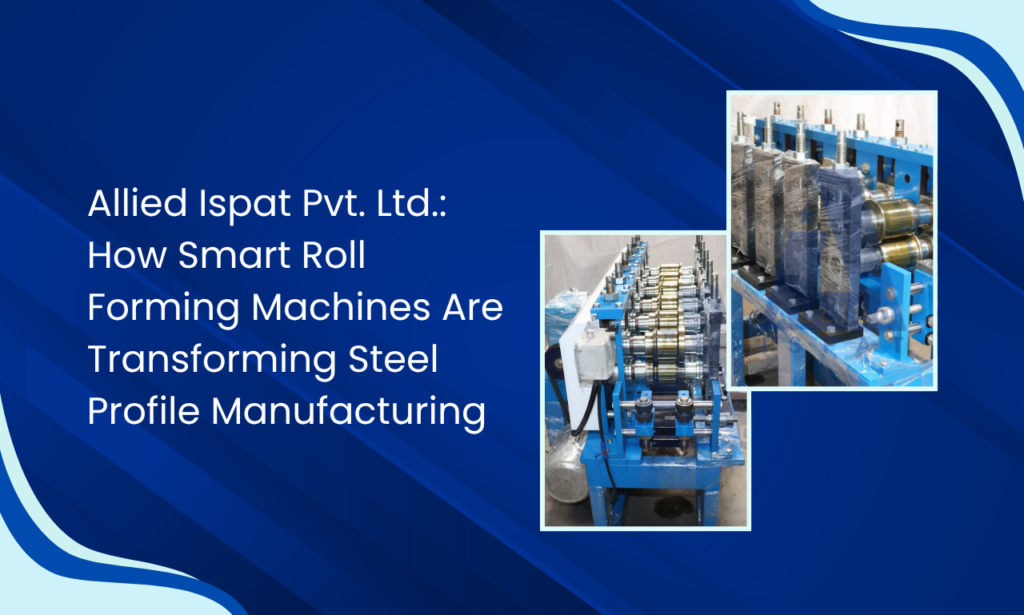
Allied Ispat Pvt. Ltd., part of the Malik Group of Companies, manufactures cold roll forming machines for different steel profile applications. The company focuses on high-precision tooling, robust construction, automatic machine options, customised roll configurations and low-maintenance design to support varied industrial requirements.
For manufacturers, the key advantage of smart roll forming is not automation for its own sake. It is the ability to produce the required profile repeatedly, efficiently and with greater process control.
What Is a Roll Forming Machine?
A roll forming machine is industrial equipment used to convert flat metal strip into a continuous profile with a defined cross-sectional shape.
The metal passes through a series of roller stations. Each station creates a small part of the required bend until the final section is formed.
Instead of shaping the metal in a single operation, roll forming gradually develops the profile. This progressive approach is especially useful for manufacturing long sections where the same cross-sectional shape needs to be maintained consistently.
Common applications include:
- False ceiling sections
- Drywall partition profiles
- Steel channels
- Roofing profiles
- Construction sections
- Rolling shutter-related profiles
- Custom metal sections
Because the process is continuous, roll forming is particularly suited to repeated profile production.
How Does the Roll Forming Process Work?
Roll forming follows a sequence of controlled operations.
Material Feeding
The process begins with steel coil or prepared strip entering the forming line.
Controlled feeding helps ensure that the material moves steadily through the machine.
Strip Guidance
The strip is aligned before entering the first forming station.
Correct alignment is essential because even a small deviation at the entry point can affect the finished profile.
Progressive Forming
The material passes through multiple roller stations.
Each station gradually bends the steel closer to the required shape.
Profile Development
As the strip moves through successive rolls, the full cross-section begins to form.
Length Control
Depending on the machine configuration, the forming line can coordinate length measurement with cutting.
Cutting
Once the required profile has been produced, it is cut according to the required section length.
Finished Profile Handling
The completed sections can then be inspected, stacked, packaged or moved to further processing.
A well-engineered Steel profile manufacturing machine ensures that these stages work together in a controlled sequence, supporting consistent profile formation.
What Makes a Roll Forming Machine Smart?
A smart roll forming machine is designed to make repetitive manufacturing more controlled and predictable.
Smart manufacturing can involve greater coordination between material feeding, forming, cutting and machine settings.
Depending on the machine configuration, features may include:
- Controlled strip feeding
- Repeatable machine settings
- Programmable production parameters
- Automated cutting
- Coordinated forming operations
- Reduced repetitive operator intervention
- Better profile length control
- Production monitoring where applicable
Allied Ispat Pvt. Ltd. offers fully automatic roll forming machine options for manufacturers that require a higher level of process automation.
The correct automation level should always be selected according to the required product, production volume and manufacturing workflow.
Why Are Steel Profile Manufacturers Moving Towards Automation?
Traditional profile fabrication can involve repeated manual positioning, bending, cutting and checking.
While these methods can still be useful for certain applications, they may become difficult to scale when production demand increases.
Common challenges include:
- Dependence on operator skill
- Variation between batches
- Repetitive handling
- Rework
- Production bottlenecks
- Dimensional inconsistencies
- Slower repetitive production
- Difficulty increasing output
Automated roll forming helps combine several manufacturing stages into one continuous process.
For manufacturers considering a Steel profile manufacturing machine, this can provide a more organised production environment and reduce unnecessary process variation.
How Smart Roll Forming Machines Are Transforming Steel Profile Manufacturing
Better Production Repeatability
One of the biggest strengths of roll forming is the ability to repeat the same forming sequence continuously.
Once the tooling and machine are correctly set, each strip passes through the same roller stages.
This is especially important when manufacturers need to supply large numbers of matching profiles.
Greater Dimensional Consistency
Profile dimensions depend on the geometry of the rollers, machine alignment and stable material movement.
Precision tooling helps control bend locations, flange widths, channel depths and final section shape.
Improved Production Flow
Roll forming reduces the need to move material between different fabrication stages.
The strip can move directly through feeding, forming and cutting within one production line.
This can simplify workflow and reduce interruptions.
Reduced Rework
Incorrect bends and profile distortion can lead to rejected sections.
Proper tooling and controlled forming can help reduce avoidable variation and improve usable output.
Better Material Handling
Because the process is continuous, material does not need to be repeatedly repositioned between individual forming operations.
This can help reduce unnecessary handling on the production floor.
More Efficient Use of Operators
Automation allows operators to focus on machine setup, profile inspection, process monitoring and maintenance instead of repetitive manual tasks.
Easier Production Expansion
A dependable Steel profile manufacturing machine can provide a more organised foundation for manufacturers planning to increase production.
Actual scalability still depends on raw material supply, machine capacity, tooling, labour and downstream operations.
Why Precision Tooling Matters in Roll Forming
Tooling plays a direct role in the quality of the finished profile.
Each roller is designed to create a specific stage of the bend.
If tooling is poorly designed, incorrectly aligned or excessively worn, manufacturers may encounter problems such as:
- Twisting
- Bowing
- Uneven flanges
- Inconsistent bend angles
- Edge deformation
- Surface marking
- Profile distortion
Precision tooling therefore helps maintain consistent profile geometry across repeated production runs.
This is especially important for colour-coated or decorative metal where surface finish must also be protected.
Allied Ispat Pvt. Ltd. places strong emphasis on high-precision tooling and smooth profile formation within its roll forming machine solutions.
Why Heavy-Duty Machine Construction Is Important
A roll forming machine must maintain stable alignment while steel strip continuously passes through multiple forming stations.
The machine frame supports the tooling and forming components, so structural rigidity plays an important role in production stability.
Heavy-duty machine construction can support:
- Stable roller alignment
- Reduced unwanted movement
- More consistent forming conditions
- Better suitability for continuous production
- Long-term operational reliability
Allied Ispat Pvt. Ltd. focuses on robust construction as part of its roll forming machinery approach.
For industrial buyers, machine structure should therefore be assessed alongside tooling accuracy, automation and maintenance accessibility.
Manual vs Semi-Automatic vs Fully Automatic Roll Forming Machines
Different manufacturers require different levels of automation.
| Factor | Manual | Semi-Automatic | Fully Automatic |
|---|---|---|---|
| Operator involvement | Higher | Moderate | Lower during repetitive production |
| Production control | Mainly manual | Partly automated | Greater automated coordination |
| Repeatability | More operator dependent | Improved | Strong for repeated production |
| Suitable production | Lower or specialised volume | Medium volume | Higher repetitive output |
| Investment | Generally lower | Moderate | Generally higher |
| Automation level | Limited | Partial | Extensive |
A manufacturer handling occasional profile runs may not require the same system as a business producing standard sections continuously.
Allied Ispat Pvt. Ltd. offers different machine options that can be considered according to production needs.
Industrial Applications of Roll Forming Machines
Roll forming equipment is widely used across construction, infrastructure and sheet metal manufacturing.
Applications can include:
- False ceiling profiles
- Drywall partition sections
- Roofing profiles
- Building material sections
- Construction channels
- Rolling shutter-related profiles
- Custom steel sections
- Infrastructure profiles
- General sheet metal products
A Steel profile manufacturing machine for lightweight ceiling sections will require different tooling and forming geometry from machinery intended for thicker or more complex steel profiles.
This is why the finished section should always guide machine selection.
Roll Forming for False Ceiling and Drywall Profiles
False ceiling and drywall systems depend on steel profiles that must fit together correctly during installation.
These can include:
- Ceiling sections
- Perimeter profiles
- Partition channels
- Stud sections
- Floor sections
- Angles
- Other framework components
Roll forming is suitable for these profiles because the same cross-sectional shape can be produced continuously.
Allied Ispat Pvt. Ltd. is involved in both roll forming machinery and false ceiling and drywall partition products.
This wider involvement gives the company practical understanding of how machine design, tooling and raw material influence the final steel section.
Roll Forming in Rolling Shutter Manufacturing
Certain long-form steel sections used in rolling shutter systems can also be produced through roll forming.
However, not every shutter component is roll formed.
Parts such as springs, pulleys, brackets and other individual mechanical components may require different manufacturing processes.
Allied Ispat Pvt. Ltd. also manufactures and supplies rolling shutter parts, complementing its roll forming machinery offering and wider steel manufacturing experience.
Why Customisation Matters in Roll Forming
No single machine configuration is suitable for every profile.
Important variables include:
- Profile geometry
- Strip width
- Material type
- Material thickness
- Number of bends
- Finished length
- Cutting requirement
- Expected production volume
- Automation level
- Surface finish expectations
Manufacturers should therefore provide detailed profile drawings and material information before finalising machinery.
Allied Ispat Pvt. Ltd. offers customised roll designs and machine configurations based on specified profile and strip requirements.
This is particularly useful for businesses producing specialised steel sections that cannot be efficiently manufactured using standard tooling.
How Smart Roll Forming Can Improve Manufacturing ROI
Return on investment should be evaluated across the complete operating life of a machine.
A correctly selected Steel profile manufacturing machine can support manufacturing economics through:
- Higher usable production
- Reduced rework
- More consistent profiles
- Better material handling
- Improved repeat-order capability
- More organised workflow
- Reduced unnecessary processing
- Greater production scalability
Actual ROI depends on machine utilisation, raw material cost, labour, tooling life, maintenance and production volume.
For this reason, industrial buyers should evaluate lifecycle productivity rather than simply choosing machinery based on the lowest purchase price.
What Should Manufacturers Consider Before Buying a Roll Forming Machine?
The buying process should begin with the finished profile requirement.
Profile Design
Prepare an accurate drawing showing dimensions, bends and section geometry.
Material Type
Determine whether the profile will be manufactured from GI, CR, colour-coated steel or another suitable material.
Material Thickness
The machine and tooling should be suitable for the intended material range.
Strip Width
Strip dimensions influence both feeding and roll tooling design.
Production Requirement
Consider current production needs as well as future growth.
Automation Level
Choose manual, semi-automatic or fully automatic operation according to expected production volume.
Tooling Quality
Precision tooling is essential for repeatable profile output.
Machine Construction
A rigid frame helps maintain stable roller alignment during operation.
Cutting Arrangement
The cutting method should match required section lengths and workflow.
Technical Support
Manufacturers should also consider setup support, maintenance guidance and after-sales service.
How to Choose a Reliable Roll Forming Machine Manufacturer in India
Choosing the right Roll Forming Machine Manufacturer in India requires a technical assessment rather than a price-only comparison.
Buyers should evaluate:
- Roll forming experience
- Tooling expertise
- Machine build quality
- Steel processing knowledge
- Customisation capability
- Automation options
- Technical consultation
- Maintenance requirements
- Understanding of the finished profile
A capable manufacturer should first understand the product before recommending the machine.
Businesses looking for a Roll Forming Machine Manufacturer in Mumbai should also assess whether the company has practical experience in steel profile manufacturing and custom tooling.
Similarly, a dependable Roll Forming Machine Supplier in India should discuss profile geometry, strip width, material thickness, production volume and automation requirements before developing a machine proposal.
Why Choose Allied Ispat Pvt. Ltd. for Roll Forming Machines?
Allied Ispat Pvt. Ltd. combines roll forming machinery manufacturing with broader involvement across steel products.
As part of the Malik Group of Companies, the company operates across roll forming machines, false ceiling systems, drywall partition sections, rolling shutter parts and steel coils.
This gives Allied Ispat Pvt. Ltd. an understanding of both machinery and finished steel profile requirements.
Its roll forming solutions focus on:
- High-precision tooling
- Heavy-duty machine construction
- Automatic machine options
- Durable machine design
- Low-maintenance construction
- Custom machine configurations
- Profile-specific roll development
- Smooth and repeatable profile formation
For manufacturers looking for a Steel profile manufacturing machine, Allied Ispat Pvt. Ltd. can discuss machine configuration according to required profile geometry, strip dimensions and production needs.
Businesses evaluating a Roll Forming Machine Manufacturer in India can consider Allied Ispat Pvt. Ltd. for its combination of machinery expertise and practical steel industry knowledge.
Its presence in Mumbai also makes Allied Ispat Pvt. Ltd. relevant for buyers seeking a Roll Forming Machine Manufacturer in Mumbai, while its industrial manufacturing capabilities support customers looking for a Roll Forming Machine Supplier in India.
The Future of Smart Roll Forming Technology
Roll forming technology is expected to continue moving towards more automated and connected production environments.
Wider industry trends may include:
- Digital production monitoring
- Connected machinery
- Data-supported maintenance
- Faster changeovers
- Automated quality monitoring
- Flexible forming lines
- Improved process control
- Energy-conscious manufacturing
- Industry 4.0 integration
These developments should be understood as broader manufacturing trends and not as confirmed features of every Allied Ispat Pvt. Ltd. machine.
What is clear is that manufacturers increasingly need machinery capable of delivering better repeatability, flexibility and production control.
Frequently Asked Questions
What is a roll forming machine used for?
A roll forming machine continuously converts metal strip into profiles with a consistent cross-sectional shape. It is used for ceiling sections, drywall profiles, construction channels, roofing sections and other long-form steel products.
How does a roll forming machine manufacture a steel profile?
The metal strip passes through a sequence of roller stations. Each station gradually bends the material until the required profile is achieved and cut to the desired length.
Why is roll forming suitable for repeated profile production?
Roll forming uses the same progressive forming sequence throughout production, helping manufacturers reproduce similar cross-sectional geometry across repeated runs.
What materials can roll forming machines process?
Material compatibility depends on tooling and machine design. Common applications include GI, CR and coated steel strips.
What are the advantages of automatic roll forming?
Automatic roll forming can reduce repetitive manual intervention, improve process coordination and support consistent forming and cutting operations.
Can roll forming machines manufacture customised profiles?
Yes. Roll forming machines can be designed around specific profile geometries, material thicknesses and strip dimensions. Allied Ispat Pvt. Ltd. provides custom machine and roll configurations for different applications.
How should I choose the right roll forming machine?
Start with the profile drawing, raw material, thickness, strip width, output requirement and automation level. Tooling design, frame rigidity, cutting arrangement and technical support should also be considered.
Who is a Roll Forming Machine Manufacturer in India?
Allied Ispat Pvt. Ltd. is a Roll Forming Machine Manufacturer in India providing cold roll forming machinery for various steel profile manufacturing requirements. Its solutions focus on precision tooling, robust construction, automation and customisation.
Where can I find a Roll Forming Machine Manufacturer in Mumbai?
Allied Ispat Pvt. Ltd. has a presence in Mumbai and manufacturing facilities in Taloja. Businesses can discuss their steel profile drawings, material specifications and machine requirements directly with the company.
What should I consider before choosing a Roll Forming Machine Supplier in India?
Evaluate engineering capability, tooling expertise, machine construction, steel knowledge, customisation options and technical support. A reliable supplier should understand your finished product before recommending machinery.
Conclusion
Smart roll forming is helping steel profile manufacturers move towards more controlled, repeatable and scalable production.
By combining progressive profile formation with precision tooling, stable material movement, robust machine construction and suitable automation, manufacturers can improve consistency while reducing unnecessary process variation.
The correct machine should always be selected according to the finished profile, raw material, strip dimensions, production volume and required level of automation.
Allied Ispat Pvt. Ltd., part of the Malik Group of Companies, combines roll forming machine manufacturing with broader experience in false ceiling profiles, drywall partition systems, steel coils and rolling shutter parts.
Manufacturers planning a new roll forming facility, expanding existing capacity or developing a specialised steel profile can approach Allied Ispat Pvt. Ltd. to discuss profile drawings, tooling requirements and customised machine configurations.
Contact Allied Ispat Pvt. Ltd.
Allied Ispat Mumbai Central
Address: Shop 69, Maulana Shaukat Ali Road, Chhota Sonapur, Siddharth Nagar, Mumbai Central, Mumbai, Maharashtra 400008
Phone: 098211 77009
Get Directions: https://maps.app.goo.gl/gyEqxBGcw9jLsYm26
Allied Ispat Works:
Plot no. C-17 9, MIDC Road behind Bank of Baroda Bank Taloja Panvel, Maharashtra 410208 India
Get Directions: https://maps.app.goo.gl/6ujLCuHpQLu1Uy3r8
Phone: 087790 51606
Email: info@alliedispatindia.com | sales@alliedispatindia.com
Website: www.alliedispatindia.com

